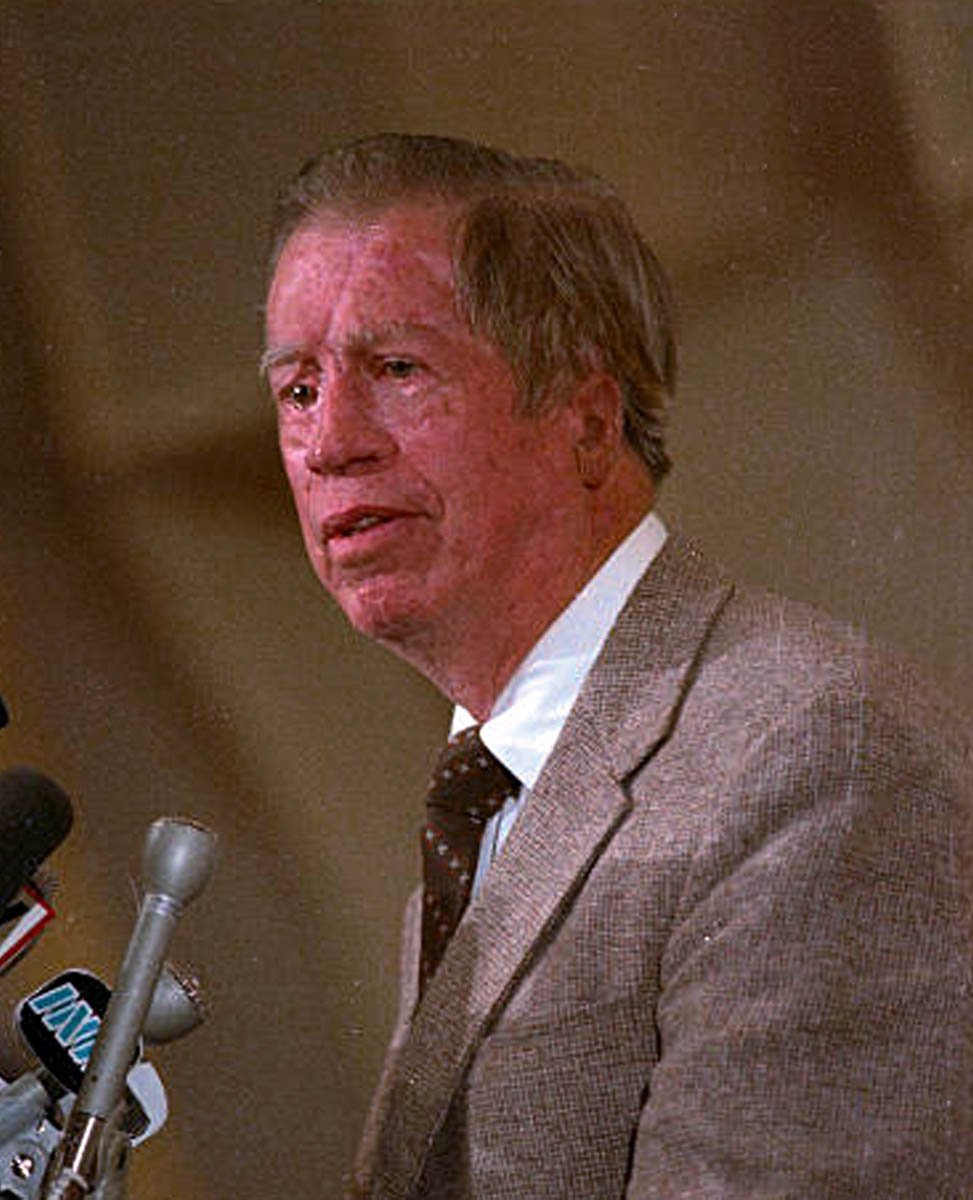
Bruce Merrifield
Robert Bruce Merrifield revolutionized peptide chemistry with his invention of solid phase peptide synthesis, a method that transformed what had been years of painstaking labor into days of automated work. For this achievement, he received the 1984 Nobel Prize in Chemistry "for his development of methodology for chemical synthesis on a solid matrix." The American Peptide Society's highest honor, the R. Bruce Merrifield Award, bears his name.
Born July 15, 1921, in Fort Worth, Texas, Merrifield grew up in southern California after his family relocated when he was one year old. He earned his bachelor's degree in chemistry in 1943 and his doctorate in biochemistry in 1949, both from the University of California at Los Angeles. After brief positions at the Philip R. Park Research Foundation and as a teaching and research assistant at UCLA, he joined the Rockefeller Institute for Medical Research in 1949 as an assistant in the laboratory of D. W. Woolley. He would spend his entire scientific career at Rockefeller, crediting both Woolley and the institution for providing the support that enabled him to devote several years to developing solid phase synthesis.
The conceptual breakthrough came from recognizing that peptide synthesis could be simplified by anchoring the growing chain to an insoluble solid support. First reported in 1962 and described in detail in his classic 1963 Journal of the American Chemical Society paper, solid phase peptide synthesis attaches the carboxyl-terminal amino acid to an insoluble resin bead. Subsequent amino acids are coupled one at a time, with excess reagents and byproducts simply washed away between steps. The method eliminates the laborious purification that had made classical solution-phase synthesis so time-consuming.
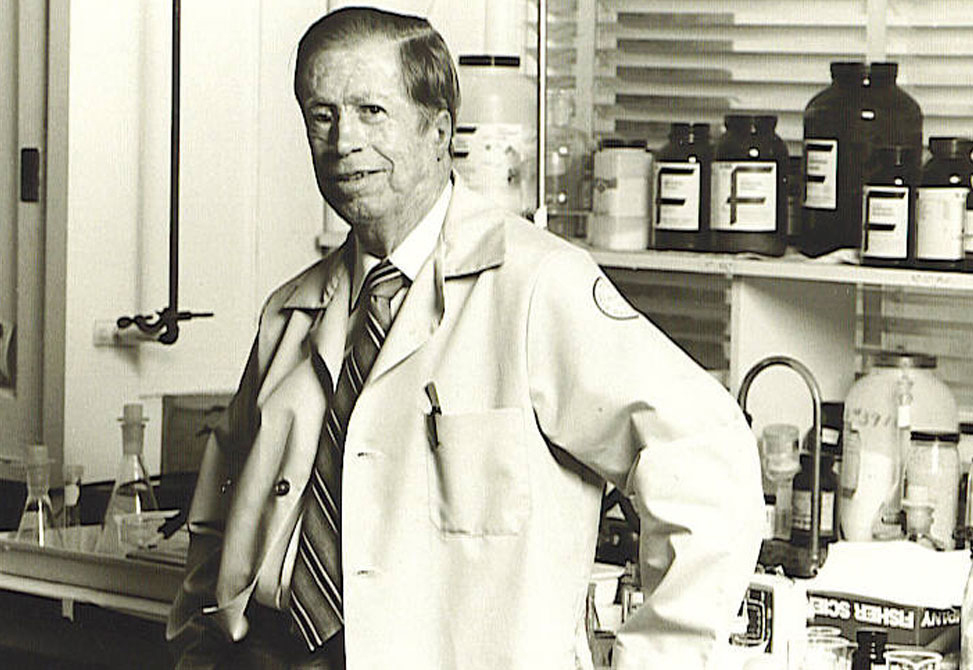
Bruce Merrifield at work in his laboratory at Rockefeller University.
Merrifield and his colleagues rapidly demonstrated the technique's validity and generality. Working with John M. Stewart and Maurice Manning, along with graduate students Garland Marshall and Arnold Marglin, he synthesized bradykinin, desamino-oxytocin, angiotensin, and insulin. Concurrently, Merrifield collaborated with Stewart and Nils Jernberg to design and build an instrument that automated the repetitive coupling and washing cycles. In 1969, Merrifield and Bernd Gutte used this machine to synthesize ribonuclease A, a 124-amino-acid enzyme, simultaneously with Ralph Hirschmann's team at Merck who achieved the same feat using solution-phase methods. The Rockefeller synthesis proved not only that medium-sized proteins could be assembled by stepwise solid phase methods, but that primary amino acid sequences alone determine tertiary structure and biological activity.
The solid phase principle has since been adapted far beyond peptides. Researchers worldwide applied it to synthesize oligonucleotides, carbohydrates, and diverse organic molecules. The method enabled combinatorial chemistry, in which libraries of thousands of compounds can be synthesized and screened for biological activity, accelerating drug discovery. Molecules synthesized using Merrifield's approach include somatostatin, β-endorphin, ACTH, and trypsin inhibitor, along with countless therapeutic candidates.
Merrifield dedicated much of his later research to refining solid phase synthesis for increasingly difficult targets. He and his colleagues studied peptide antibiotics and designed antagonists of glucagon with potential applications in diabetes treatment. His 1963 paper was listed by the Journal of the American Chemical Society as the fifth most cited paper in the journal's 125-year history, and in 2006 the ACS Division of the History of Chemistry recognized it as a Chemical Breakthrough Publication.
Beyond the Nobel Prize and the Pierce Award, Merrifield received the Albert Lasker Award for Basic Medical Research (1969), the Gairdner Foundation International Award (1970), the ACS Award for Creative Work in Synthetic Organic Chemistry (1972), the Nichols Medal (1973), the Royal Society of Chemistry Medal (1987), and the Ralph F. Hirschmann Award from the ACS (1990). He was elected to the National Academy of Sciences in 1972 and received honorary doctorates from fifteen universities. In 1968, he served as the first Nobel Guest Professor at Uppsala University, Sweden.
Named John D. Rockefeller Jr. Professor in 1983, Merrifield became emeritus in 1992 but continued working at the bench for another decade. His frequent advice to graduate students was to never abandon experimental research, because the most innovative ideas are conceived at the bench. In 1993, he published his scientific autobiography, Life During the Golden Age of Peptide Chemistry. His dedication, courage, and optimism inspired generations of scientists who trained in his laboratory and all who encountered him through his steadfast participation at conferences including the American Peptide Symposia.
Bruce Merrifield died May 14, 2006, at his home in Cresskill, New Jersey. He was survived by his wife Elizabeth, six children, and sixteen grandchildren.