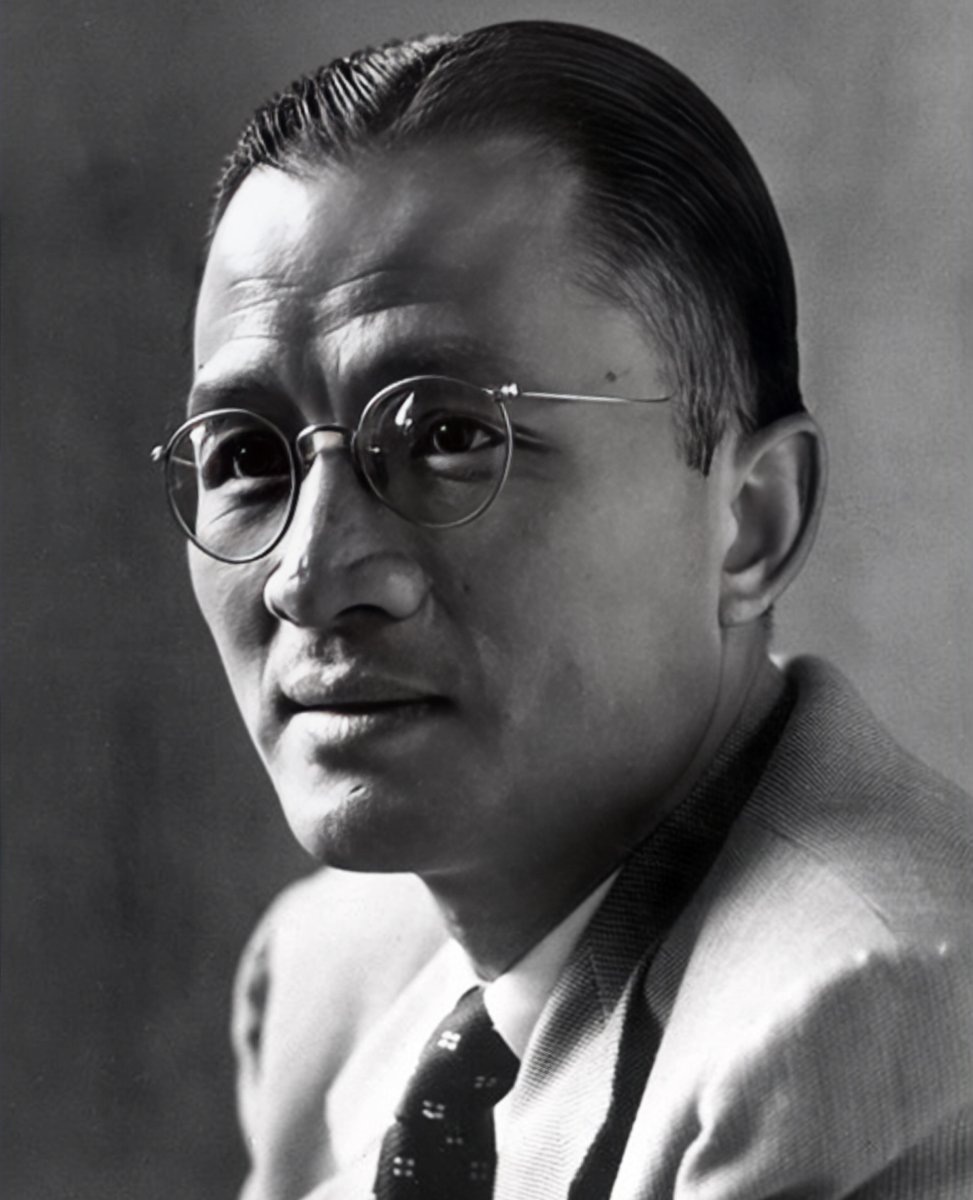
Cho Hao Li
Choh Hao Li was a biochemist and peptide chemist whose half-century investigation of the pituitary gland yielded discoveries that transformed endocrinology and established foundations for modern peptide therapeutics. His isolation and synthesis of growth hormone and his discovery of β-endorphin rank among the most consequential achievements in twentieth-century biochemistry.
Born April 21, 1913, in Canton (Guangzhou), China, Li was one of eleven children of a successful industrialist whose family placed strong emphasis on education. He earned his Bachelor of Science degree in chemistry from the University of Nanking in 1933 and taught there for two years before immigrating to the United States in 1935 for graduate studies at the University of California, Berkeley. He received his Ph.D. in organic chemistry in 1938.
Li's first academic appointment came in the midst of the Depression, when anti-Asian sentiment made employment difficult for the young scholar. Herbert McLean Evans took an interest in Li and offered him a tiny workspace in the basement of the Institute of Experimental Biology at Berkeley. There, Li began developing methods for isolating anterior pituitary hormones in pure form, launching what would become a lifelong scientific mission.
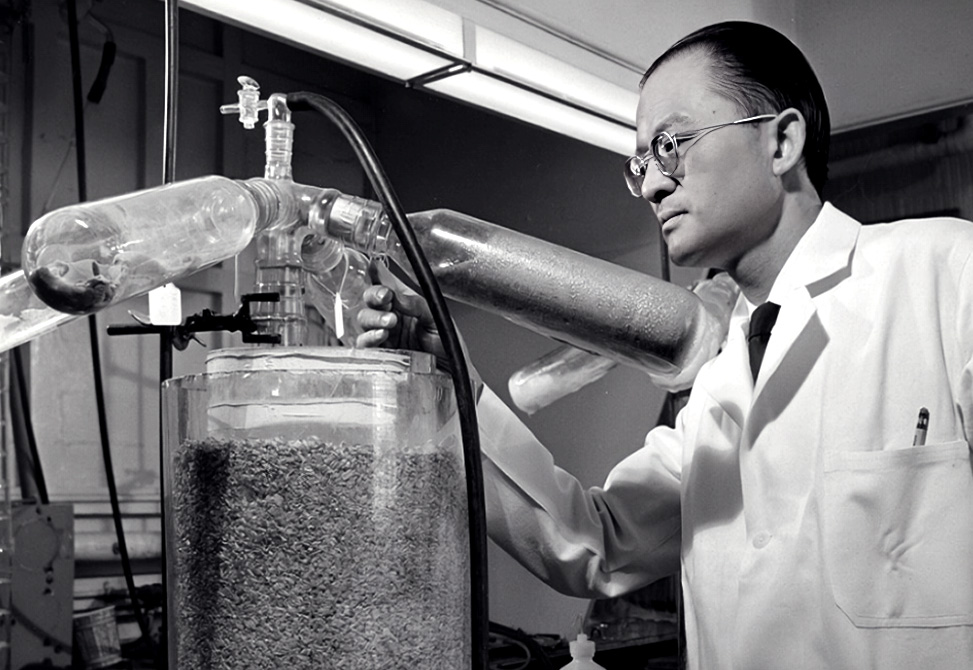
Choh Hao Li synthesizes human growth hormone at UCSF, making possible later development of successful treatments for childhood growth disorders. Li spent more than 30 years at UC Berkeley and UCSF.
Over the following decades, Li became first or among the first to isolate and purify six of the eight known anterior pituitary hormones. His initial breakthrough came in 1940 with the isolation of luteinizing hormone. He subsequently isolated and characterized adrenocorticotropic hormone (ACTH) in 1953, follicle-stimulating hormone (FSH), β-lipotropin in 1964, melanocyte-stimulating hormone (MSH), and prolactin. His systematic elucidation of these hormones earned him recognition as the master of the "master gland."
Li's work on human growth hormone (somatotropin) represented his most sustained achievement. After isolating the hormone and demonstrating its species specificity, he determined its complete 256-amino-acid sequence in 1966. Four years later, working with Donald Yamashiro, he accomplished the chemical synthesis of human growth hormone, announced on January 6, 1971. At 256 amino acids, it was the largest protein synthesized up to that time. This work laid essential groundwork for treating children with growth hormone deficiency, a condition affecting approximately one in every 3,800 newborns.
Li's final major discovery came in 1975–1976 when he and David Chung isolated β-endorphin from camel pituitary extracts. This 31-amino-acid peptide, found to be 48 times more potent than morphine when administered into the brain, opened entirely new fields of research into endogenous pain regulation, reward pathways, and the neurochemistry of well-being. The discovery came amidst the broader revolution in opioid peptide research that included the enkephalins and dynorphins, but Li's characterization of β-endorphin's structure and synthesis of the peptide proved foundational for understanding the brain's own analgesic systems.
Throughout his career, Li pioneered the synthesis of biologically active peptides and their analogs, employing solid-phase methods to produce ACTH, β-endorphin, lipotropin, and growth hormone. His laboratory demonstrated that biological activity could reside in hormone fragments, opening possibilities for structure-activity studies and drug design. Before his retirement, Li also identified and synthesized insulin-like growth factor 1 (IGF-1), a protein mediating many of growth hormone's effects.
Li served as founding Director of the Hormone Research Laboratory at UC Berkeley from 1950 to 1967, then moved with the laboratory to the University of California, San Francisco, where he continued as Director until his retirement in 1983. As Professor Emeritus, he established and directed the Laboratory of Molecular Endocrinology at UCSF until his death. During his career, leading figures in protein hormone chemistry and endocrinology trained in his laboratory as doctoral students, postdoctoral fellows, and visiting scientists.
Li received the Albert Lasker Award for Basic Medical Research in 1962 and was nominated at least twice for the Nobel Prize. His other honors included a Guggenheim Fellowship in 1949, the American Chemical Society Award in 1951, election to the American Academy of Arts and Sciences in 1955, and membership in the Academia Sinica. He received ten honorary degrees. The American Peptide Society presented him with the Alan E. Pierce Award in 1987.
Li published over 1,100 scientific articles with more than 300 collaborators and edited the eleven-volume series Hormonal Proteins and Peptides (Academic Press, 1973–1983). Victor Hruby published an In Memoriam tribute in the International Journal of Peptide and Protein Research in 1988.
Li became a naturalized United States citizen in 1955. He married fellow chemistry student Shen-hwai Lu (Annie) in 1938; they had three children who all pursued professional careers. Choh Hao Li died on November 28, 1987, in San Francisco, just months after receiving the Pierce Award, concluding a scientific career that had fundamentally shaped our understanding of hormonal regulation and peptide chemistry.