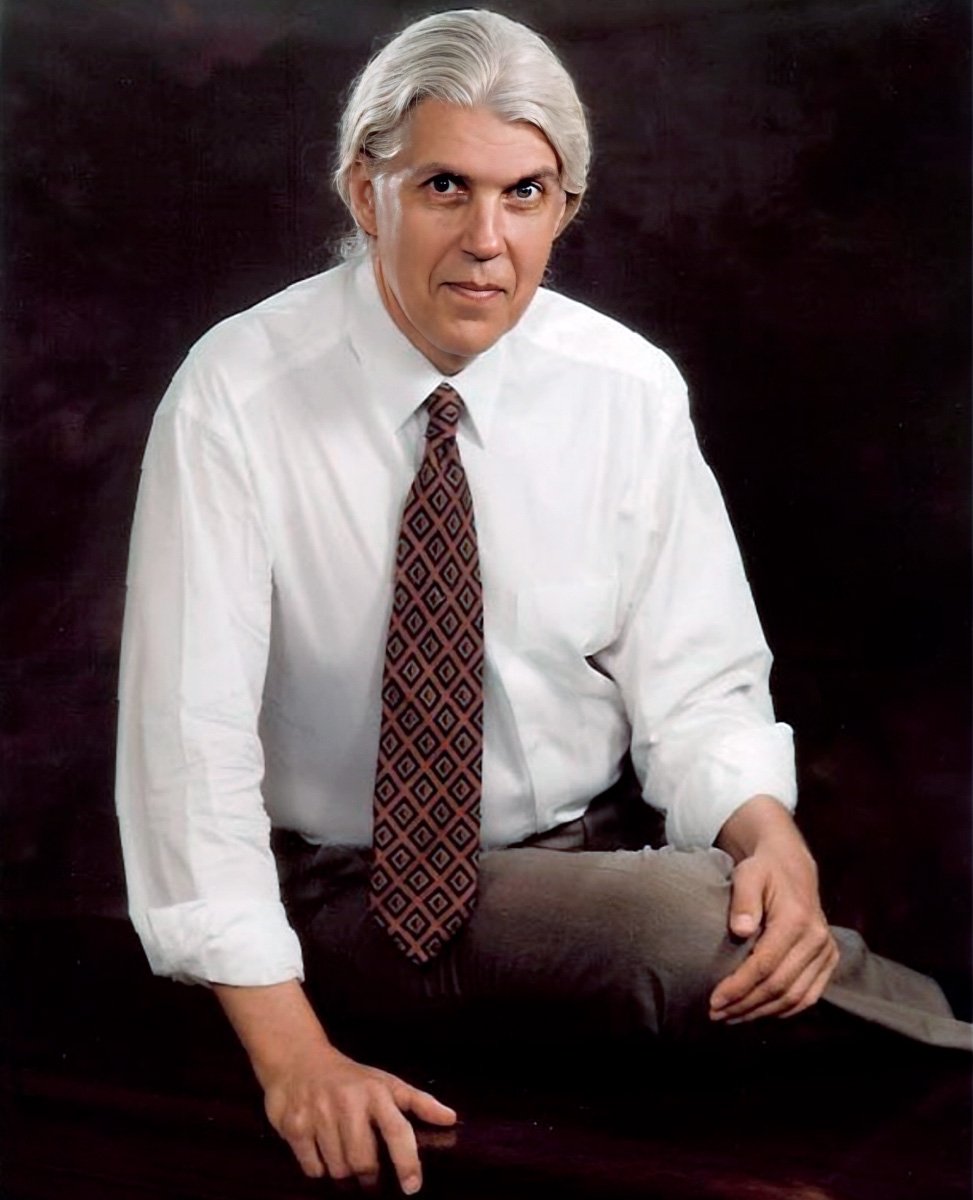
Daniel S. Kemp
Dr. Daniel S. Kemp founded the fields of templated peptide ligation and nucleated protein secondary structures during a career spanning more than four decades at MIT. His work establishing the principles of chemoselective ligation of unprotected peptide fragments laid the conceptual foundation for modern methods of protein synthesis, while his pioneering use of molecular scaffolds to stabilize alpha-helices and beta-sheets transformed understanding of the intrinsic rules governing protein folding and stability.
Kemp was born October 20, 1936, in Portland, Oregon, the only child of Paul Kemp and Ellen "Lovie" Kemp. He grew up in Missoula, Montana, where he graduated with honors from Missoula County High School. He enrolled at Reed College, where he performed undergraduate research with Arthur F. Scott on the reactivity of divalent chromium, earning his B.A. in chemistry in 1958. Awarded a National Science Foundation Fellowship, he pursued doctoral studies at Harvard University under Nobel laureate R. B. Woodward, one of the preeminent synthetic organic chemists of the twentieth century. His dissertation research focused on the reactivity of the N-ethylbenzisoxazolium cation. Upon earning his Ph.D. in 1964, Kemp was elected to the Harvard Society of Fellows. He joined the MIT Department of Chemistry faculty thereafter and remained for over 45 years, supervising the doctoral research of 55 graduate students and mentoring dozens of postdoctoral fellows and undergraduates.
Kemp's early research produced several landmark contributions to organic chemistry methodology. The eponymous Kemp elimination, Kemp's triacid, and the Kemp decarboxylation reaction became standard tools in the field. The Kemp elimination in particular emerged as a model reaction for studying enzyme catalysis and has been used extensively in computational studies of enzymatic rate enhancement.
In the second half of his career, Kemp's interests shifted toward peptide chemistry and protein biochemistry. With his thiol capture strategy, he became the first to demonstrate chemoselective ligation of unprotected peptide fragments and the first to use a transient covalent bond to facilitate peptide ligation. These two concepts are central to modern methods of protein synthesis, including the native chemical ligation approach that has enabled total chemical synthesis of numerous proteins. In groundbreaking work on conformational control, Kemp pioneered the use of molecular scaffolds to stabilize the most abundant secondary structural elements in proteins. Recognizing early that the intrinsic constraints of proline could serve in an alpha-helix template, he discovered that a properly placed thioether bridge constrains vicinal proline residues in an ideal conformation for helix nucleation. This template approach provided quantitative tools for dissecting the energetics of helix and sheet formation that had previously been inaccessible.
Kemp authored more than 150 scientific papers and was the leading author of an influential organic chemistry textbook first published in 1980. Alumni from his laboratory became renowned leaders in academia and industry. A recipient of the Humboldt Research Fellowship, he spent sabbaticals at the University of Oxford and the Technical University of Munich. His awards include the Everett Moore Baker Memorial Award for Excellence in Undergraduate Teaching in 1993, the Arthur C. Cope Scholar Award in 1997, and the Ralph F. Hirschmann Award in Peptide Chemistry in 2000.
Kemp was renowned as an educator who treated each lecture like a major performance, carefully orchestrating his delivery and developing questions to guide, captivate, and challenge students. In 2014 he helped establish the Center for Teaching and Learning at Reed College. Outside the laboratory, he had a passion for French cuisine and baking, and he pursued gemology with scientific rigor, building an impressive collection of gemstones he cut himself. A lover of the performing arts, he traveled the world extensively and was an avid reader with wide-ranging interests in philosophy and culture. Kemp died May 2, 2020, near Concord, Massachusetts. He was 83.