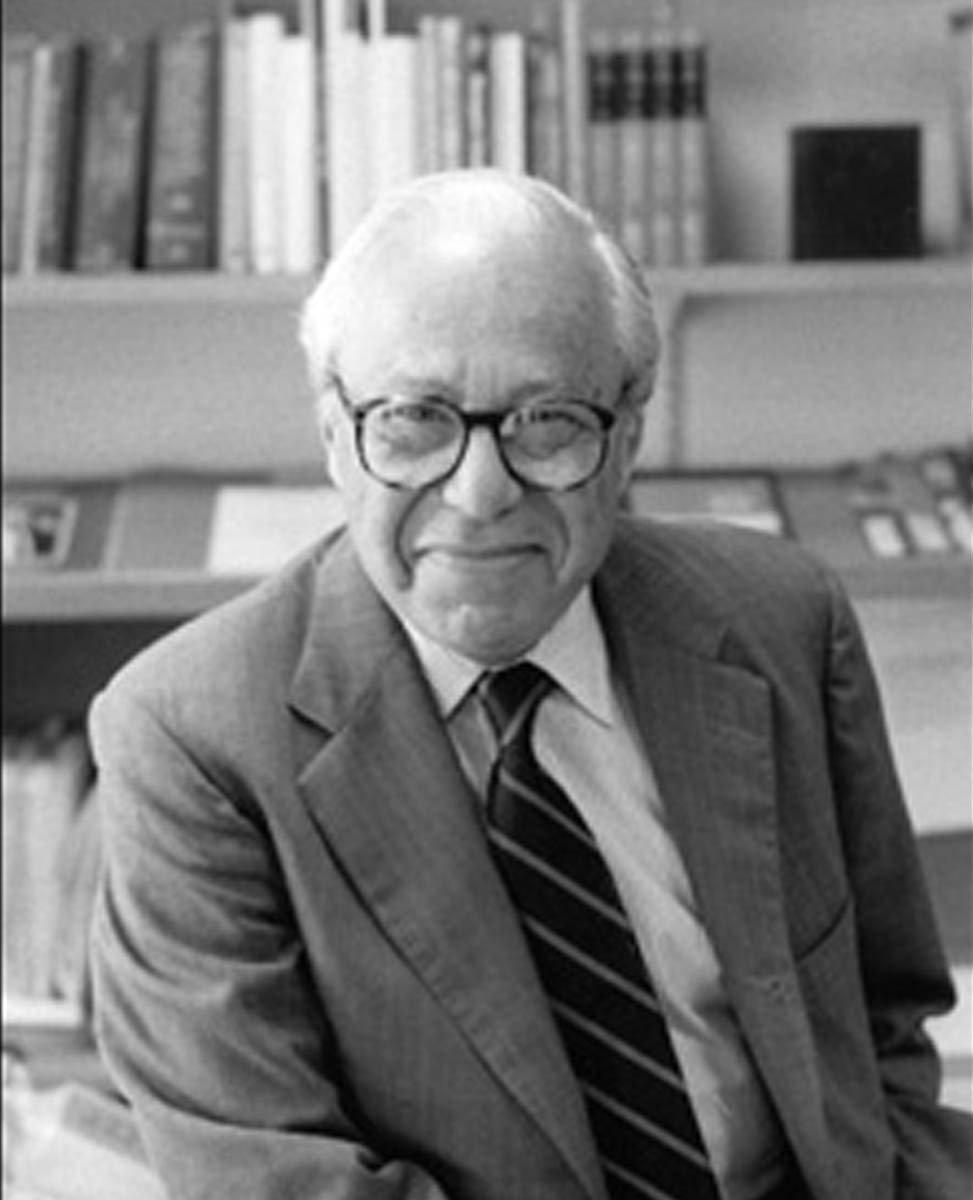
Elkan R. Blout
Dr. Elkan R. Blout was a renaissance scientist whose parallel careers in industry and academia produced fundamental contributions to peptide science while his later leadership roles transformed major scientific institutions. His pioneering studies of poly-α-amino acids and their conformational propensities presaged the ongoing goal of relating amino acid sequence to protein three-dimensional structure. His work with cyclic peptides as constrained models for bioactive peptides and protein structural features, combined with his early recognition of the power of nuclear magnetic resonance for peptide and protein structural study, established methodological foundations that continue to shape the field.
Blout was born on July 2, 1919, in New York City, the only child in his family. He spent a postgraduate year at Phillips Exeter Academy before enrolling at Princeton University. After a brief foray into chemical engineering, he majored in chemistry and graduated in 1939. He earned his Ph.D. in chemistry from Columbia University in 1942 at the age of 23. A postdoctoral year in the Harvard Chemistry Department with Louis Fieser and Robert Woodward proved consequential: Woodward introduced Blout to Edwin Land at Polaroid, who persuaded him to forego pharmaceutical industry employment to do something practical at Polaroid. Blout accepted on the spot, beginning an eighteen-year career that would run parallel to his emergence as a leading peptide scientist.
At Polaroid from 1943 to 1962, Blout rose from chemist to Associate Director of Research in 1948 and to Vice President and General Manager of Research in 1958. He led the team that developed the color developing process for instant photography, synthesizing more than 5,000 compounds in search of the key ingredients and accumulating over 50 patents. In 1960 instant color film became a commercial reality. Blout recalled that to the scientific parents of this brainchild, it was all very wonderful and beautiful.
While fully engaged at Polaroid, Blout established a spectroscopy laboratory at Children's Hospital Boston in 1950 to study the biophysics of peptides and proteins, funded initially by a U.S. Army grant. He became Research Associate in Pathology at Harvard Medical School that year, Lecturer in Biophysics in 1960, and Professor of Biological Chemistry in 1962, when he left Polaroid to pursue academic research full time. He was named Edward S. Harkness Professor of Biological Chemistry in 1964 and chaired the Department of Biological Chemistry from 1965 to 1969.
Blout's scientific contributions centered on understanding how amino acid sequence determines polypeptide conformation. His studies of synthetic poly-α-amino acids using optical rotatory dispersion established fundamental relationships between amino acid composition and secondary structure preferences. His work with linear polypeptides containing glycine and proline led to a major research program on cyclic peptides, which he pursued because their conformational constraints made them more amenable to experimental and predictive analysis than linear peptides. Cyclic peptides containing proline and glycine served as models of turns in proteins, where the main chain reverses direction. Over more than two decades Blout and his coworkers used 13C nuclear magnetic resonance, conformational energy calculations and other methods to establish relationships between cyclic peptide structure and biological function.
Blout built scientific alliances across the globe, maintaining strong ties with scientists in the Soviet Union, Israel, Italy and elsewhere. His election as a foreign member of the USSR Academy of Sciences reflected the international reach of his influence. Those who worked with him knew him as a superb mentor who encouraged and questioned while conveying an unfailingly positive attitude.
In his later career Blout made major contributions to scientific leadership and public service. He served as Treasurer of the National Academy of Sciences from 1980 to 1992, overseeing a fivefold increase in the organization's endowment and giving the Academy financial autonomy to freely pursue issues crucial to society. He was Treasurer of the American Academy of Arts and Sciences from 1992 to 1998. As Dean for Academic Affairs at the Harvard School of Public Health from 1978 to 1989, he led a renaissance in scientific research and education, establishing the Office for Continuing Education in 1982 and creating the Division of Biological Sciences in 1986, which brought all laboratory sciences under one administration. He chaired the Department of Environmental Science and Physiology from 1986 to 1988.
In 1991, at age 72, Blout became Senior Adviser to the Food and Drug Administration under Commissioner David Kessler, bringing basic science grounding within the agency. According to Kessler, his impact was huge. Blout continued this role until 1999, well into his eighties.
Blout was elected to the National Academy of Sciences in 1969 and was a member of the Institute of Medicine. He was a Fellow of the American Association for the Advancement of Science and the American Academy of Arts and Sciences. He received honorary degrees from Harvard University in 1962 and Loyola University in 1976. Shortly before his retirement in 1990, two professorships were created in his honor, one at Harvard Medical School and one at the Harvard School of Public Health. He received the Ralph F. Hirschmann Award in Peptide Chemistry from the American Chemical Society in 1991. In 1990 President George H.W. Bush presented him with the National Medal of Science for his pioneering studies of protein conformation and devotion to the scientific enterprise of the Nation.
Blout married Joan Dreyfus, whom he met while she was a graduate student in Gilbert Stork's laboratory at Columbia; they had three children, James, Susan and William. He married Gail Ferris in 1984, and they adopted a daughter, Darya, in 1993. An avid saltwater fisherman, Blout named successive boats the Peptide. He died on December 20, 2006, in Boston at the age of 87.