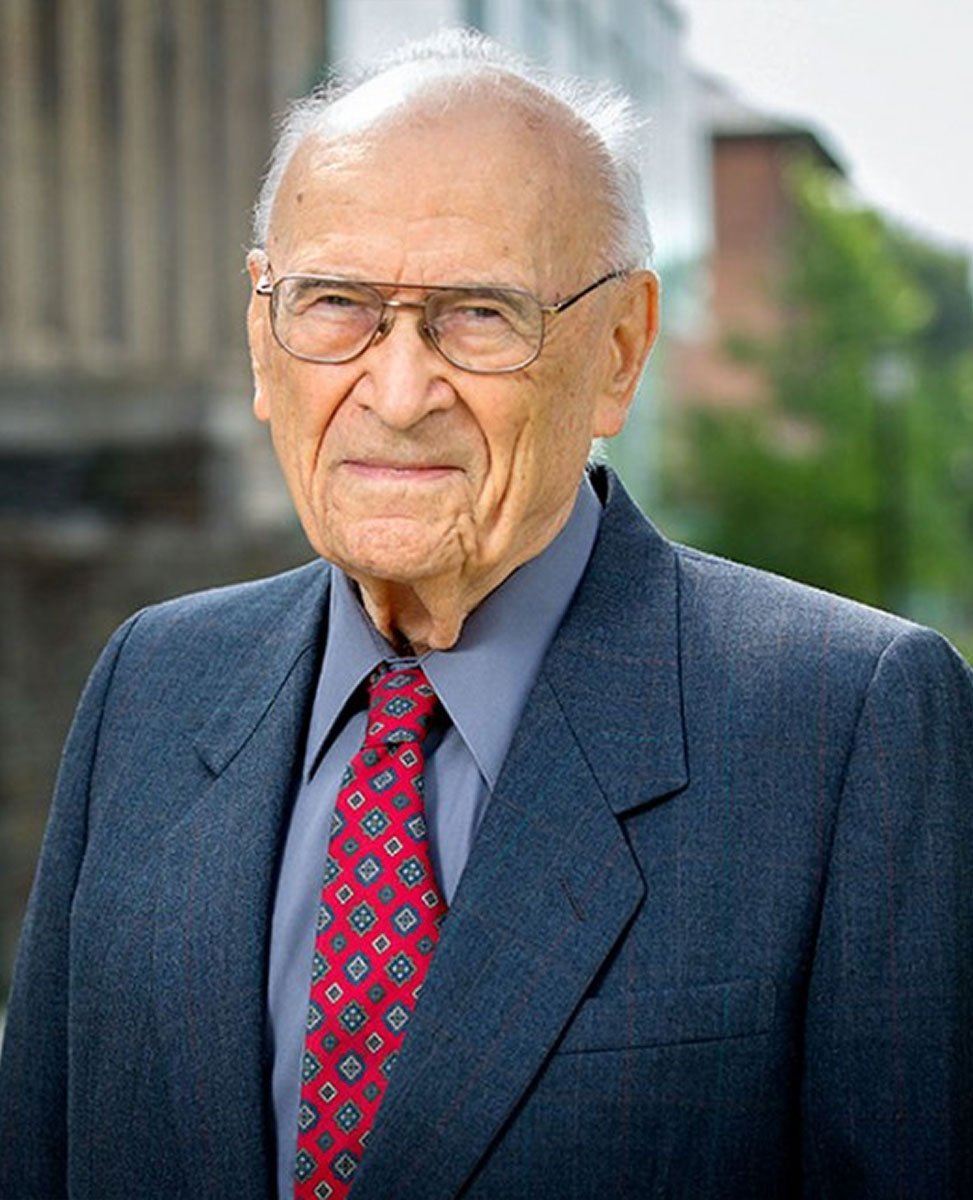
Harold A. Scheraga
Dr. Harold A. Scheraga was a founding father of protein science whose career spanned the entire history of modern protein chemistry. A pioneer in protein biophysics, he combined experimental and theoretical approaches in a uniquely productive way to show how amino acid sequences influence the three-dimensional structure, folding pathway, thermodynamics and biological activity of proteins. His work on protein solvation, the hydrophobic effect, and the consequences for protein folding transformed the field and laid the foundations for computational biology.
Scheraga was born October 18, 1921, in Brooklyn, New York, to Samuel and Etta Scheraga. He spent his early childhood in Monticello, New York, where his father, a machinist, opened a store selling radios and musical instruments. The business failed after the 1929 stock market crash, and the family returned to Brooklyn. The financial strain during the Great Depression was so severe that Scheraga offered to drop out of school to help support the family, but his father insisted he continue his education. He later credited this experience with shaping his outlook and career aspirations. As a high school student Scheraga was drawn to mathematics and especially classics, which he intended to pursue in college, but exposure to physics during his education at the City College of New York convinced him to focus on physical chemistry. He received his B.S. from CCNY in 1941, then enrolled at Duke University for doctoral studies. His graduate work was interrupted by the necessity of supporting the war effort, and he spent considerable time on applied research in ballistics. His thesis, on the Kerr effect in small molecules, was completed under the supervision of Paul Gross. A chance observation of a new book in the Duke chemistry library by Edwin Cohn and John Edsall drew him into protein physical chemistry. He earned his Ph.D. in 1946 and was awarded an ACS postdoctoral fellowship to work with John Edsall in the Physical Chemistry Department at Harvard Medical School on flow birefringence experiments to determine the size and shape of blood plasma proteins.
In 1947 Peter Debye offered Scheraga an instructor position at Cornell University on the same day as his interview. He would spend the next 73 years in the Baker Laboratory of Chemistry. He became associate professor in 1950, full professor in 1958, and was appointed to the George W. and Grace L. Todd Professorship of Chemistry in 1965. Scheraga served as department chair from 1960 to 1967, a period of growth and renewal that included initiation of the S.T. Olin Chemistry Research Laboratory and expansion into molecular biology and materials science. He retired with emeritus status in 1992 but maintained a robust research program that continued until his death. His most recent paper was published in June 2020. At the time of his passing, he had been continuously funded by the NIH for 64 years.
When Scheraga began his independent research in the 1940s, proteins were still viewed largely as ellipsoidal colloidal assemblies of amino acids. He initially distinguished himself by applying experimental physical chemistry to protein science, developing theories of the hydrodynamic properties of proteins that made it possible to interpret experimental data on size and shape. Following the publications of Sanger on the amino acid sequence of insulin and of Pauling on the alpha and beta structures of the protein backbone, Scheraga turned his attention to the helix-coil transition in polyamino acids and polynucleotides, and then to the interactions involving protein side chains, initially hydrogen bonding and subsequently hydrophobic interactions. His theoretical and experimental work on helix-coil transitions gave the helix formation parameters for individual amino acids. These studies were summarized in an 800-page book with David Poland, Theory of the Helix-Coil Transition in Biophysics.
A major focus of Scheraga's career was bovine pancreatic ribonuclease A, the small enzyme that became a proving ground for understanding protein folding. Before an X-ray structure was available, he developed methods for experimentally determining distances between specific sites in the molecule; these results were confirmed when the crystal structure was determined. He addressed the oxidative folding pathways of ribonuclease and investigated beta-hairpin-forming peptides as models for folding initiation. The identification of three tyrosine-aspartate interactions in ribonuclease A motivated his development of molecular mechanics approaches to compute protein structure. Initially using a hard-sphere potential, this work evolved into the all-atom force field ECEPP, the Empirical Conformational Energy Program for Peptides, which became one of the most influential empirical potential energy functions for proteins and the engine of research in his group for decades.
Scheraga recognized what he called "the multiple-minima problem in protein folding": the challenge of finding the global energy minimum among the tremendous number of local minima decorating a protein's potential energy surface. He developed numerous stochastic methodologies for global optimization that proved significantly more efficient than random search methods. The Monte Carlo minimization method of Li and Scheraga found wide application and was adopted by other fields of science. Scheraga also conducted seminal work on the blood-clotting cascade, studying the mechanism of the thrombin-induced conversion of fibrinogen to fibrin. His collaboration with clinical researchers led to elucidation of the molecular basis of a hematologic disorder. He carried out the first calculations of structures of enzyme-substrate complexes.
Scheraga mentored over 400 graduate students, postdoctoral fellows and research associates over his career, producing an output of nearly 1,400 publications. His honors include the Eli Lilly Award in Biological Chemistry, the Kendall Award, the Repligen Award for Chemistry of Biological Processes, the Mobil Award, the IBM Award, the Nichols Medal, the Pauling Medal, the Linderstrøm-Lang Medal, the Stein and Moore Award of the Protein Society, and the Ralph F. Hirschmann Award in Peptide Chemistry in 1999. He was a Guggenheim Fellow and Fulbright Research Scholar, and he spent sabbaticals at the Carlsberg Laboratory in Copenhagen with Kai Linderstrøm-Lang and at the Weizmann Institute in Israel with Ephraim and Aharon Katzir. He was elected to the National Academy of Sciences and the American Academy of Arts and Sciences, and was a Fellow of the American Association for the Advancement of Science. In 2018, when his alma mater decided to present him with an honorary doctorate, the president of the City College of New York traveled to Ithaca to personally confer the degree. The Scheraga-Burke Meeting Room in Cornell's Physical Sciences Building is named in his honor.
Scheraga met his wife Miriam Kurnow through a Jewish social club in Brooklyn while he was a CCNY student. They married while he was at Duke, and she worked for 30 years in the Cornell University Library. Their three children all attended Cornell. Miriam died in January 2020, shortly before what would have been their 77th wedding anniversary. Scheraga died August 1, 2020, in Ithaca. He was 98.