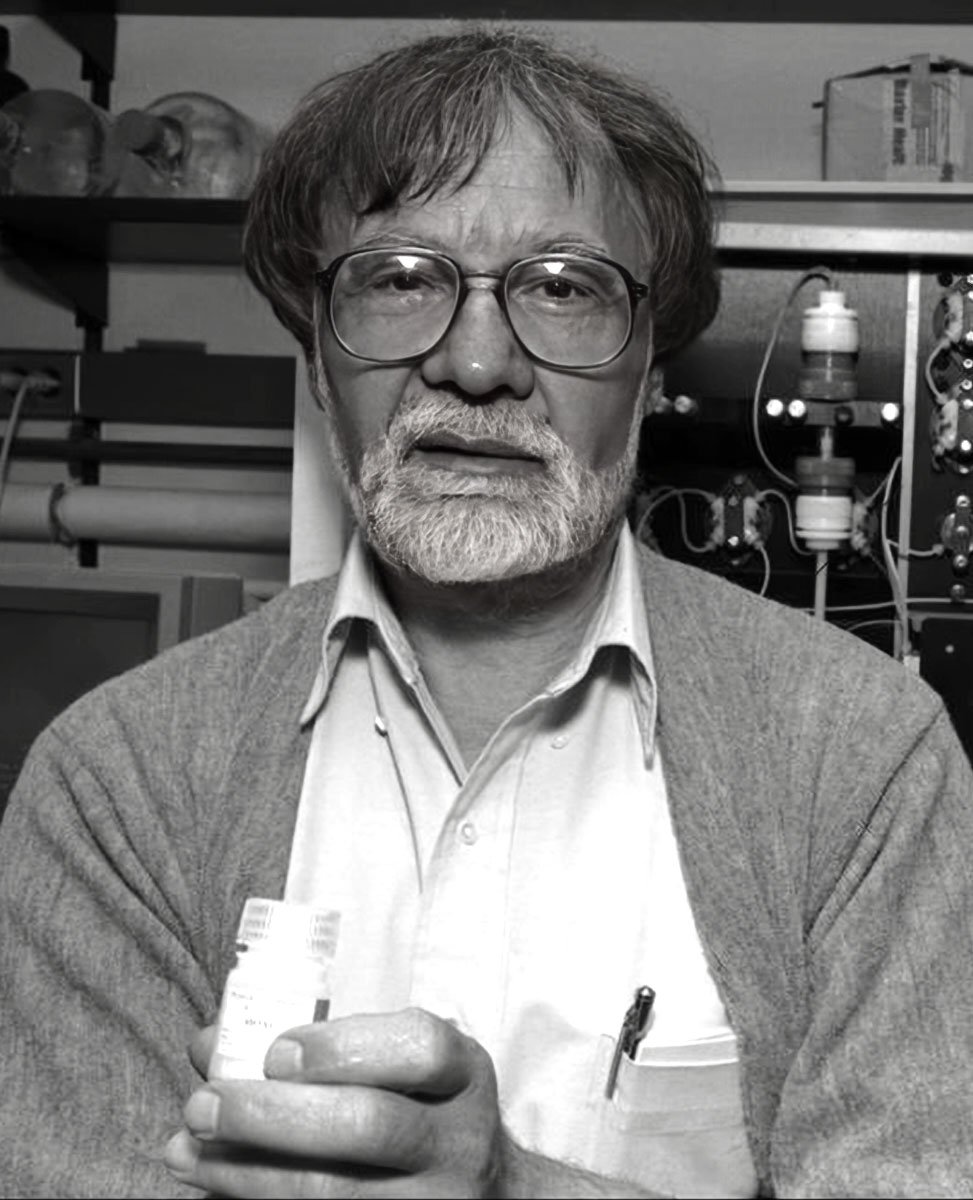
Louis A. Carpino
Dr. Louis A. Carpino was a pioneer in the development of amino-protecting groups and coupling reagents whose innovations fundamentally transformed peptide synthesis. His creation of both the tert-butyloxycarbonyl and 9-fluorenylmethoxycarbonyl protecting groups established the two dominant strategies for solid-phase peptide synthesis that remain in use today. Peptide synthesis has been aptly defined as the suitable combination of protecting groups and coupling reagents, and Carpino revolutionized both domains over a career spanning more than six decades.
Carpino was born on December 13, 1927, in Des Moines, Iowa, the son of Italian immigrants. He grew up in Des Moines and attended local schools through college. He earned his Ph.D. in organic chemistry from the University of Illinois in 1953, working with Harold R. Snyder. In the fall of 1954 he joined the faculty at the University of Massachusetts Amherst, where he would spend his entire career.
Carpino's first major contribution came in 1957 with the development of the tert-butyloxycarbonyl group as a protecting group for amino acids. The Boc group's much greater acid lability compared to the benzyloxycarbonyl group facilitated peptide synthesis and enabled a new synthetic strategy combining Boc as a temporary Nα-amino protecting group with more acid-stable benzyl-based side-chain protection. When Robert Bruce Merrifield developed solid-phase peptide synthesis, the Boc/benzyl strategy became the standard approach for assembling peptide chains on solid supports.
Carpino's next major accomplishment addressed limitations inherent in the Boc strategy. The repeated acidic conditions required for Boc removal caused gradual loss of permanent side-chain protecting groups during synthesis of long peptides, and final cleavage with liquid hydrogen fluoride led to side reactions including aspartimide formation and N-to-O acyl shifts. In 1970, working with Grace Y. Han, Carpino introduced the 9-fluorenylmethoxycarbonyl group as a completely orthogonal protecting system. The Fmoc group is removed rapidly and efficiently by secondary amines such as piperidine through proton abstraction, conditions that do not affect acid-labile tert-butyl protecting groups on side chains. The dibenzofulvene released during deprotection is trapped immediately, minimizing side reactions. Fmoc amino acids can be highly activated and coupled efficiently without epimerization, and their strong ultraviolet absorption allows monitoring of incorporation during peptide assembly. The Fmoc/tBu strategy, adapted for solid-phase synthesis by Eric Atherton and Robert Sheppard at the Medical Research Council Laboratory of Molecular Biology in Cambridge, became the method of choice for chemical synthesis of peptides and remains so today.
Beyond his landmark protecting groups, Carpino developed numerous additional innovations. The benzothiophenesulfone-2-methyloxycarbonyl group represents a class of protecting groups removable under the mild conditions of Michael addition. The 2,2,4,6,7-pentamethyldihydrobenzofuran-5-sulfonyl group provides side-chain protection for arginine that is easily removed by trifluoroacetic acid. His coupling reagents based on 1-hydroxy-7-azabenzotriazole, including the uronium salt HATU and phosphonium salt PyAOP, offer exceptional efficiency, speed, generality and control of epimerization. Fmoc-amino acid fluorides facilitated efficient solid-phase synthesis of peptaibols such as alamethicin, while the more reactive Fmoc-amino acid chlorides enabled coupling of extremely hindered systems such as N-methyl-α-aminoisobutyric acid to α-aminoisobutyric acid.
Carpino held approximately 30 patents for his innovations. He received the Ralph F. Hirschmann Award in Peptide Chemistry from the American Chemical Society in 1992, the Humboldt Award, and the Max Bergmann Gold Medal in 1998. At the University of Massachusetts he received the Samuel Conti Faculty Fellowship Award and the College Outstanding Researcher Award.
Known as a quiet person who shunned attention while fostering intense scientific collaboration, Carpino was remembered by colleagues as a great teacher, a creative director who shared his ideas freely, and an attentive listener who showed respect for everyone. He habitually carried three-by-five index cards in his shirt pocket for capturing ideas and notes. In 1958 he married Barbara, one of his former chemistry students, who completed her degree with the class of 1962. They had six children who joined them on sabbaticals in Italy and other locations abroad.
Carpino retired in 2004 with emeritus status but continued working actively in his laboratory. He never stopped thinking about improved coupling reagents and was developing a new reagent to address safety concerns with existing compounds when he died at home in Amherst on January 4, 2019, at the age of 91. His papers, including notebooks, correspondence, patents, photographs and the 1998 Max Bergmann Medal, are archived in the Special Collections of the University of Massachusetts Amherst Libraries.