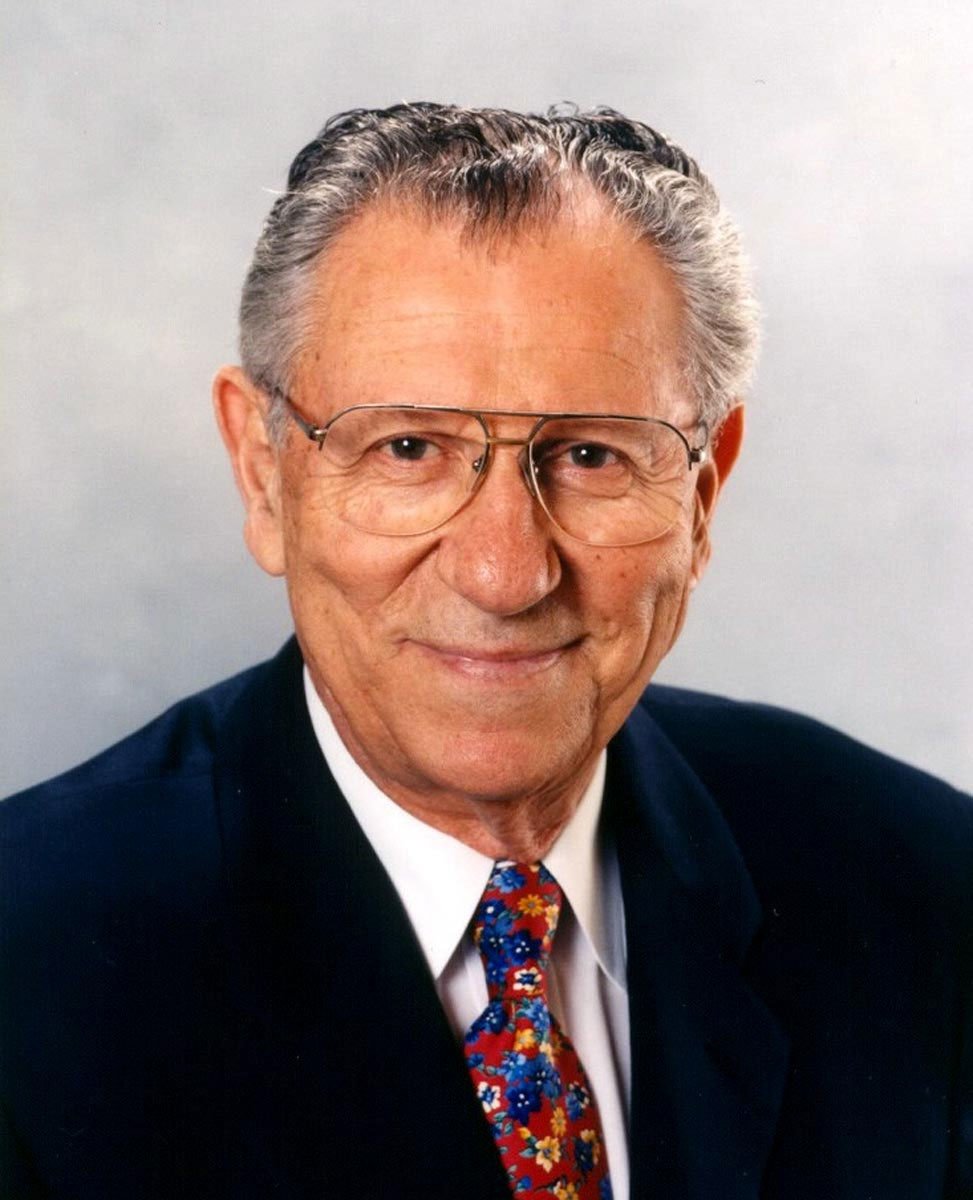
Murray Goodman
Murray Goodman was the père des peptides, the father of the peptide community. Through his research, his editorial vision, his boundless mentorship, and his legendary international travels, he did more than perhaps any other single individual to unite peptide chemists around the world into a coherent scientific family.
Goodman was born July 6, 1928, in Brooklyn, New York, into an immigrant family from Krivoizera, Ukraine. He earned his B.S. from Brooklyn College in 1950 and his doctorate from the University of California, Berkeley in 1953, where he worked with Melvin Calvin, later the 1961 Nobel laureate, on the use of isotopes as tracers to probe the mechanisms of photosynthesis. His postdoctoral training brought him into the orbit of two more giants: John C. Sheehan at MIT and Lord Alexander Todd at Cambridge University, where he worked on synthetic nucleotides and peptide natural products. Todd would receive the Nobel Prize in Chemistry in 1957.
In 1956, Goodman joined the faculty of the Polytechnic Institute of Brooklyn, where he quickly rose to Full Professor and became Director of the Polymer Research Institute. The lure of the West Coast drew him to the University of California, San Diego in 1970 as Professor of Chemistry. He remained at UCSD for the rest of his career, serving as Chair of the Chemistry Department for six years and as Acting Provost of Revelle College from 1972 to 1974.
Goodman's research contributions spanned the full breadth of peptide science. Early in his career, he developed stepwise approaches for synthesizing linear oligopeptides as models of protein conformations. He uncovered the "active monomer" mechanism of N-carboxyanhydride polymerization and conducted foundational studies on racemization in peptide synthesis. He pioneered the use of circular dichroism to study peptide conformations in solution and was among the first to recognize the potential of NMR spectroscopy for this purpose. His "Integrated Approach," combining synthesis with NMR, conformational analysis, and biological assays, became a model for the field. Later work explored retro-inverso peptides, cyclic lanthionine structures with opioid activity, and collagen-like triple helical architectures that opened new possibilities for biomaterials.
His editorial contributions proved equally transformative. As founding editor of Biopolymers in 1963, he created a forum where chemistry could meet structural research and biology. He served the journal for over four decades until his death. He also founded Peptide Science, the official journal of the American Peptide Society. His final editorial monument was the five-volume Synthesis of Peptides and Peptidomimetics, published as part of the Houben-Weyl series in 2002–2003, a comprehensive treatise that remains an essential reference.
Goodman served as President of the American Peptide Society from 2001 to 2003. His honors included the Scoffone Medal from the University of Padua in 1980, the Alexander von Humboldt Research Award in 1986, the Pierce Award from the American Peptide Society in 1989, the Max Bergmann Medal in 1991, and the Ralph F. Hirschmann Award in Peptide Chemistry from the American Chemical Society in 1997. He was elected a foreign member of the Russian Academy of Sciences in 1999. Shortly before his death, UCSD honored him with the endowment of the Murray Goodman Chair in Chemistry.
The numbers alone are staggering: nearly 500 publications, 85 doctoral students, more than 200 postdoctoral fellows, and over 50 visiting scientists hosted in his laboratory. Many became leaders in peptide chemistry across the globe. His excellence in teaching was recognized with UCSD's Chancellor's Associates Award for Excellence in Graduate Teaching. Colleagues remembered his legendary around-the-world journeys, three-week circuits taking him from California to Japan to India to Israel to Europe and back, returning energized by the peptide science he had encountered. His home was always open; scientists from nearly every country were his guests.
Those who knew him recalled his warmth, his wisdom, and his signature greeting: "What's doing?" He was, as one obituary noted, "a warm and sincere human being, a mensch." Murray Goodman died on June 1, 2004, in Munich, Germany, where he had traveled on a scientific visit. He was survived by his wife Zelda, his partner of more than 50 years. The American Peptide Society's Murray Goodman Scientific Excellence and Mentorship Award, established in 2007 through an endowment from Zelda Goodman, ensures that his legacy of research excellence and dedication to training the next generation continues.