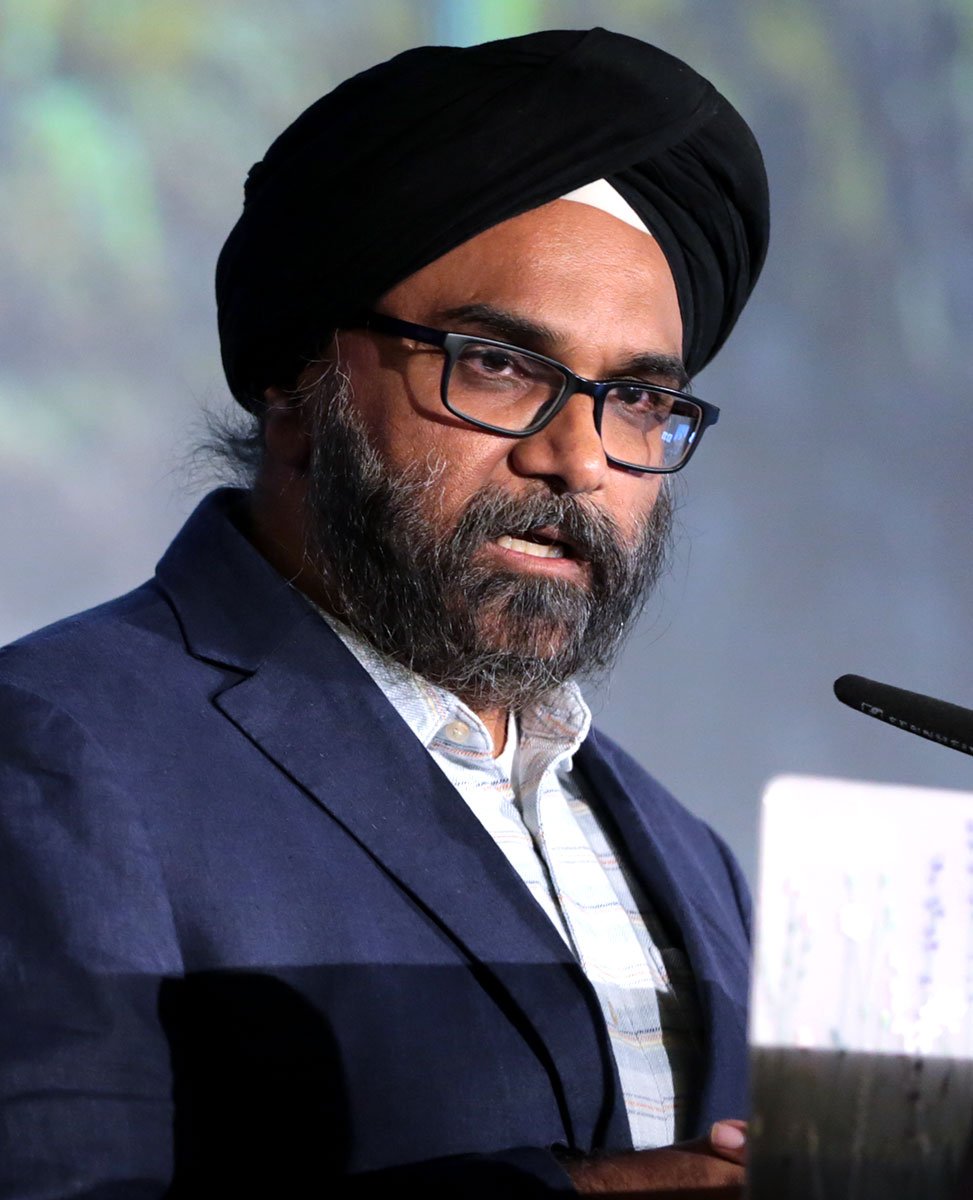
Paramjit Arora
Dr. Paramjit S. Arora is a leader in the development of peptidomimetic strategies for modulating protein-protein interactions. His hydrogen bond surrogate approach for stabilizing short α-helices has provided a general method for constraining peptides in bioactive conformations, enabling the design of cell-permeable inhibitors that target protein interfaces previously considered undruggable. His work has produced the first orthosteric inhibitors of the Ras-Sos interaction, a key node in oncogenic signaling pathways.
Arora earned his B.S. in chemistry from the University of California, Berkeley, in 1992, where he conducted undergraduate research with Richard Mathies from 1988 to 1992. He received his Ph.D. in organic chemistry from the University of California, Irvine, in 1999, studying peptide-based molecular recognition under the direction of James Nowick. He then pursued an American Cancer Society postdoctoral fellowship at the California Institute of Technology, working with Peter Dervan on DNA recognition, before joining the faculty of New York University as Assistant Professor of Chemistry in 2002. He is now Professor of Chemistry at NYU.
The central hypothesis guiding Arora's research is that mimicry of folded peptide domains with metabolically stable synthetic molecules can yield modulators of protein-protein interactions. The α-helix is the most prevalent secondary structure in proteins and plays fundamental roles in mediating intermolecular recognition. However, short peptides corresponding to interfacial helices typically fail to adopt stable helical conformations in solution, limiting their utility as inhibitors.
Arora addressed this challenge by developing the hydrogen bond surrogate strategy. In canonical α-helices, intramolecular hydrogen bonds between the carbonyl oxygen of residue i and the amide nitrogen of residue i+4 stabilize the helical fold. The HBS approach replaces the N-terminal hydrogen bond with a covalent carbon-carbon linkage installed by ring-closing olefin metathesis. This substitution nucleates helix formation, shifting the equilibrium toward the folded state without blocking the solvent-exposed recognition surface. Circular dichroism, NMR and X-ray crystallography have confirmed that HBS peptides adopt canonical α-helical conformations with exceptional thermal stability.
Arora has applied HBS helices to inhibit therapeutically significant protein-protein interactions. In collaboration with Dafna Bar-Sagi, he designed an HBS mimic of the catalytic αH helix from the guanine nucleotide exchange factor Son of Sevenless. This Sos mimetic blocks the Ras-Sos interaction, suppresses nucleotide exchange and downregulates Ras signaling in response to receptor tyrosine kinase activation. Published in Nature Chemical Biology in 2011, this work demonstrated the first orthosteric inhibitor of the Ras activation pathway and established a new paradigm for intercepting oncogenic signaling. Subsequent studies produced a Sos proteomimetic that functions as a pan-Ras inhibitor. Arora's group has also developed HBS helices targeting the p53-MDM2 interaction and the HIF-1α-coactivator complex, with HIF-1α mimetics reducing tumor burden in mouse xenograft models.
Beyond helix stabilization, Arora has developed oxopiperazine helix mimetics as nonpeptidic scaffolds that reproduce the side-chain topology of α-helices. His group has created computational tools including HippDB, a database of helical interfaces in protein-protein interactions that identifies targets amenable to disruption by synthetic helix mimetics.
In parallel research, Arora has developed new methodology for amide bond formation. Recognizing that conventional peptide coupling generates substantial waste from stoichiometric reagents, he has designed organocatalysts for amino acid condensation based on principles from native chemical ligation and enzymatic catalysis. His aldehyde capture ligation strategy uses chemoselective aldehyde-amine condensation to enforce proximity between coupling partners, enabling amide bond formation with difficult substrates.
Arora's contributions have been recognized with numerous honors. He received the Whitehead Fellowship for Young Faculty in Biomedicine in 2005 and the Cottrell Scholar Award from Research Corporation in 2005, recognizing excellence in both teaching and research. He received the inaugural American Chemical Society Division of Organic Chemistry Young Investigator Symposium Award in 2006. The American Peptide Society honored him with the Rao Makineni Lectureship in 2019 for recent contributions of unusual merit to peptide science. He received the Ralph F. Hirschmann Award in Peptide Chemistry from the American Chemical Society in 2024, sponsored by Merck Research Laboratories, recognizing outstanding achievements in the chemistry, biochemistry and biophysics of peptides.