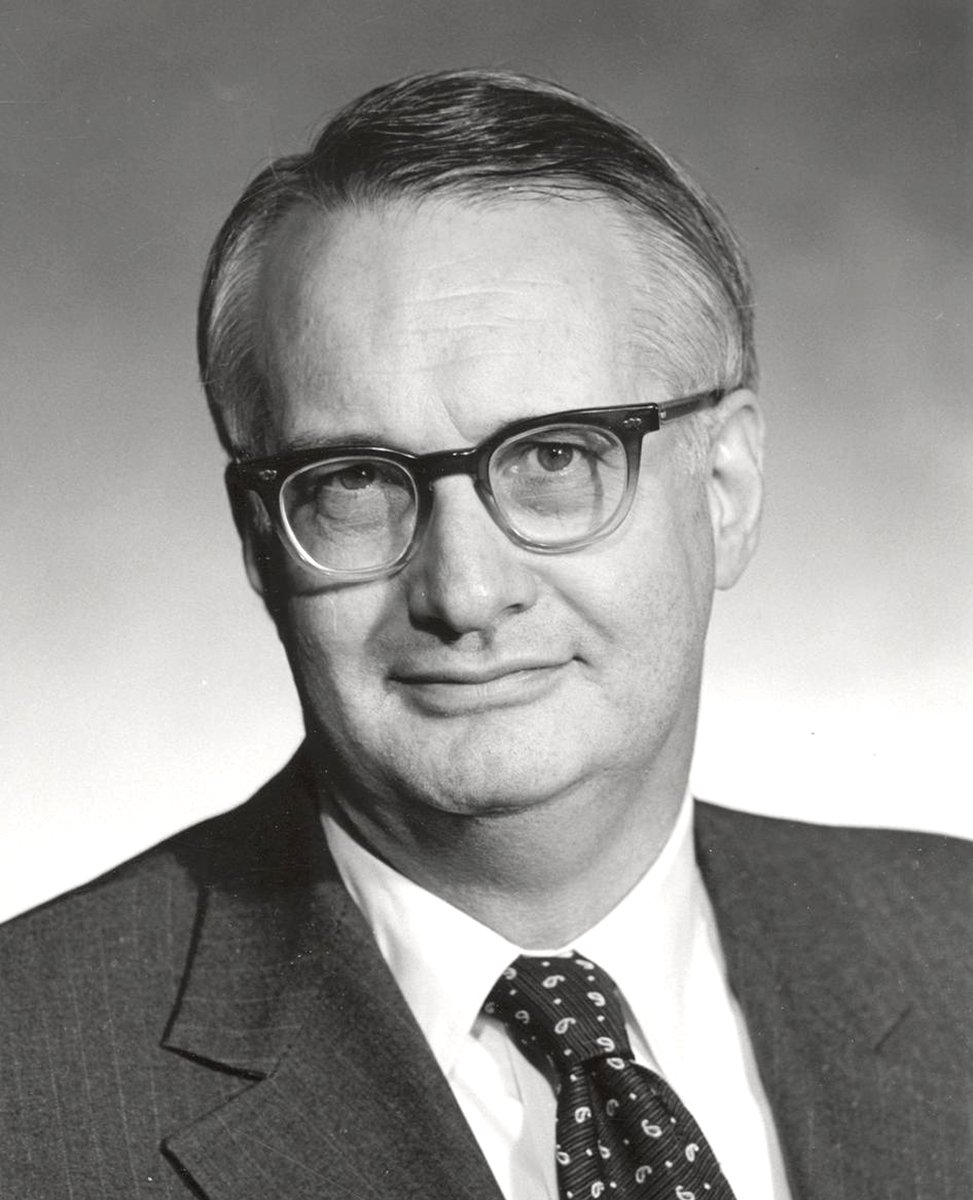
Ralph F. Hirschmann
Ralph Franz Hirschmann was a medicinal chemist whose leadership of peptide research at Merck produced landmark achievements in protein synthesis and drug discovery, establishing approaches that continue to shape pharmaceutical development. His team's 1969 total synthesis of ribonuclease demonstrated that enzymes could be created through purely chemical means, a feat many had thought impossible.
Born May 6, 1922, in Fürth, Bavaria, Germany, Hirschmann was the youngest of three sons in a family where his father worked as a banker. In December 1936, as Nazi persecution intensified, the Hirschmann family fled Germany and settled in Kansas City, Missouri. He attended Oberlin College in Ohio, earning his bachelor's degree in 1943, and became a naturalized United States citizen in 1944. Following graduation, he served three years in the U.S. Army in the Pacific Theater during World War II. After the war, Hirschmann studied organic chemistry under William S. Johnson at the University of Wisconsin-Madison, receiving his doctorate in 1950.
That same year, Hirschmann joined Merck Research Laboratories in Rahway, New Jersey, beginning a 37-year career that would transform both the company and the field. His early work focused on steroid and vitamin K synthesis, but he quickly recognized opportunities to apply organic chemistry to biomedical problems. He introduced the concept of "drug latentiation," anticipating what would later become known as prodrug design and targeted drug release.
In the early 1960s, as the steroid field matured, Merck asked Hirschmann to initiate a program in peptide and protein synthesis. Working with Robert G. Denkewalter, he developed innovative approaches including the reinstitution of N-carboxy-anhydrides for controlled peptide synthesis and the discovery of several amino acid protecting groups. Most notably, in 1968 his team introduced the S-acetamidomethyl (Acm) group for cysteine protection, a reagent that remains essential in peptide chemistry more than fifty years later. Daniel F. Veber, who would become a leading peptide chemist in his own right, was among the key contributors to this work.
These advances enabled Hirschmann's group to pursue an audacious goal: the total chemical synthesis of an enzyme. The 124-amino-acid ribonuclease was chosen as the target because its structure was well characterized. Hirschmann's team employed fragment condensation, building the enzyme from peptide segments six to seventeen residues in length, which were assembled into two large sections and then joined. On January 16, 1969, the Merck team announced their success in a joint press conference with Bruce Merrifield and Bernd Gutte of Rockefeller University, who had simultaneously achieved the synthesis using Merrifield's solid-phase approach. The achievement made front-page news in The New York Times, heralding that "An Enzyme Is Synthesized for First Time." When Merrifield received the Nobel Prize in Chemistry in 1984, many in the scientific community, including Daniel Rich, expressed surprise that Hirschmann did not share the honor.
As Hirschmann rose through Merck's leadership—becoming head of new lead discovery in 1971, senior vice president for basic research in chemistry in 1978, and senior vice president of chemistry in 1984—his teams discovered and developed numerous widely prescribed medications. These included Mevacor for cholesterol reduction, Vasotec for hypertension, Proscar for enlarged prostate, and Ivomec, the antiparasitic agent now used to combat river blindness in developing nations.
Upon mandatory retirement from Merck in 1987 at age 65, Hirschmann joined the University of Pennsylvania as the Rao Makineni Professor of Bioorganic Chemistry, with a concurrent appointment at the Medical University of South Carolina that continued until 1999. At Penn, collaborating with Amos B. Smith III and K. C. Nicolaou, he pioneered peptidomimetics—the design of small molecules that mimic peptide function using nonpeptide scaffolds. This work introduced β-D-glucose as a privileged scaffold for somatostatin mimics and developed nonpeptide inhibitors of aspartic acid proteases including renin and HIV-1 protease. Gary Molander of the University of Pennsylvania noted that "dozens of biotechnology and drug companies were started" based on Hirschmann's developments and that "the whole biotechnology field" emerged through his approaches.
Hirschmann received the American Peptide Society's Alan E. Pierce Award in 1983 as its fourth recipient. His subsequent honors included the Max Bergmann Medal (1993), the Josef Rudinger Award from the European Peptide Society (1996), the ACS Alfred Burger Award in Medicinal Chemistry (1994), the ACS Arthur C. Cope Award (1999), and the National Medal of Science, presented by President Bill Clinton in 2000. In 1988, Merck Research Laboratories established the ACS Ralph F. Hirschmann Award in Peptide Chemistry in his honor. He was elected to the National Academy of Sciences, the American Academy of Arts and Sciences, and the Institute of Medicine.
Hirschmann authored or coauthored approximately 200 scientific papers and was associated with more than 100 patents. Failing health forced his retirement from teaching in 2006. He died on June 20, 2009, at his home in Lansdale, Pennsylvania, survived by his wife of 58 years, Lucy Aliminosa Hirschmann, their son Ralph, daughter Carla Hummel, and six grandchildren.