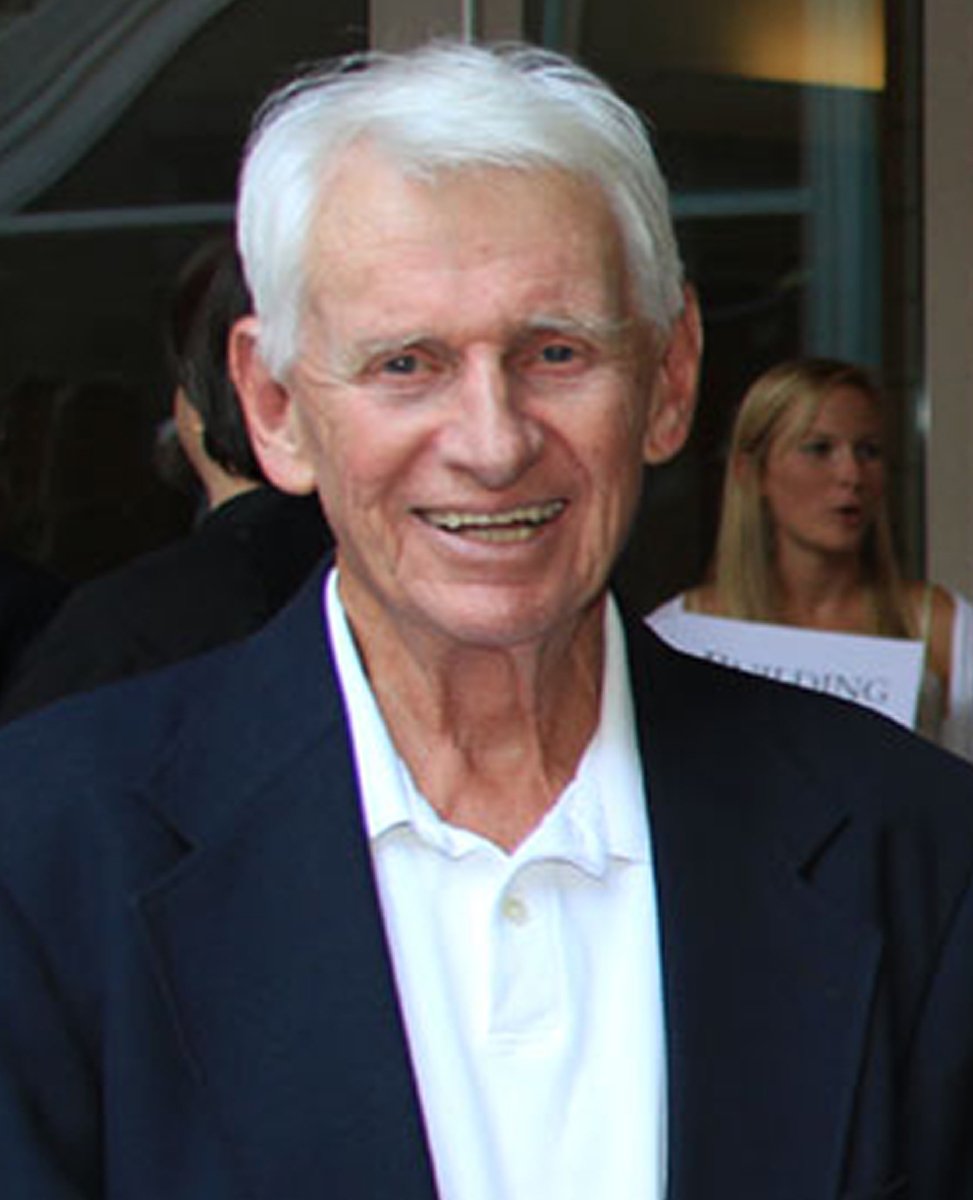
Richard G. Hiskey
Professor Richard G. Hiskey made fundamental contributions to sulfur chemistry in peptide synthesis and to understanding the role of γ-carboxyglutamic acid in blood coagulation. His methods for producing orthogonally protected mixed disulfides enabled the directed synthesis of insulin and other multi-disulfide peptides. His work on vitamin K-dependent coagulation factors elucidated the structural requirements for calcium binding and phospholipid interaction.
Hiskey was born on May 21, 1929, in Emporia, Kansas. He attended Emporia State Teachers College and Kansas State University before earning his Ph.D. in chemistry from Wayne State University in 1955. Following service in the United States Army from 1955 to 1957, he joined the Department of Chemistry at the University of North Carolina at Chapel Hill in 1958, where he spent his entire academic career.
His initial research addressed the chemistry of mixed disulfides and the factors stabilizing or destabilizing these molecules. Mixed disulfides occur transiently during protein folding when cysteine thiols oxidize to form cystine bridges. Working toward the synthesis of insulin, Hiskey developed methods for producing mixed disulfides containing two or more cystine residues with different sulfur-protecting groups. This orthogonal protection strategy allowed controlled, sequential formation of specific disulfide bonds rather than random oxidation. His 1981 chapter on sulfhydryl group protection in The Peptides: Analysis, Synthesis, Biology became a standard reference in the field.
The second major phase of Hiskey's research concerned γ-carboxyglutamic acid, a vitamin K-dependent amino acid essential for blood coagulation. Gla residues occur at ten positions within the first 33 residues of prothrombin and at similar positions in factors VII, IX and X and protein C. In 1982 he developed a method for chemical modification of Gla residues and used it to study metal ion binding and the interaction of prothrombin fragments with phospholipid surfaces. His group synthesized peptide segments of the prothrombin amino terminus to establish the minimum structural requirements for calcium-induced conformational changes, the role of the conserved cystine loop and the number and location of Gla residues necessary for phospholipid binding. The National Heart, Lung and Blood Institute recognized this work with a MERIT Award from 1986 to 1996.
Hiskey served the University of North Carolina in numerous leadership roles, including Director of Graduate Studies from 1965 to 1970, Chairman of the Department of Chemistry from 1970 to 1975, elected Chairman of the Division of Natural Sciences from 1975 to 1981, and Faculty Representative to the Atlantic Coast Conference and National Collegiate Athletic Association from 1985 to 1995. He collaborated with 55 M.S. and Ph.D. students, producing over 160 refereed publications.
He served the peptide community as a member of the Organizing Committee of the American Peptide Symposium from 1978 to 1983 and again from 1988 to 1990, and as Co-Chairman of the 1982 Gordon Research Conference on the Chemistry and Biology of Peptides. His work on peptide synthesis led to an invitation to visit Japan as a Japan Society for the Promotion of Science Fellow in 1983.
His honors include the John Simon Guggenheim Foundation Fellowship and Kenan Research Leave at the Max Planck Institute for Cell Chemistry in 1970 to 1971, the Standard Oil Foundation Award for Excellence in Undergraduate Teaching in 1970, the Tanner Award for Excellence in Undergraduate Teaching in 1986, election to the Society of the Golden Fleece by UNC students in 1989, election as Fellow of the American Association for the Advancement of Science in 1983, and Outstanding Alumnus Awards from Kansas State University in 1973, Wayne State University in 1978 and Emporia State University in 1979. Following his retirement in 1996 as Alumni Distinguished Professor Emeritus, the department established the Richard G. Hiskey Graduate Student Fellowship in his honor. Hiskey died on July 28, 2016, in Chapel Hill.