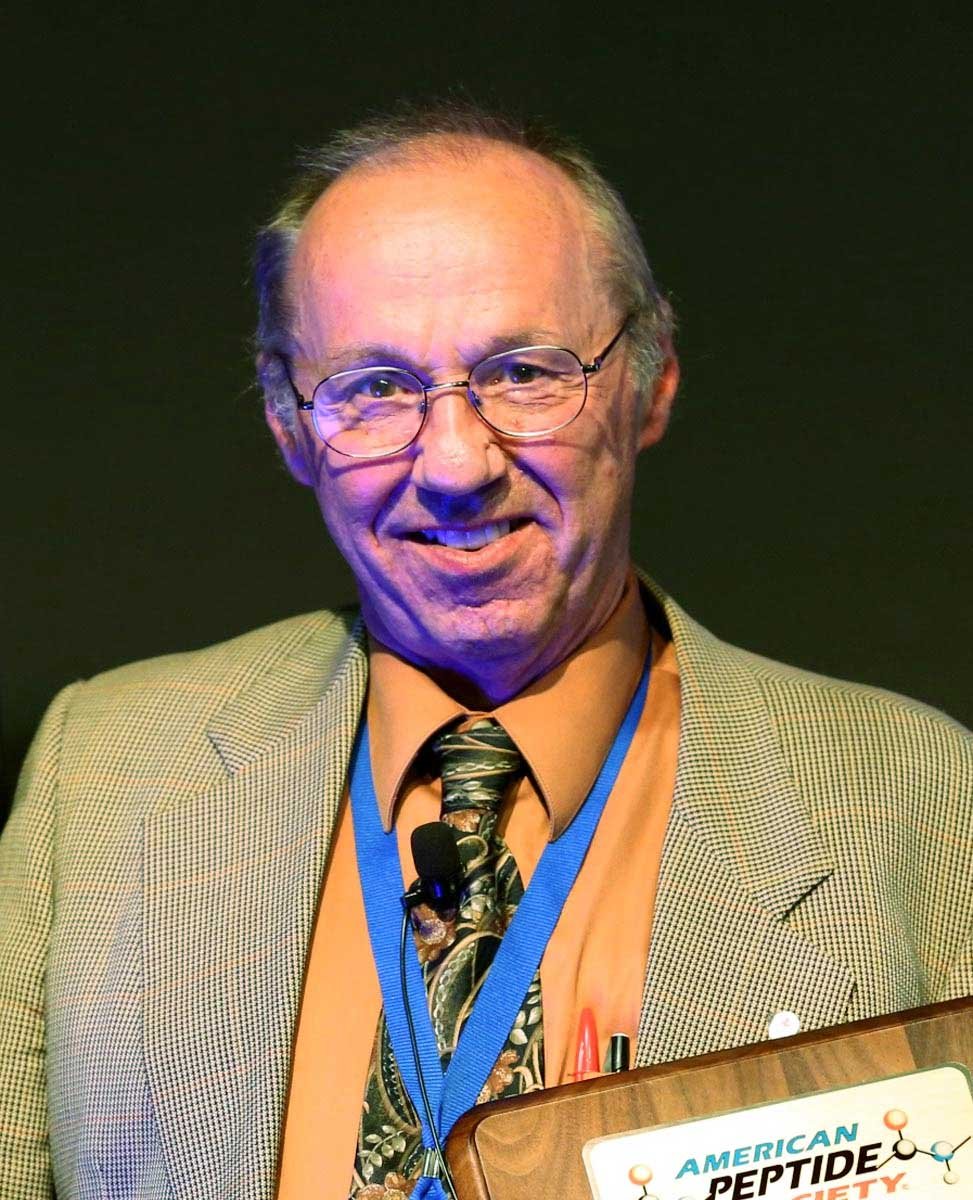
Robert Hodges
Professor Robert S. Hodges combined peptide chemistry with chromatographic innovation and protein design across a career spanning five decades. His work on coiled-coil structures, antimicrobial peptides and HPLC methodology influenced fields from structural biology to vaccine development. Beyond the laboratory, he represented Canada as an Olympic speed skater before building one of the most productive peptide research programs in North America.
Hodges was born in Saskatoon, Saskatchewan, on December 30, 1943. He earned his B.Sc. in biochemistry with honors from the University of Saskatchewan in 1965 and his Ph.D. in biochemistry from the University of Alberta in 1971, where he sequenced tropomyosin, the first two-stranded α-helical coiled-coil protein. He trained with R. Bruce Merrifield at Rockefeller University from 1971 to 1974, using solid-phase synthesis to study ribonuclease.
In 1974 Hodges joined the University of Alberta as assistant professor and became a founding member of the Medical Research Council Group in Protein Structure and Function. He remained in Edmonton for more than 25 years, serving as Director of the Alberta Peptide Institute and, from 1994, as Director and CEO of the Protein Engineering Network of Centres of Excellence, a position he assumed from Nobel laureate Michael Smith. In 2000 he moved to the University of Colorado School of Medicine as Professor of Biochemistry and Molecular Genetics and holder of the John Stewart Endowed Chair in Peptide Chemistry.

Robert Hodges and his family at the 2017 Merrifield Award Ceremony in Whistler, Canada.
Hodges established the two-stranded α-helical coiled-coil as an ideal model system for studying protein stability, subunit interactions and folding. His group systematically characterized the contributions of hydrophobic core residues, interchain electrostatics and helical propensity to coiled-coil stability, developing the STABLECOIL algorithm to predict folding from sequence. These principles informed the design of heterodimeric coiled-coil systems for controlled biomolecule release and synthetic vaccines presenting helical epitopes to the immune system.
His laboratory pioneered reversed-phase HPLC methodology for peptide separation, introducing peptide standards of defined composition to monitor column performance and developing hydrophilic interaction chromatography approaches that advanced proteomic applications. In later years he applied his expertise to antimicrobial peptides, designing α-helical cationic AMPs with enhanced therapeutic indices, and to synthetic peptide vaccines targeting bacterial adhesins, SARS coronavirus spike protein and conserved regions of influenza hemagglutinin.
Hodges chaired the 13th American Peptide Symposium in Edmonton in 1993, which attracted the largest attendance in the Symposium's history. He served as President of the American Peptide Society from 1997 to 1999. His honors include the Vincent du Vigneaud Award in 2002, the Murray Goodman Scientific Excellence and Mentorship Award in 2013 and the R. Bruce Merrifield Award in 2017. He received the Distinguished Medical Research Council of Canada Scientist Award from 1995 to 2000, the Boehringer-Mannheim Award from the Canadian Society of Biochemistry and Molecular Biology in 1995 and the Alberta Science and Technology Award in 1995. He was elected a Fellow of the Royal Society of Canada in 2016. He published more than 500 papers and founded several companies, including Synthetic Peptides Inc., Cytovax Biotechnologies, PeptiVir and AMP Discovery.
Before his scientific career, Hodges competed as an elite speed skater, representing Canada at the 1968 Winter Olympics in Grenoble and the 1972 Winter Olympics in Sapporo, as well as three World Championships. He was inducted into the Saskatoon and Saskatchewan Sports Halls of Fame and the Canadian Speed Skating Association Hall of Fame. Robert Hodges died on April 16, 2021, in Saskatoon.