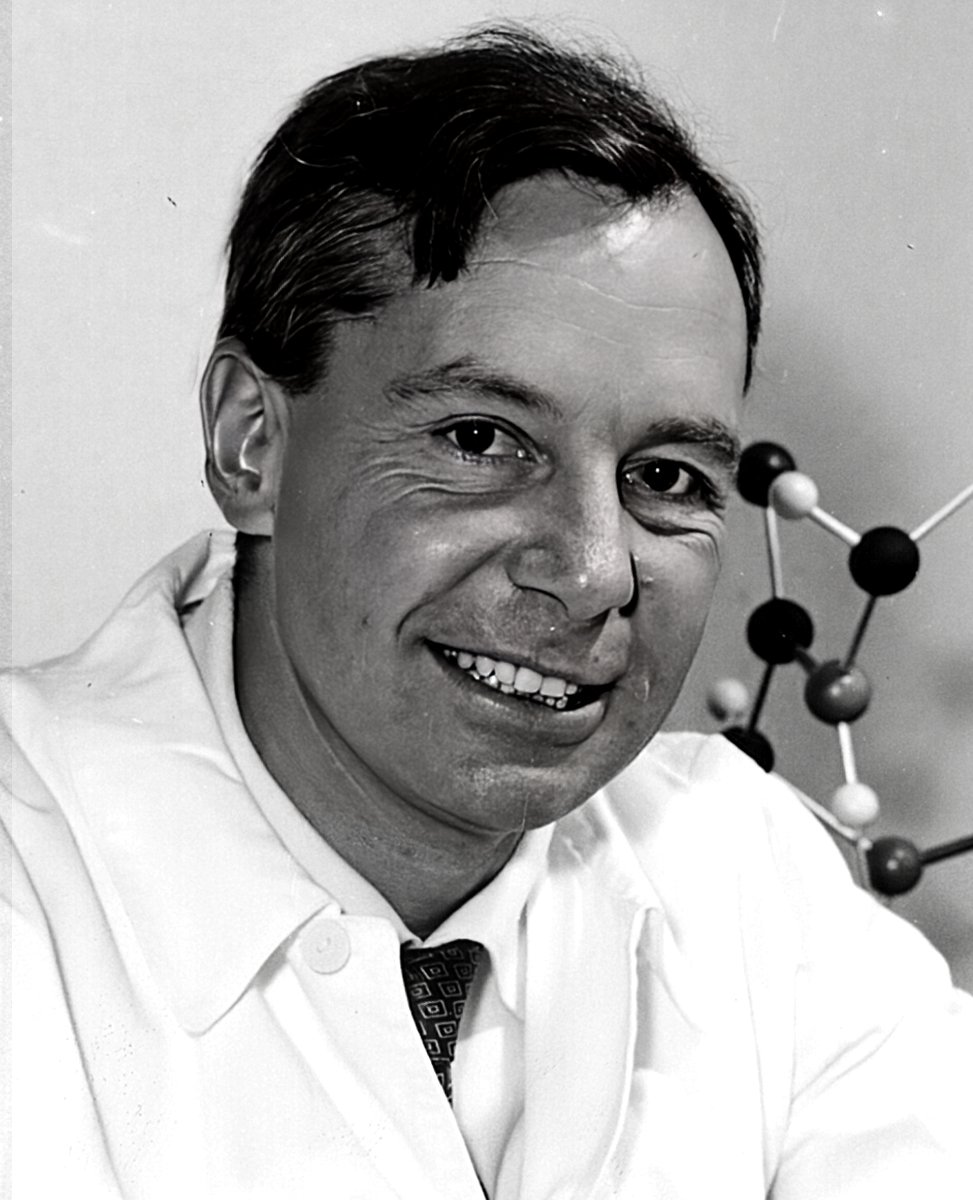
Robert Schwyzer
Robert Schwyzer was a Swiss peptide chemist whose work at CIBA and ETH Zurich bridged industrial pharmaceutical development and fundamental research into peptide-receptor interactions. His syntheses of angiotensin and ACTH produced clinically important drugs, while his later investigations into peptide-membrane interactions established new paradigms for understanding hormone action.
Born December 8, 1920, in Zurich, Switzerland, Schwyzer spent his early childhood in Minnesota, where his father served as a country doctor and surgeon following the family's emigration to the United States in 1924. The family returned to Switzerland in 1933, and Schwyzer completed his schooling in Zurich. He served as an air defense officer in the Swiss Army during World War II before studying chemistry at the University of Zurich, where he earned his Ph.D. in 1947 under Nobel laureate Paul Karrer, working on vitamins and antivitamins. He completed his habilitation at the University of Zurich in 1951.
In 1952, Schwyzer joined CIBA AG in Basel with a mandate to establish a modern peptide research group. The Swiss pharmaceutical companies recognized the therapeutic potential of peptide chemistry earlier than most academic institutions, and Schwyzer's group quickly became one of the most successful and innovative peptide divisions in the industry. His team refined solution-phase peptide synthesis, developing intelligent strategies for assembling long peptide chains through optimally designed protected fragment intermediates that enabled production at industrial scale.
The syntheses achieved by Schwyzer and his collaborators during the 1950s and early 1960s were landmarks of the field: gramicidin S in 1956, [Ile5]angiotensin II in 1957, ACTH1-24 in 1961, α-MSH and β-MSH in 1963, and the complete ACTH1-39 sequence in 1963–1965. The total synthesis of the 39-residue ACTH represented a milestone as the longest single peptide chain assembled by chemical synthesis at that time, produced in high purity in decagram quantities with full biological activity. These achievements translated directly into therapeutics: CIBA marketed synthetic angiotensin as Hypertensin in 1959, and in 1963 launched Synacthen (tetracosactide), the synthetic ACTH1-24 that remains in clinical use today for adrenal function testing and therapeutic applications.
In 1963, ETH Zurich invited Schwyzer to become founding director of the new Institute of Molecular Biology and Biophysics on the Hönggerberg campus. There he joined a remarkable group of peptide and protein researchers including Josef Rudinger, Herbert Zuber, and Kurt Wüthrich, who would receive the Nobel Prize in Chemistry in 2002. The ETH and University of Zurich integrated their molecular biology activities in a joint building that fostered collaboration and produced numerous highly cited publications.
At ETH, Schwyzer's research evolved toward fundamental questions at the interface of bioorganic chemistry and biology. He devoted much of his effort to elucidating mechanisms of peptide hormone action, particularly the conformational aspects of peptides and their interactions with receptors. His investigations into peptide-membrane interactions led to the influential "membrane compartments" concept, which proposed that target cell lipid membranes catalyze interactions between regulatory peptides and their cell surface receptors. This framework explained observed correlations between three-dimensional peptide structures induced by membrane surfaces and receptor subtype selectivity—work he applied to opioid peptides, tachykinins, and melanocortins. Schwyzer was also a pioneer in studying peptide-protein conjugates, initiating research in the 1970s on what are now called peptide-nanobodies.
Schwyzer received the Otto Naegeli Prize in 1964, the Vernon Stouffer Prize in 1968, the Paul Karrer Gold Medal from the University of Zurich in 1969, and the Alan E. Pierce Award from the American Peptide Society in 1985. He was elected to the German National Academy of Sciences Leopoldina. Theodor Wieland recognized him as one of the most famous peptide chemists of the "third epoch" of peptide science. He retired from ETH in 1988.
Schwyzer married Rosa, Rösli, Nägeli in 1948; they had three children. Colleagues remembered him as a charming person, an excellent lecturer, and a sportive colleague who was welcomed and highly respected wherever he traveled in Europe, the United States, China, and Japan. Robert Schwyzer died on September 29, 2015, in Switzerland, three weeks after his wife's passing.