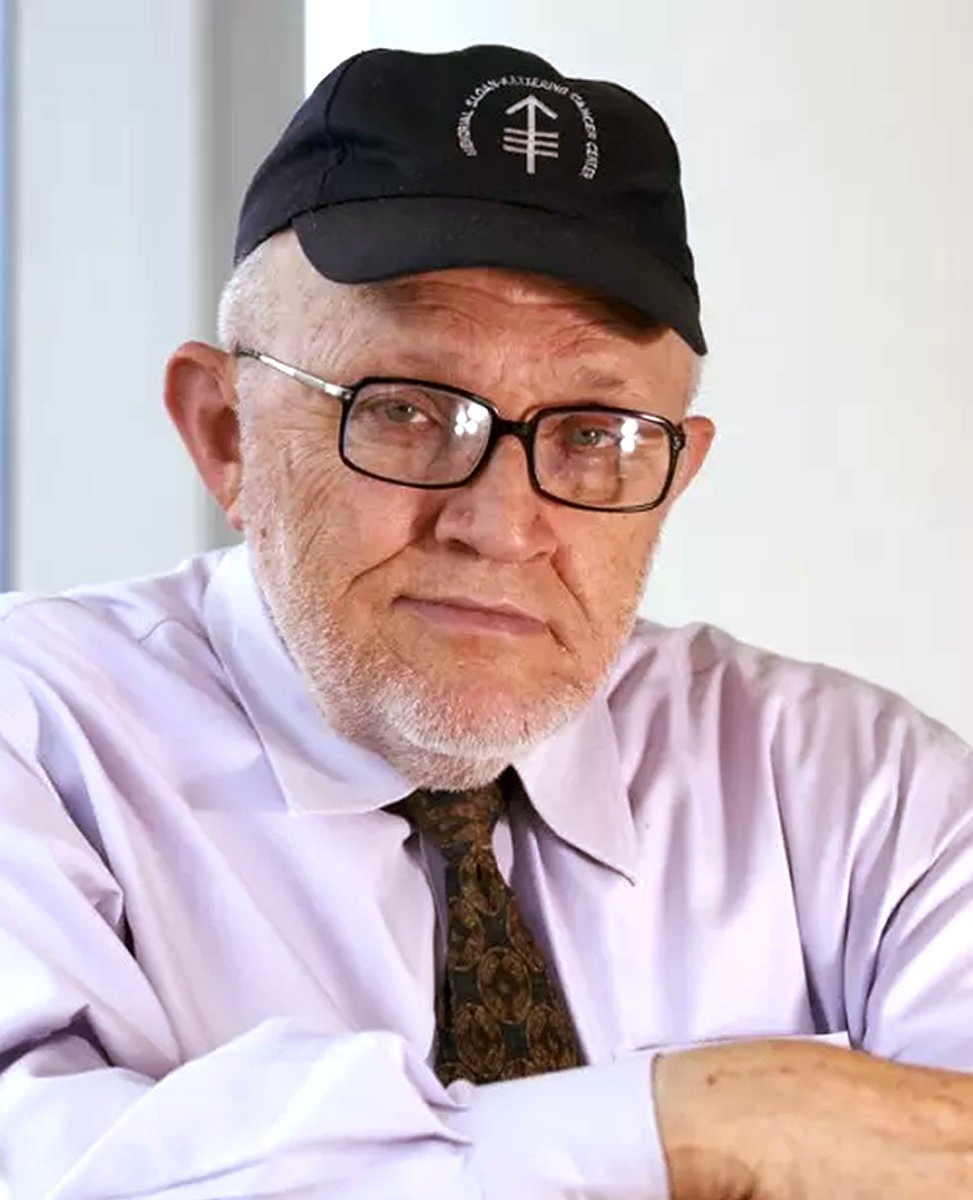
Samuel Danishefsky
Dr. Samuel J. Danishefsky is one of the preeminent synthetic organic chemists of his generation, renowned for the total synthesis of complex natural products and for pioneering the chemical synthesis of carbohydrates and glycopeptides that enabled the development of anticancer vaccines. His guiding principle that mechanism leads to method and method leads to strategy has driven fundamental discoveries with direct applications in cancer treatment.
Danishefsky was born on March 10, 1936, in Bayonne, New Jersey. He entered college as a premedical student before deciding to focus on chemistry. He earned his B.S. from Yeshiva University in 1956 and his Ph.D. in organic chemistry from Harvard University in 1962 under the guidance of Peter Yates. His doctoral studies partially overlapped with a National Institutes of Health postdoctoral fellowship in the laboratory of Gilbert Stork at Columbia University, completed in 1963.
Danishefsky began his academic career at the University of Pittsburgh in 1963 as Assistant Professor. He became Professor in 1971 and University Professor in 1978. In 1979 he moved to Yale University, where he was named Eugene Higgins Professor in 1983 and Sterling Professor of Chemistry in 1989. In 1991 he joined the Memorial Sloan Kettering Cancer Center as Kettering Chair and Director of the Laboratory for Bioorganic Chemistry. He accepted a joint appointment at Columbia University in 1993 as Centennial Professor of Chemistry, splitting his time between Columbia and Sloan Kettering.
In 1974 the Danishefsky group introduced what became known as the Danishefsky-Kitahara diene, a highly reactive heterosubstituted diene that revolutionized hetero-Diels-Alder chemistry. The hyperreactivity of this diene enabled efficient synthesis of oxygen heterocycles and led Danishefsky into carbohydrate chemistry, where he made his most important contributions to synthetic methodology. More than 400 papers worldwide have employed this reagent in the synthesis of natural products and pharmaceuticals.
Danishefsky has achieved the total synthesis of numerous complex natural products with anticancer potential. In 1996 his group published an important third synthesis of Taxol, the landmark anticancer natural product, following the initial Holton and Nicolaou total syntheses by two years. The Danishefsky route, characterized by completion of the oxetane D ring prior to construction of the eight-membered B ring, demonstrated the power of strategic planning in complex molecule synthesis. He was the first to synthesize the epothilones, a class of microtubule-stabilizing agents isolated from the myxobacterium Sorangium cellulosum. The epothilones are effective against cancer cells that have developed resistance to Taxol and are more water-soluble, offering significant therapeutic advantages. Danishefsky's group has created more than 100 epothilone analogs, including fludelone and iso-fludelone, which exhibited excellent solubility, biological stability and remarkable potency in preclinical studies. His concept of Diverted Total Synthesis allows systematic editing of natural products to remove sites of nonspecific toxicity while enhancing potency and pharmacokinetic properties.
Danishefsky's work on carbohydrate and glycopeptide synthesis has had direct clinical impact through the development of fully synthetic anticancer vaccines. Cancer cells often display altered carbohydrate antigens on their surfaces, including globo H, the Tn antigen, and the Thomsen-Friedenreich antigen, which can serve as targets for immune recognition. Danishefsky solved the difficult problem of synthesizing globo H hexasaccharide, conjugated it to keyhole limpet hemocyanin as a carrier protein, and advanced the resulting vaccine to clinical trials in prostate cancer patients with Memorial Sloan Kettering clinicians. The vaccine proved safe and capable of inducing high-titer antibodies against globo H. Similar strategies led to clinical trials of vaccines targeting the clustered Tn antigen and other tumor-associated carbohydrates.
The Danishefsky laboratory developed enabling methodologies for assembling carbohydrates onto peptide backbones, including the glycal assembly method for stereocontrolled glycosidic bond formation. His group extended native chemical ligation, originally limited to cysteine, to include valine and other amino acids through novel chemistry, greatly expanding the scope of chemical protein synthesis. In a landmark achievement reported in 2012 and 2013, the Danishefsky group synthesized homogeneous erythropoietin, arguably the largest and most complex biological molecule ever assembled by the methods of organic chemistry. The 166-amino acid glycoprotein, with carbohydrates attached at correct locations and with correct bonding mechanisms, represented the first time a homogeneous form of native EPO containing all carbohydrates had been obtained. The synthesized protein stimulated red blood cell production in vitro, demonstrating retained biological function.
Danishefsky's contributions to peptide synthesis include the development of isonitrile-mediated amide bond formation as an alternative to traditional coupling methods. This chemistry, which employs thioacids reacting with isonitriles through formimidate carboxylate mixed anhydride intermediates, has been applied to solid-phase peptide synthesis and fragment coupling.
Danishefsky has been a member of the National Academy of Sciences since 1986. His numerous honors include the Wolf Prize in Chemistry in 1995/1996, shared with his mentor Gilbert Stork, for designing and developing novel chemical reactions that opened new avenues to the synthesis of complex molecules. He received the Tetrahedron Prize in 1996, the Claude S. Hudson Award in Carbohydrate Chemistry in 1997, the Arthur C. Cope Award in 1998, the Nagoya Medal in Gold in 1999, the F.A. Cotton Medal for Excellence in Chemical Research in 2001, the Benjamin Franklin Medal in Chemistry in 2006, the NAS Award in Chemical Sciences in 2006, the Roger Adams Award in 2007, the Bristol-Myers Squibb Lifetime Achievement Award, and the Ralph F. Hirschmann Award in Peptide Chemistry in 2014.
Danishefsky met his wife Sarah while he was a postdoctoral fellow in Stork's laboratory at Columbia and she was a graduate student. Sarah Danishefsky has run his laboratory, and they have two children.