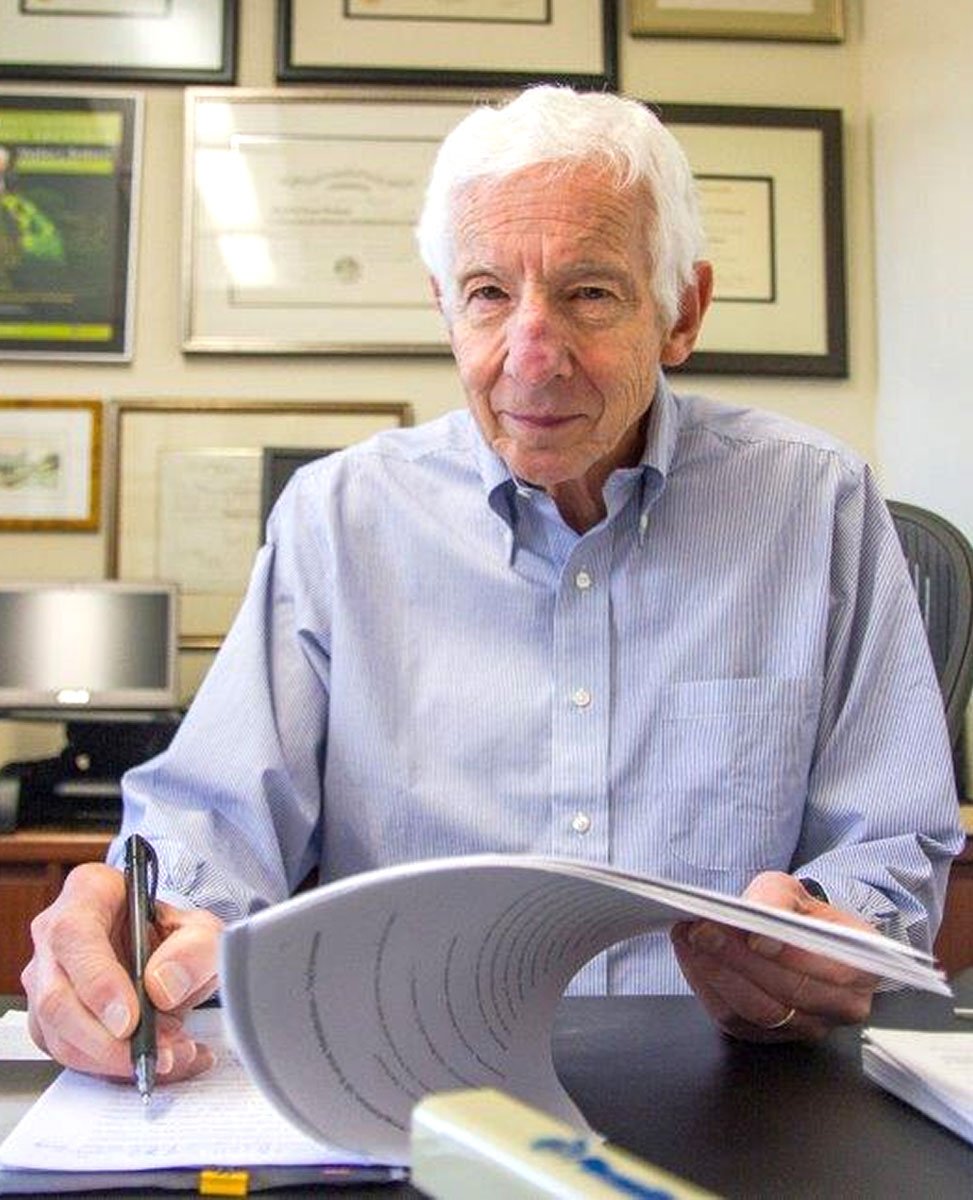
Stephen J. Benkovic
Dr. Stephen J. Benkovic is among the most prominent mechanistic enzymologists in the world, recognized for major contributions that have initiated or shaped our understanding of how proteins function as catalysts. He was the first to hypothesize that conformational changes outside an enzyme's active site were necessary for achieving maximal catalysis, a concept beautifully illustrated by his studies on dihydrofolate reductase. His discoveries of how multi-enzyme complexes assemble to achieve specificity and function and of the purinosome, the first reversible metabolon in de novo purine biosynthesis, have opened new frontiers in understanding cellular metabolism.
Benkovic was born in Orange, New Jersey. He attended Lehigh University, where he received his B.S. in chemistry and A.B. in English literature in 1960, graduating magna cum laude and Phi Beta Kappa. He earned his Ph.D. in organic chemistry from Cornell University in 1963, with minors in physical chemistry and biochemistry. From 1964 to 1965 he was a postdoctoral research associate at the University of California at Santa Barbara. He joined the Penn State faculty as an assistant professor of chemistry in 1965, was promoted to associate professor in 1967 and to full professor in 1970. The University honored him with the title of Evan Pugh Professor of Chemistry in 1977, Holder of the University Chair in Biological Sciences in 1984, and Holder of the Eberly Family Chair in Chemistry in 1986.
A major theme of Benkovic's research has been understanding the source of enzymatic catalytic efficiency. He dissected the catalytic cycle of dihydrofolate reductase into individual steps using pre-steady-state kinetic methods and tied the contributions of various amino acids, both within and outside the active site, to specific steps. He found that significant changes in the rates of hydride transfer were not limited to active-site residues, nor were the effects of multiple mutations additive in terms of free energy. The amide backbone and side chains of distal residues were found by NMR to be in regions of high-frequency motion, and molecular dynamics simulations revealed that the motions of these distal residues were coupled. Genomic analysis of multiple DHFR sequences showed low overall DNA sequence homology of about 30 percent but surprisingly high conservation in the same regions whose amino acids had been implicated in catalysis. This work established the paradigm that enzyme catalysis should be described in terms of a series of orchestrated protein conformations.
Benkovic's studies on multi-enzyme systems, particularly DNA replication in T4 bacteriophage, have charted the assembly, function and disassembly of the replisome that coordinates DNA replication. Early DNA research had relied on examining end results rather than watching the process unfold. Benkovic brought tools together from physics, chemistry and biochemistry to create a mechanistic understanding of how these systems operated, discovering that many tightly held assumptions were incorrect. He not only described new aspects of DNA replication but also discovered that replication enzymes played additional roles within cells, such as aiding DNA binding. His research has extended to DNA translesion bypass by human repair polymerases, providing insights into how cells cope with DNA damage.
In 2008 Benkovic discovered the purinosome, the first example of a reversible metabolon in de novo purine biosynthesis. Using confocal microscopy on HeLa cells with chimeric constructs of the six enzymes of this pathway, he and his collaborators observed merged punctates indicating that these enzymes condense within cells to form functional complexes. Unlike traditional static metabolons, purinosome formation is reversible, assembling only in response to cellular demands. Super-resolution imaging revealed that purinosome assembly is microtubule-assisted and that purinosomes colocalize with mitochondria, positioning them to capture substrates exported from mitochondria for efficient purine biosynthesis.
Although boron-containing compounds had long been avoided as pharmaceuticals because of concerns about toxicity, Benkovic created a library of benzoxaborole compounds that showed surprising antifungal activity in phenotypic screening. This work led to the founding of Anacor Pharmaceuticals, which he cofounded with Lucille Shapiro. The company developed two topical drugs: tavaborole, marketed as Kerydin for nail infections, and crisaborole for atopic dermatitis. He also cofounded Boragen, a company developing boron-containing antifungicides for agricultural applications.
Benkovic's honors include the Pfizer Award in Enzyme Chemistry from the American Chemical Society in 1977, a Guggenheim Fellowship in 1976, the Gowland Hopkins Award in 1986, the Arthur C. Cope Scholar Award in 1988, an NIH MERIT Award in 1988, the Repligen Award for Chemistry of Biological Processes in 1989, the Alfred Bader Award in Bioinorganic or Bioorganic Chemistry in 1994, an honorary doctorate of science from Lehigh University in 1995, the Chemical Pioneer Award from the American Institute of Chemists in 1998, the Christian B. Anfinsen Award in 2000, the Merck Award from the American Society for Biochemistry and Molecular Biology in 2003, the Nakanishi Prize in 2005, the Royal Society Centenary Award in 2006, the Benjamin Franklin Medal in Life Science in 2009, the Ralph F. Hirschmann Award in Peptide Chemistry in 2010, and the National Academy of Sciences Award in Chemical Sciences in 2011. In 2009 President Barack Obama presented him with the National Medal of Science, the nation's highest award for lifetime achievement in scientific research.
He was elected to the American Academy of Arts and Sciences in 1984, the National Academy of Sciences in 1985, the Institute of Medicine of the National Academy of Sciences, and the American Philosophical Society. He is a Fellow of the American Association for the Advancement of Science and the National Academy of Inventors. In 2022 he was elected a Foreign Member of the Royal Society, with selection reserved for persons of the greatest eminence for their scientific discoveries and attainments. In 2024 Penn State announced plans to rename the Chemistry Building in his honor, recognizing his extraordinary research impact and the legacy he and his wife Patricia have built through their mentoring of generations of scientists.