Global Peptide Groups - The Chmielewski Group
The cell is, by design, a fortress. Lipid bilayers, defended compartments, surveillance systems poised to recognize and reject what does not belong. The history of peptide therapeutics has been, in part, a history of finding the right keys for those locks without setting off the alarms. Some of the most consequential keys have come from a single laboratory in West Lafayette, Indiana.
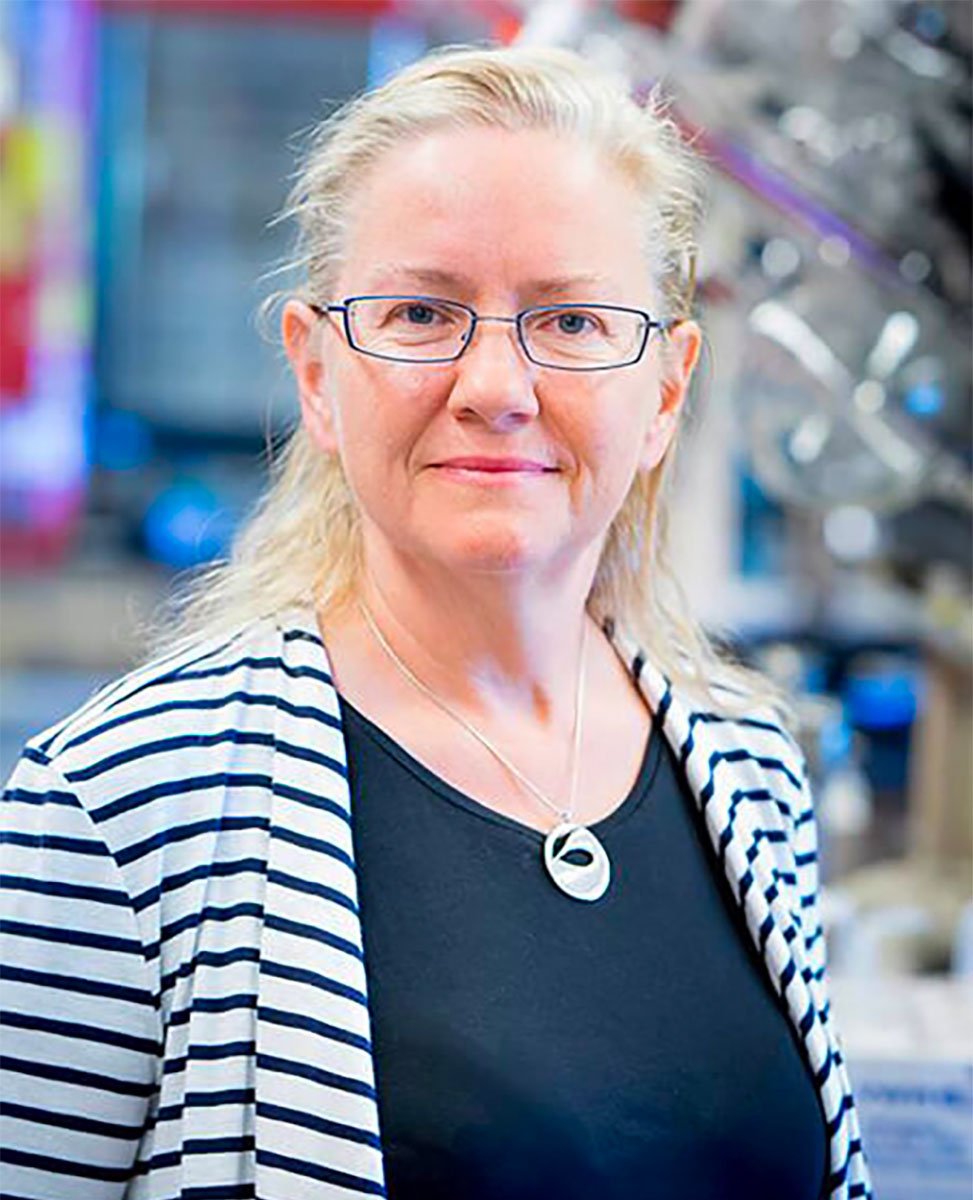
Jean Chmielewski joined the Purdue Department of Chemistry as an assistant professor in 1990, after a PhD with Ronald Breslow at Columbia University and postdoctoral training with E. T. Kaiser at Rockefeller University and Peter Schultz at the University of California, Berkeley. The lineage was a chemist's lineage: Breslow on biomimetic design, Kaiser on amphiphilic peptide architecture, Schultz on chemical biology. The questions she carried forward asked what the smallest, most defined peptide system could accomplish in living cells. Across more than three decades, those questions have produced cell-penetrating polyproline helices that target intracellular bacteria, metal-assembled collagen scaffolds for regenerative medicine, coiled-coil crystals that deliver folded protein cargo, and dimeric inhibitors aimed at HIV reservoirs in the brain. Chmielewski was named Alice Watson Kramer Distinguished Professor of Chemistry in 2006 and Professor of Biomedical Engineering in 2009.
The Chmielewskians
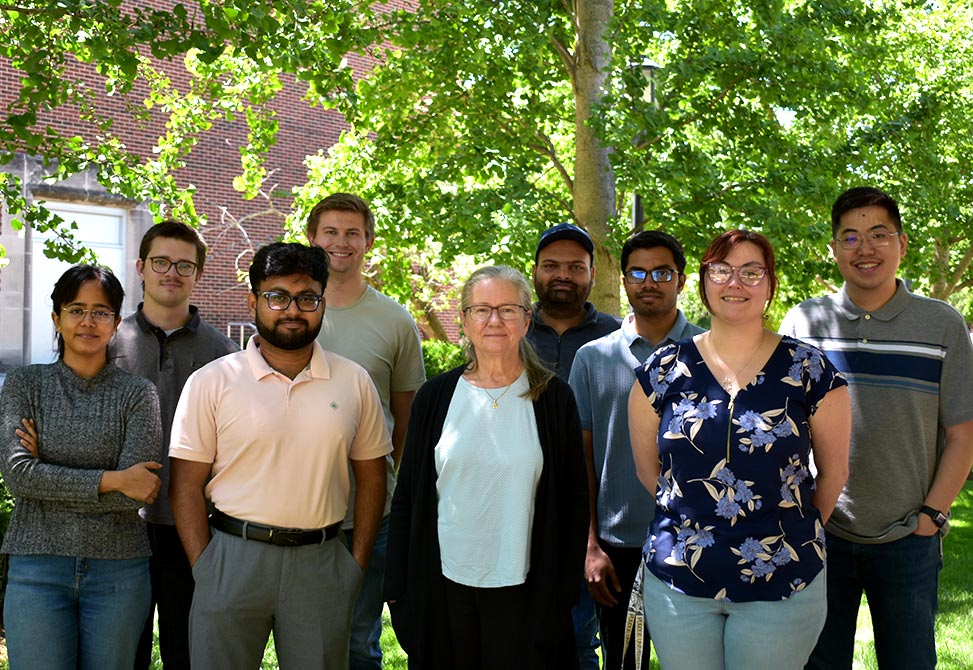
The current group is small by design. Seven graduate students and two undergraduates work alongside Chmielewski in the lab, a scale she keeps deliberately. "Every member of the group leads their own project," she says. "That is central to how the group runs." Each student meets one-on-one with Chmielewski on a biweekly cadence to talk through experiments, plans, and reasoning. Senior students mentor newer ones; troubleshooting happens at the bench rather than only in formal meetings. Group members describe a culture in which independence and collaboration sit alongside one another rather than competing.
What unites the group is less a single technique than a habit of mind. Members move freely between organic synthesis, automated peptide synthesis, biophysical characterization, electron microscopy, and cell-based assays as the science requires. The group's recent recognition reflects this range. The 2025 Morrill Award, Purdue's highest faculty honor, recognized teaching, research, and engagement together rather than any single one. The 2025 Francis P. Garvan-John M. Olin Medal from the American Chemical Society, named for women chemists who advance the field, recognized both Chmielewski's research record and her sustained mentorship of women and underrepresented chemists.
A graduate student in the group, asked what the most valuable part of the experience has been, did not name a paper or a technique. "I have learned how to identify a research problem and approach it from multiple angles," he said. "The process of developing a project from scratch to completion independently, while maintaining scientific curiosity, is what stays with you."

The Science of Chemical Approaches to Biology
The Chmielewski Group designs peptides to engage biology where small molecules struggle: inside cells, across compartments, against targets that have resisted conventional drug discovery. The unifying logic is chemical. Every project begins by asking what the smallest defined peptide system can do, what can be built into the residues themselves, and what handles can be added through sidechain chemistry, scaffold geometry, or metal-ligand coordination. The answers have led the group across antimicrobial drug discovery, intracellular protein delivery, regenerative biomaterials, and HIV reservoir eradication.
A recurring methodological thread runs through the work: metal-ligand chemistry as a programmable design lever. Zinc, nickel, cobalt, and gadolinium ions, paired with histidine and other coordinating residues engineered into the peptide sequence, give the group reversible, geometrically defined assembly behavior at the bench. The same chemistry organizes coiled coils into crystals, collagen mimetics into florettes, and helical barrels into higher-order architectures that can hold and release cargo on demand.
Research Themes
Cell-Penetrating Polyproline Helices for Intracellular Antibiotics
A growing number of pathogenic bacteria, including Mycobacterium tuberculosis, Salmonella, Brucella, Listeria, and methicillin-resistant Staphylococcus aureus, reproduce inside mammalian macrophages, where most clinically used antibiotics cannot reach them. The Chmielewski Group has built a class of cell-penetrating peptides, cationic amphiphilic polyproline helices, that enter macrophages and carry antibiotic cargo with them. These peptides depart from the cationic, amphipathic cell-penetrating peptide designs that dominated the field in the early 2000s; they use a rigid polyproline scaffold whose surface chemistry rather than overall charge dictates entry. The polyproline scaffold and its kanamycin conjugates have shown activity against drug-resistant intracellular pathogens in cell culture and in mouse models of infection.
Metal-Triggered Assembly of Peptide Biomaterials
Long before "programmable matter" became a phrase, the Chmielewski Group was using metal-ligand chemistry to organize peptides into ordered nano- and microscale architectures. Trimeric coiled-coil peptides assemble into banded fibers, three-dimensional crystals, and tunable nanotubes when the right metal coordination sites are designed into the sequence. Collagen-mimetic peptides assemble into florettes, microcages, curved disks, and hollow spheres. The principle is general: programmable, reversible, geometrically defined assembly through residues you can engineer at the bench. The materials have been used for cell encapsulation and release, three-dimensional cell culture, magnetic resonance imaging contrast, and bacterial decontamination.
Intracellular Protein Delivery Through Coiled-Coil Crystals
The most recent direction brings two earlier threads together. Working with Ni(II)-mediated coordination, the group has reduced the trimeric coiled-coil microcrystals it previously developed to nanoscale dimensions, around 180 nm in length. The nanocrystals are loaded with His-tagged enhanced green fluorescent protein cargo at roughly 750 protein molecules per crystal, then surface-decorated with the cell-penetrating TAT peptide. The result is a modular protein delivery vehicle in which both cargo loading and surface functionalization run through the same metal-coordination chemistry. TAT-functionalized nanocrystals deliver folded protein cargo to the cytosol of HeLa cells without measurable cytotoxicity. The platform is in principle extensible to any His-tagged therapeutic protein.
Eradicating HIV Reservoirs
A long-running thread in the group's work targets HIV at points current antiretrovirals do not reach. Early work produced dimerization inhibitors of HIV-1 protease, designed to block the active enzyme by destabilizing its quaternary structure rather than competing for its active site. More recent work targets the latent reservoirs that persist on antiretroviral therapy, including reservoirs in the brain. Dimeric prodrugs that inhibit the blood-brain barrier efflux transporter P-glycoprotein, paired with antiviral cargo, aim to deliver therapeutic concentrations to those compartments. A newer collaboration with Mark Lipton at Purdue develops first-in-class dual inhibitors of HDAC3 and HIV-1 protease, bringing chromatin biology and antiviral chemistry together in a single molecule. Early data presented at APS 2025 show significant decreases in viral infectivity in cells.
Scale and Impact
Across more than 150 peer-reviewed publications, the Chmielewski Group has trained generations of PhD chemists now in faculty positions and industry research roles. Recognition has included the Vincent du Vigneaud Award from the American Peptide Society, the Goodman Scientific Excellence and Mentorship Award, the Arthur C. Cope Scholar Award and Edward Leete Award from the American Chemical Society, election as a Fellow of the American Association for the Advancement of Science, the Bill and Melinda Gates Grand Challenges Explorations Award, the Herbert Newby McCoy Award, Purdue's highest natural sciences research honor, the Stanley C. Israel Regional Award for Advancing Diversity in the Chemical Sciences, the 2025 Morrill Award, Purdue's highest faculty honor, and the 2025 Francis P. Garvan-John M. Olin Medal.
Learn More
Selected Publications
Encinas, A.; Agrahari, A.; Chmielewski*, J. "Functionalized Coiled-Coil Peptide Nanocrystals for Cellular Protein Delivery" Chem. Mater., 2026, 38, 2445-2452.
Curtis, R. W.; Nepal, M.; Nambiar, M.; Jorgensen, M. D.; Chmielewski*, J. "Hierarchical Assembly of a Tetrameric Coiled-Coil Into Cuboid Structures" Pept. Sci., 2025, 117, e24390.
Encinas, A.; Blade, R.; Abutaleb, N. S.; Abouelkhair, A. A.; Caine, C.; Seleem, M. N.; Chmielewski*, J. "Effects of Rigidity and Configuration of Charged Moieties within Cationic Amphiphilic Polyproline Helices on Cell Penetration and Antibiotic Activity" ACS Infect. Dis., 2024, 10, 3052-3058.
Agrahari, A.; Lipton, M.; Chmielewski*, J. "Metal-Promoted Higher-Order Assembly of Disulfide-Stapled Helical Barrels" Nanomaterials, 2023, 13, 2645.
Ernenwein, D.; Geisler, I.; Pavlishchuk, A.; Chmielewski*, J. "Metal-Assembled Collagen Peptide Microflorettes as Magnetic Resonance Imaging Agents" Molecules, 2023, 28, 2953.
Jorgensen, M. D.; Chmielewski*, J. "Recent advances in coiled-coil peptide materials and their biomedical applications" Chem. Commun., 2022, 58, 11625-11636.
Jorgensen, M. D.; Chmielewski*, J. "Co-assembled Coiled-Coil Peptide Nanotubes with Enhanced Stability and Metal-Dependent Cargo Loading" ACS Omega, 2022, 7, 20945-20951.
Curtis, R. W.; Scrudders, K. L.; Ulcickas, J. R. W.; Simpson, G. J.; Low-Nam, S. T.; Chmielewski*, J. "Supramolecular Assembly of His-Tagged Fluorescent Protein Guests within Coiled-Coil Peptide Crystal Hosts: Three-Dimensional Ordering and Protein Thermal Stability" ACS Biomater. Sci. Eng., 2022, 8, 1860-1866.
Gleaton, J.; Curtis, R. W.; Chmielewski*, J. "Formation of Microcages from a Collagen Mimetic Peptide via Metal-Ligand Interactions" Molecules, 2021, 26, 4888-4899.
Zeiders, S. M.; Chmielewski*, J. "Antibiotic-cell-penetrating peptide conjugates targeting challenging drug-resistant and intracellular pathogenic bacteria" Chem. Bio. Drug Des., 2021, 98, 762-778.
Jorgensen, M. D.; Chmielewski*, J. "Reversible crosslinked assembly of a trimeric coiled-coil peptide into a three-dimensional matrix for cell encapsulation and release" J. Pept. Sci., 2021, 28, 3302.
Dietsche, T. A.; Eldesouky, H. E.; Zeiders, S. M.; Seleem, M. N.; Chmielewski*, J. "Targeting Intracellular Pathogenic Bacteria through N-Terminal Modification of Cationic Amphiphilic Polyproline Helices" J. Org. Chem., 2020, 85, 7468-7475.
Agrawal, N.; Rowe, J.; Lan, J.; Yu, Q.; Hrycyna, C. A.; Chmielewski*, J. "Potential Tools for Eradicating HIV Reservoirs in the Brain: Development of Trojan Horse Prodrugs for the Inhibition of P-Glycoprotein with Anti-HIV-1 Activity" J. Med. Chem., 2020, 63, 2131-2138.
Nambiar, M.; Wang, L. S.; Rotello, V.; Chmielewski*, J. "Reversible Hierarchical Assembly of Trimeric Coiled-Coil Peptides into Banded Nano- and Microstructures" J. Am. Chem. Soc., 2018, 140, 13028-13033.
Nepal, M.; Mohamed, M.; Blade, R.; Eldesouky, H.; Anderson, T.; Seleem, M. N.; Chmielewski*, J. "A Library Approach to Cationic Amphiphilic Polyproline Helices that Target Intracellular Pathogenic Bacteria" ACS Infect. Dis., 2018, 4, 1300-1305.
Strauss, K.; Chmielewski*, J. "Advances in the Design and Higher-order Assembly of Collagen Mimetic Peptides for Regenerative Medicine" Curr. Opin. Biotechnol., 2017, 46, 34-41.
Nepal, M.; Sheeldo, M.; Das, C.; Chmielewski*, J. "Accessing Three-Dimensional Crystals with Incorporated Guests through Metal-Directed Coiled-Coil Peptide Assembly" J. Am. Chem. Soc., 2016, 138, 11051-11057.
Przybyla, D.; Chmielewski*, J. "Metal-Triggered Self Assembling Collagen Peptide Disks" J. Am. Chem. Soc., 2010, 132, 7866-7867.
Przybyla, D.; Chmielewski*, J. "Metal Triggered Radial Self Assembly of Collagen Peptide Fibers" J. Am. Chem. Soc., 2008, 130, 12610-12611.
Fillon, Y.; Anderson, J.; Chmielewski*, J. "Cell Penetrating Agents Based on a Polyproline Scaffold" J. Am. Chem. Soc., 2005, 127, 11798-11803.

A Conversation with Professor Jean Chmielewski
APS: What first drew you into chemistry, and how did peptides become the language you wanted to work in?
Chmielewski: Organic chemistry pulled me in first. I loved the idea that you could draw a structure on paper, build it on the bench, and watch it do something useful. As I learned more, I started caring more about the questions the molecules let me ask. Peptides sat right at the boundary I wanted to work on: small enough to design and synthesize with precision, large enough to engage biology meaningfully. During my postdoctoral training I worked on helix-turn-helix and stabilized helical systems, and the way a handful of residues could specify a defined structure stayed with me. That balance, the smallest molecular grammar that yields biological consequence, has framed the work since.
APS: Across more than three decades at Purdue, what would you point to as the contribution that most defines the group's work?
Chmielewski: Two papers come to mind, both because they opened directions we are still pursuing. The first, in 2005, was a cell-penetrating scaffold built on polyproline rather than the disordered cationic motifs that dominated the field at the time. We showed that a rigid, defined helix decorated with the right surface chemistry could enter cells, and ultimately target pathogenic bacteria that hide within those cells. That work taught us that scaffold geometry is not a passive backbone; it shapes everything downstream. The second, in 2008, used metal-ligand coordination to trigger radial self-assembly of collagen-mimetic peptides. Metal triggers gave us programmable handles for assembly, disassembly, and cargo loading. The nanocrystal work we recently published in Chemistry of Materials grows directly from that lineage.
APS: The recent Chemistry of Materials paper on coiled-coil nanocrystals seems to bring those threads together. How do you see the field moving over the next several years?
Chmielewski: Three currents stand out to me. The first is intracellular delivery. We have learned to enter cells; the harder problem is now to deliver folded, functional protein cargo to a defined subcellular location. The second is the convergence between peptides and materials chemistry. Peptides are no longer only candidate therapeutics; they are programmable building blocks for ordered nanostructures. The third is computational design. The recent leaps in structure prediction and de novo design are giving us starting points that would have taken us years to find empirically. None of this replaces wet chemistry. It changes which questions are worth asking on the bench.
APS: One of the recurring themes in your work seems to be using metal-ligand chemistry as a design lever. What keeps you returning to that toolkit?
Chmielewski: Metals are honest. They give you defined geometry, defined stoichiometry, and reversible coordination chemistry that you can tune through pH, temperature, or competing ligands. When we first used Zn(II) to organize coiled coils into microcrystals, and later Ni(II) to make nanocrystals that could be loaded with His-tagged protein cargo, we were not chasing novelty for its own sake. We were looking for a programmable handle that we could engineer at the residue level and then use to address a biological problem.
APS: Where do you see the most stubborn translational bottlenecks for peptide therapeutics, particularly in the kinds of intracellular targets your group works on?
Chmielewski: Endosomal escape remains a significant bottleneck in this space. Many cargoes enter cells reliably; the hard part is getting them out of endosomes and into the compartment where they need to act. A second issue is scale. Peptide-metal assemblies that are elegant on the bench can be unforgiving to manufacture reproducibly. A third is the heterogeneity of disease itself. Our current work seeking a cure for HIV, for example, targets latent reservoirs, and the biology of those reservoirs is not uniform across patients. These are not chemistry problems alone. They require partnership with structural biologists, virologists, and clinicians, and we have been fortunate to have those partners both at Purdue and beyond.
APS: Your students consistently describe a culture of independence paired with close mentoring. How do you think about building that balance?
Chmielewski: Every member of the group leads their own project. That is central to how the group runs. Independence is how a graduate student becomes a scientist rather than a pair of hands. At the same time, I meet with each student on a biweekly cadence, and we talk through the science in detail. I want them to wrestle with the experiment first, then bring their reasoning to the table. I also lean on senior students to mentor newer ones; that exchange teaches everyone something. The goal is not to produce people who can follow my program. It is to produce people who can run their own.
APS: How do you think about funding strategy across a research portfolio that spans antimicrobial peptides, regenerative biomaterials, intracellular delivery, and HIV therapeutics?
Chmielewski: I keep two kinds of work going at once. One kind is fundamental, where the question is mechanistic and the timeline is long. The other is translational, where there is a defined disease target and a clearer path to application. Federal funding agencies, primarily the National Institutes of Health and the National Science Foundation, support both kinds, but they reward different framings. I tell my group that a strong fundamental result will eventually find its translational home, sometimes in a way you did not predict.
APS: What advice would you give a graduate student who is considering peptide science as a research home?
Chmielewski: Read broadly. Peptide science sits at the intersection of organic chemistry, biophysics, structural biology, materials science, and increasingly computation. The students who do best in my group are the ones who treat technique boundaries as porous rather than fixed. Be willing to learn the next method. Be willing to ask a question outside your formal training. And do not undervalue chemical intuition; it's what tells you which experiment is worth running before the data come in. I would add what one of my own students likes to say: independence and asking for help are not in tension. The strongest scientists I know do both.
APS: A closing thought you would want to share with the peptide community.
Chmielewski: This community is generous. I have watched it welcome new researchers, support junior PIs, and share unpublished results in ways that would be unthinkable in some neighboring fields. After co-chairing the most recent APS symposium and looking at where our science is going, I am most optimistic about the next generation of peptide chemists, materials designers, and chemical biologists who are about to step in. Our job, those of us further along, is to keep the door open for them. The science is in good hands.