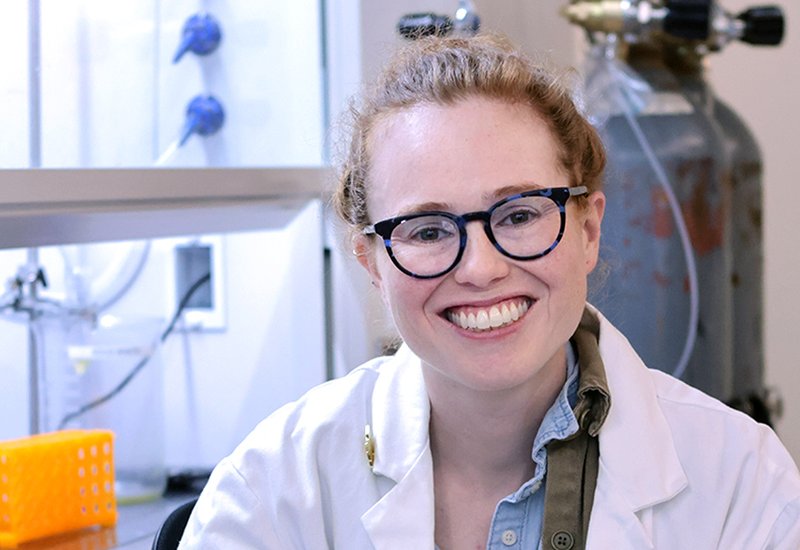
Katherine Albanese returned to Wake Forest University in 2024 to launch an independent research program, eight years after earning her bachelor's degree in chemistry at the same institution. The intervening years took her through doctoral training at UNC Chapel Hill and postdoctoral work at the University of Bristol, assembling a toolkit that spans molecular recognition, protein engineering, and computational design.
Her doctoral research in former APS President, 2017–2019, and 2023 Vincent du Vigneaud awardee, Marcey Waters' laboratory addressed a fundamental question in epigenetics: how do reader proteins distinguish methylated lysine from its unmodified form on histone tails? In work published in ACS Chemical Biology in 2020 and featured on the journal's cover, Albanese and colleagues created chromodomain variants with enhanced affinity for H3K9 methylation marks. These "super binders" achieved the tightest reported reader–H3K9me interaction at that time, offering alternatives to antibodies for detecting histone modifications in research and potentially in diagnostics. As it happens, that cover was designed by Lars Sahl, who now manages this website and digital presence. It is a small world.
Related work probed the underlying molecular recognition more deeply. Albanese dissected the noncovalent interactions governing methylated lysine recognition, particularly cation-π contacts between the trimethylammonium group and aromatic residues lining the binding pocket. A 2022 publication in the Journal of the American Chemical Society extended this analysis to sulfonium-π interactions, comparing trimethylsulfonium and trimethylammonium binding and demonstrating that polarizability and solvation differences make sulfonium the stronger partner. The findings have implications for understanding S-adenosylmethionine-dependent methyltransferases, enzymes central to cellular methylation chemistry.
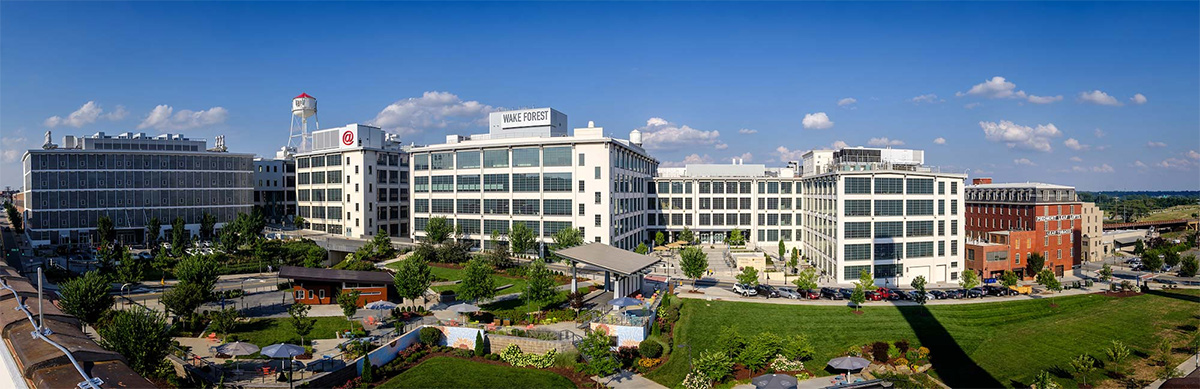
The Downtown Campus at Wake Forest University, Winston-Salem, NC
Postdoctoral training with Dek Woolfson at Bristol, a 2025 Vincent du Vigneaud awardee, shifted her focus toward building proteins from scratch. The Woolfson laboratory has long explored α-helical coiled coils, and Albanese contributed to extending this work into single-chain proteins with defined architectures. A 2024 publication in Nature Chemical Biology, on which she shares first authorship, describes a computational pipeline for designing α-helical barrel proteins starting from validated peptide assemblies. The approach seeds designs with sequences known to form the desired oligomeric states, then uses loop-building algorithms to connect helices into monomeric proteins. The resulting barrels contain central channels capable of binding small molecules, a feature with obvious utility for sensor and catalyst design.
The Albanese Lab at Wake Forest now bridges these two research threads from its space at Wake Downtown. Histones present a particular challenge for computational design: their tails lack stable three-dimensional structure, which confounds algorithms trained on well-folded proteins. Albanese is adapting computational pipelines to work from sequence rather than structure, a fundamentally different problem. Her design philosophy emphasizes what she terms rational seeding — identifying key molecular features known to mediate recognition and using them as starting points, rather than allowing algorithms to explore sequence space without guidance.
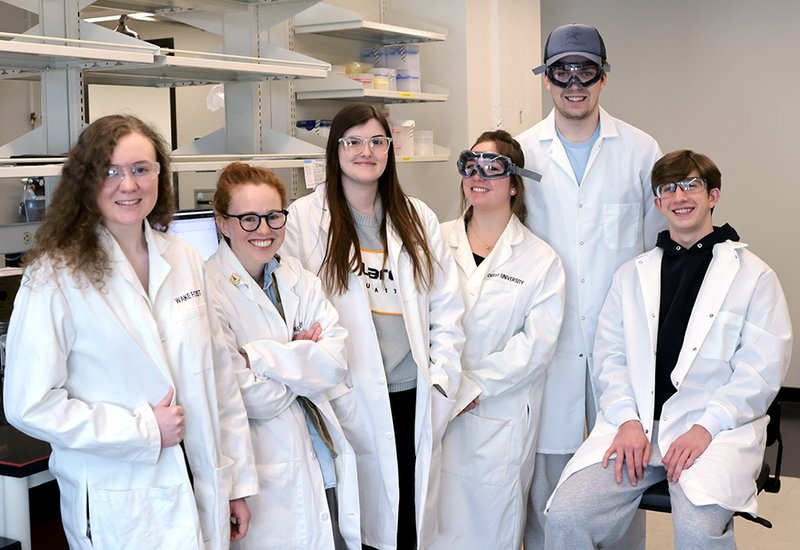
The group has grown quickly to include two graduate students, twelve undergraduates, and two high school researchers. Joel Chubb, a postdoctoral fellow who worked with Albanese in the Woolfson group at Bristol, spent a year in the lab before moving to Nick Polizzi's group at Dana-Farber Cancer Institute. Polizzi, himself a former postdoc of Bill DeGrado, adds another thread in the tightly woven fabric of the peptide community. "It brightens my day to spend time in the lab with my students and see them grow and develop as independent thinkers and creative scientists," Albanese says of her current group. Her early publications suggest this is a lab to watch, and we look forward to hearing more from her.