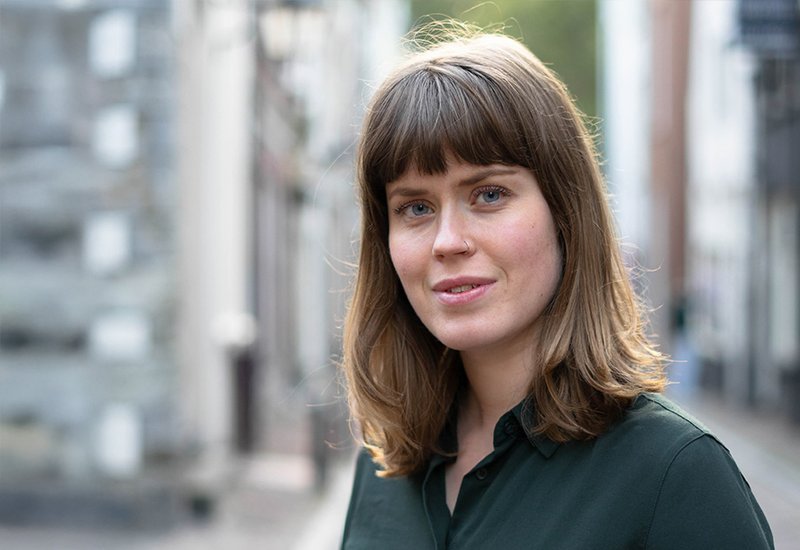
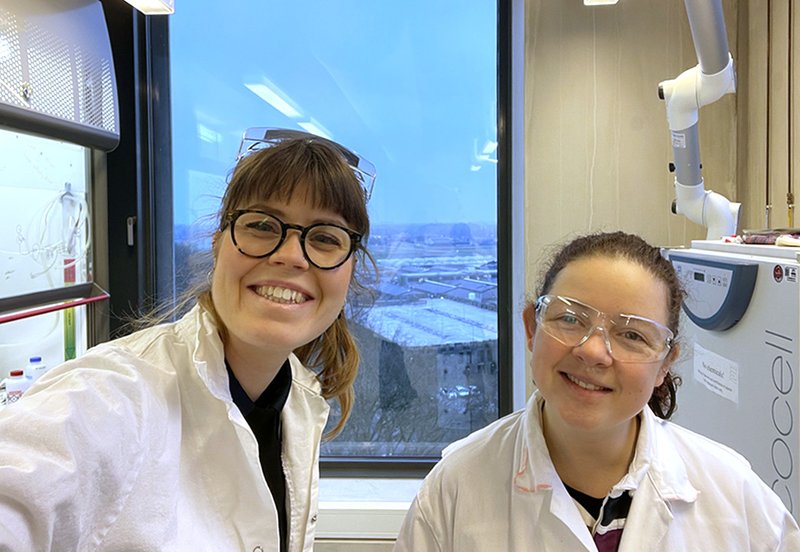
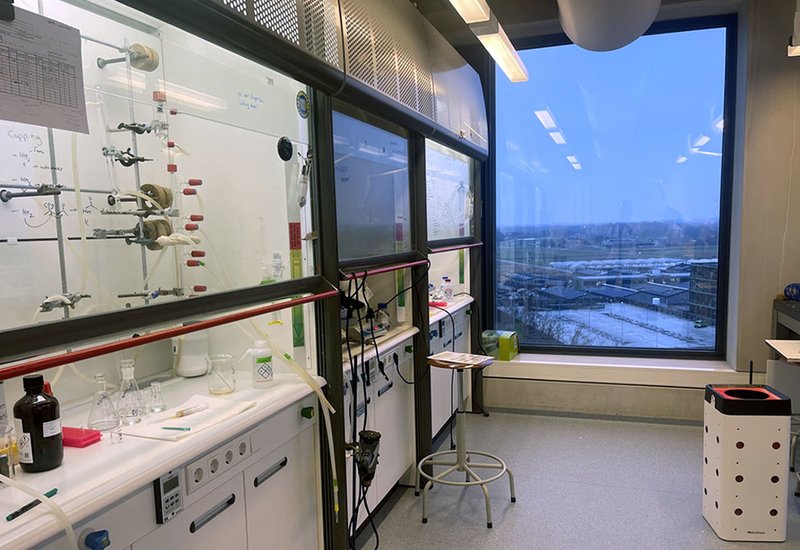
The transition from postdoctoral fellow to independent investigator remains one of the most demanding passages in academic science. Finding the right institutional fit, securing start-up funding, recruiting talented students, and carving out a research identity distinct from doctoral and postdoctoral mentors all collide at once. For Eva Meeus, who launched her laboratory at Wageningen University in January 2026, this moment arrives at the intersection of two fields she has spent years mastering: bioorthogonal catalysis and peptide chemistry.
Eva earned her doctorate at the University of Amsterdam in early 2024, working under Joost Reek and Bas de Bruin on transition metal catalyzed nitrene and oxygen atom transfer reactions performed in water. The choice of aqueous solvent was intentional. Conventional organometallic catalysis typically demands anhydrous conditions, but biological systems operate in water. Her thesis explored how cobalt and copper complexes could perform aziridination and sulfimidation reactions under conditions compatible with living cells, laying the groundwork for catalysts that might one day function inside the body.
During her doctoral studies, an HRSMC Mobility Grant sent her to Thomas Ward's laboratory in Basel, where she gained hands-on experience with artificial metalloenzymes, hybrid constructs that embed synthetic catalysts within protein scaffolds. That collaboration produced a cobalt TAML based system capable of asymmetric oxygen atom transfer, published in Chemical Communications. "This was one of the most formative periods of my Ph.D.," Meeus recalls, "where I explored a completely new field in a completely new lab, surrounded by completely new people. You can imagine how far I was out of my comfort zone! But it was fantastic." The exposure reinforced a conviction that peptides could serve not merely as drug targets but as ligand scaffolds themselves, protecting reactive metal centers from the chaotic environment inside cells. "I can recommend all Ph.D. students, if possible, to do a short visit abroad," she adds. "It not only challenges you to step out of your comfort zone, quickly adapt, and build resilience, it also teaches you exciting new chemistry and gives you the chance to make new friends with whom you can explore the beauty of a new country."
An NWO Rubicon Postdoctoral Fellowship brought Meeus to ETH Zurich and the group of Bill Morandi, where she turned her attention directly to peptide modification. The shift was substantial. "Going from transition-metal catalysis to peptide synthesis and diversification via skeletal editing, not a single metal was involved in the latter!" she laughs. "Nonetheless, changing fields has been really shaping as well. Having learned so much about peptide chemistry now enables me to synthesize and explore peptides as ligands for catalyst development." Her postdoctoral work focused on late-stage diversification of tryptophan-containing peptides through nitrogen atom insertion, a method that allows chemists to edit peptide drugs after synthesis rather than redesigning them from scratch. The resulting paper appeared in the Journal of the American Chemical Society in 2025, and is featured here on the APS website.
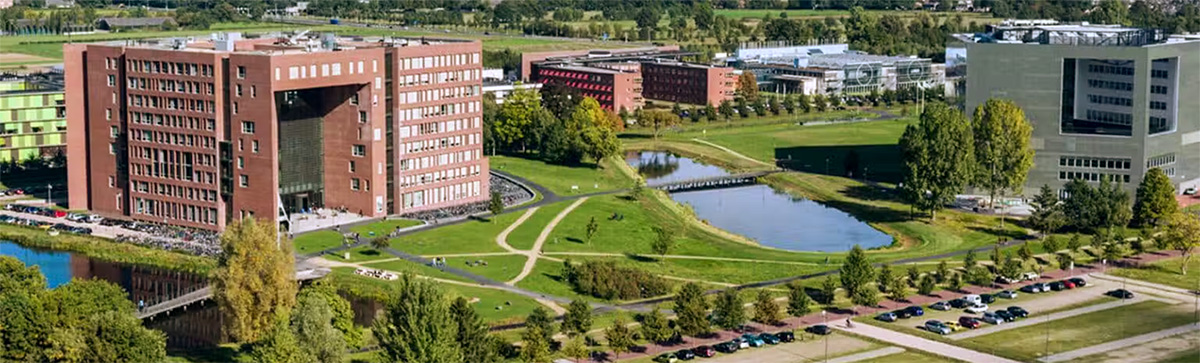
The Wageningen University and Research Campus in the Netherlands
The Meeus Lab at Wageningen now merges these threads. "I have the pleasure to start my lab together with Lieke Huls, who accepted the challenge to combine her teaching job with research," Meeus notes. Lieke earned her BSc in Chemistry and MSc in Molecular Chemistry at Radboud University, where she worked in Roeland Nolte's group on the synthesis and catalytic activity of double porphyrin cages. Since 2023 she has been part of the teaching team at Wageningen's Laboratory of Organic Chemistry. In January 2026 she began a part-time Ph.D. under Meeus's supervision, making her the lab's founding graduate student. "My lab is embedded within the chair group Organic Chemistry, formally known as the Laboratory of Organic Chemistry," Meeus adds. "Here we have all the state-of-the-art equipment and infrastructure to make a swift start." One research line develops peptide-based ligand scaffolds that host and shield transition metals, enabling new-to-nature reactions inside cells. A second line targets prodrug activation, designing catalytic systems that convert inactive molecules into therapeutics precisely where needed in the body. Both programs demand expertise in organometallic chemistry, peptide synthesis, and biological assay development, a combination Meeus has assembled across three countries and four research groups.
The Dutch funding landscape will shape how quickly these ambitions materialize. The NWO Talent Programme offers a clear progression: Veni grants support researchers within three years of their doctorate, providing up to 320,000 euros to establish independence. Vidi grants, available within eight years, offer 850,000 euros to build a small group. The top tier, Vici, provides 1.5 million euros for senior investigators. Success rates are competitive. Winning even one of these awards can define a Dutch academic career, and Meeus has already demonstrated her ability to secure external funding with the Rubicon fellowship that took her to Zurich.
Recognition has come quickly. In 2025 alone, Meeus was named a CAS Future Leader and selected for the Lindau Nobel Laureate Meeting, honors that place her among the most promising young chemists in Europe. "Both programs have been excellent platforms to meet peers and exchange perspectives, experiences, but even the occasional struggles," she reflects. "Being part of a supportive community is invaluable. That is why I am really excited to join the APS community!"
Whether the Meeus Lab becomes a lasting force in peptide-catalysis will depend on the next few years: the students she recruits, the grants she wins, and the problems she chooses to pursue. For now, the pieces are in place.
We welcome Eva into the APS community and look forward to following her progress here and at future APS symposia.