A Visual Feast at the Bilayer
In the summer of 2015, Hua-De Gao landed in Orlando for what would be his first trip abroad alone. He had pre-booked an airport shuttle. Outside the terminal, a confident driver ushered him into a car. By the time they reached the hotel, the driver had handed over a business card and confessed that he had picked up the wrong passenger, then proposed a tidy solution: cancel the original booking, pay in cash for this ride, and he would return at the end of the week to drive Gao back to the airport. Gao agreed. On departure day, the number on the card was a dead line. The hotel owner offered a sympathetic look. He had been scammed.
Gao tells the story now to capture something essential about himself. "My default is trust," he says, "and my response to adversity is resilience." It is also, by accident, the reason he became a peptide scientist. The trip to Orlando was the 2015 American Peptide Symposium. Between the scam and the dead phone line, sitting in lecture halls and standing in front of posters, Gao realized that these tiny biomolecules could drive massive medical breakthroughs. The spark caught.
The road to Orlando had begun with a B.S. in Life Science, an M.S. in Molecular Biology focused on prion proteins, and a deepening conviction that biological questions tend to bend, eventually, toward chemistry and physics. By the time Gao arrived at the symposium he was already searching for the right vocabulary to ask the questions he wanted to answer. The talks in Orlando gave him the language. Peptides could be designed, modified, conjugated. They could remodel membranes. They could carry payloads. The mechanisms were strange and beautiful and, importantly, accessible.
Gao returned to Taiwan and joined the Department of Chemistry at National Taiwan University, where he was co-advised by Professor Yu-Ju Chen and Professor Hsien-Ming Lee at Academia Sinica. His doctoral thesis, "Design of Trigger-Responsive Membrane Lytic Peptides and Smart Peptidyl Liposomes," staked out the territory he has continued to occupy: peptides that interact productively with lipid bilayers, but only when conditions allow them to. The transdisciplinary path from life science through molecular biology to chemistry and biophysics, he says, taught him that biological problems often require chemical solutions and physical validations. It trained him not just to run assays, but to bridge different scientific languages.
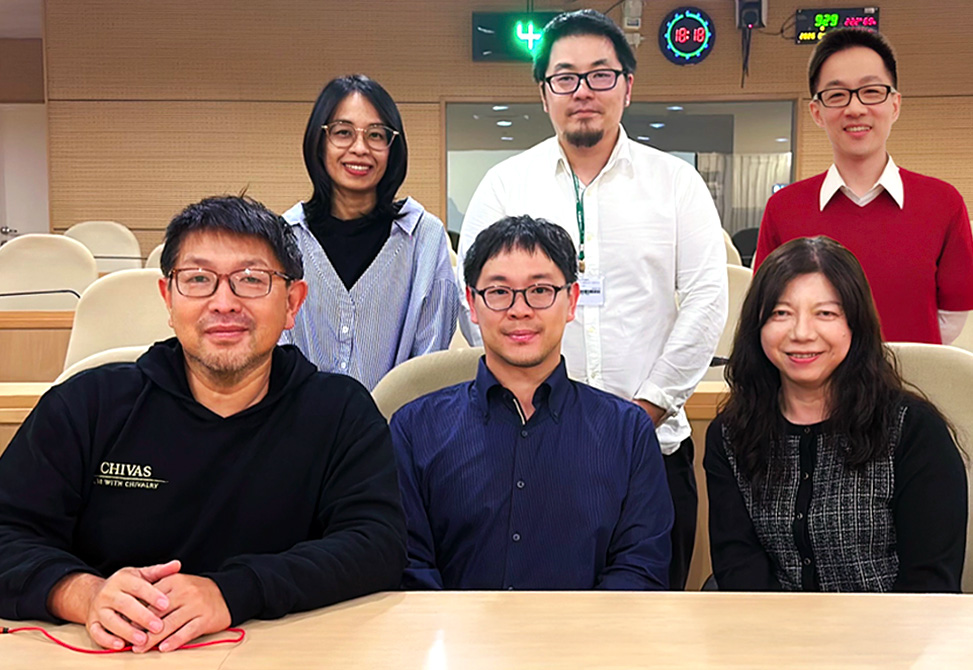
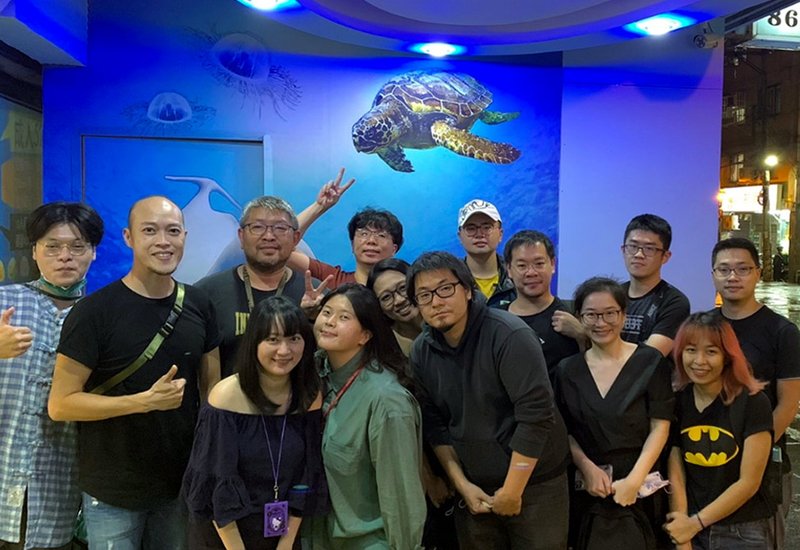
Celebrating our JACS publication with Prof. Lee and Prof. Chen
Gao remained in the Hsien-Ming Lee Lab as a postdoctoral fellow, a role he describes as closer to research assistant professor than trainee. The transition let him push from mechanism toward translational application without losing momentum. His current focus is unary trigger-responsive peptidyl liposome drug delivery, a system in which the peptide must be conjugated to the membrane surface yet not act prematurely, then must act decisively when triggered. Peptide-to-membrane interactions in this conjugated mode had not been well studied before, and the gap had been a barrier to progress in the field. The work that resolved it appeared earlier this year in J. Am. Chem. Soc., providing the mechanistic insights that allow stable encapsulation and effective trigger-responsiveness in the same construct. An earlier paper in ACS Nano, on a near-infrared-activatable enzyme platform built on upconversion nanoparticles, had foreshadowed the design philosophy that runs through his work: build something that stays quiet until invited to perform.
When asked which methods feel central to his work, Gao names two pillars: the design of trigger-responsive membrane-active peptides, and advanced structural analysis. Circular dichroism and fluorescence are present in the toolkit, but the instruments that excite him most are cryo-EM and small-angle X-ray scattering. SAXS and cryo-EM let him structurally and visually decipher how peptides interact with lipid membranes at a near-molecular level. He describes the experience without restraint. "It's a visual feast of light, structure, and biology." The phrase captures something about the way Gao approaches science, which is less as a measurement problem and more as a perceptual one. He wants to see the mechanism happen.
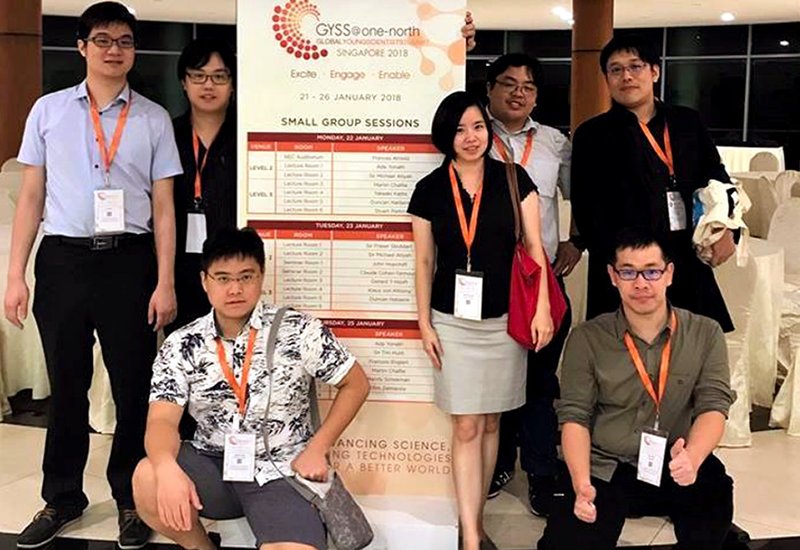
Two events outside the lab have shaped him as much as any experiment. The first was the 2015 Orlando symposium that drew him into peptide science. The second was an invitation in 2018 to attend the Global Young Scientists Summit in Singapore, where extended conversations with Nobel laureates instilled what he calls a big-picture mindset: the habit of asking, before any experiment, what the largest question is and which adjacent disciplines might already have part of the answer. The mindset suits a researcher who has crossed three subfields and watched each one yield insights the others could not.
Gao speaks with consistent warmth about the people who shaped his trajectory. Dr. Hsien-Ming Lee has been a constant guiding force since he joined the group, and the rigorous co-supervision from Dr. Yu-Ju Chen during his Ph.D. taught him how to apply systematic scientific thinking to ambiguous problems. The Feodor Lynen Fellowship from the Alexander von Humboldt Foundation, awarded to him as a postdoctoral researcher, sits alongside beamtime allocations and the GYSS invitation as recognitions of an arc that his advisors have been quietly tracking for some time.
When the bench gets heavy, Gao reaches for two practices that have stayed with him since his student years. The first is cycling along the riverside parks and scenic bikeways that thread through Taipei. The rhythmic pedaling, he says, helps the heavy pressures of the lab fade away. The second is karaoke, which he describes as a conversation with himself: the resonance and rhythm of music let him recharge his resilience for the next challenge at the bench. He has not returned to an American Peptide Symposium since the 2015 trip that first drew him in, but he is looking ahead to APS2027 in Boston as the moment to reconnect with the field that gave him his calling.
Ten years on, the scammer's business card is long gone. The light from that first Orlando trip has not dimmed.