Mapping the Invisible
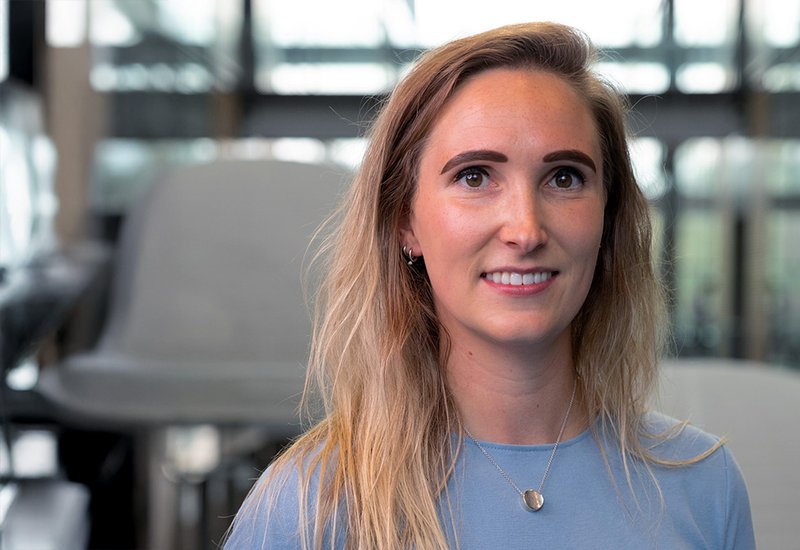
Danielle Morgan had just submitted her Ph.D. thesis at the University of Glasgow when she boarded a flight to Whistler for the 27th American Peptide Symposium in June 2022. The airline lost her luggage. With a flash talk scheduled for the first morning, she dashed to local shops and found the only remotely presentable footwear available: a pair of sandals. She gave her presentation in them. After the session, she went bungee jumping off a bridge over a river. Her PI, terrified of heights, refused to hold her phone to film it, so she handed it to a nearby taxi driver. After the jump, he told her he had accidentally dropped her phone into the river. She panicked, until he revealed he was joking.
It was, she admits, a stressful day. But it captures something essential about Danielle: she will find a way through, and she will take the leap.
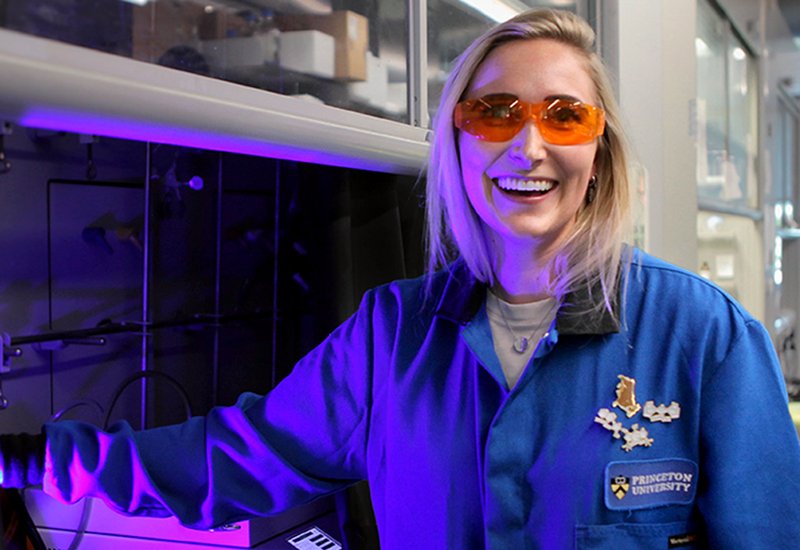
Now a third-year postdoctoral researcher in the MacMillan Group at Princeton University, Danielle works at the intersection of peptide science and chemical biology. Her research applies µMap, a photocatalytic proximity labeling platform developed in the MacMillan lab, to map how peptides interact with proteins in living cells and intact tissues. In particular, she is tackling one of the most formidable challenges in therapeutic development: understanding how peptides cross the blood-brain barrier.
The blood-brain barrier protects the central nervous system but also blocks most drugs from reaching the brain. Cell-penetrating peptides can cross this barrier, yet the molecular mechanisms underlying their transport remain poorly understood. Danielle's recent work, published on bioRxiv, demonstrates how µMap can reveal the receptors and intracellular trafficking pathways that enable peptide transcytosis. By controlling the timing of light activation, the platform captures time-resolved snapshots of peptide-protein interactions as they unfold—a kind of molecular cinema capturing what was once invisible.
The discoveries are already yielding surprises. Her work has revealed that certain cell-penetrating peptides undergo glycosylation during transcytosis, a post-translational modification that may influence their trafficking and fate. Such insights could reshape how researchers design brain-targeted therapeutics.
Danielle's path to Princeton began in Glasgow, where she completed both her undergraduate degree and her Ph.D. under the supervision of Professor Andrew Jamieson. Her doctoral research focused on stapling strategies for alpha-helical peptides—the chemical crosslinks that lock peptides into their bioactive conformations and improve their drug-like properties. She developed a novel diyne-girder stapling methodology that produces peptides which are not only helical and protease-stable but also Raman-active, enabling their visualization in cells without fluorescent labels.
The Jamieson lab's collaborative culture and Glasgow's state-of-the-art facilities shaped her scientific identity. During the pandemic, she contributed to rapid-response efforts to develop stapled ACE2 peptidomimetics targeting the SARS-CoV-2 spike protein, work that tested both the promise and the limits of peptide-based interventions against emerging pathogens.
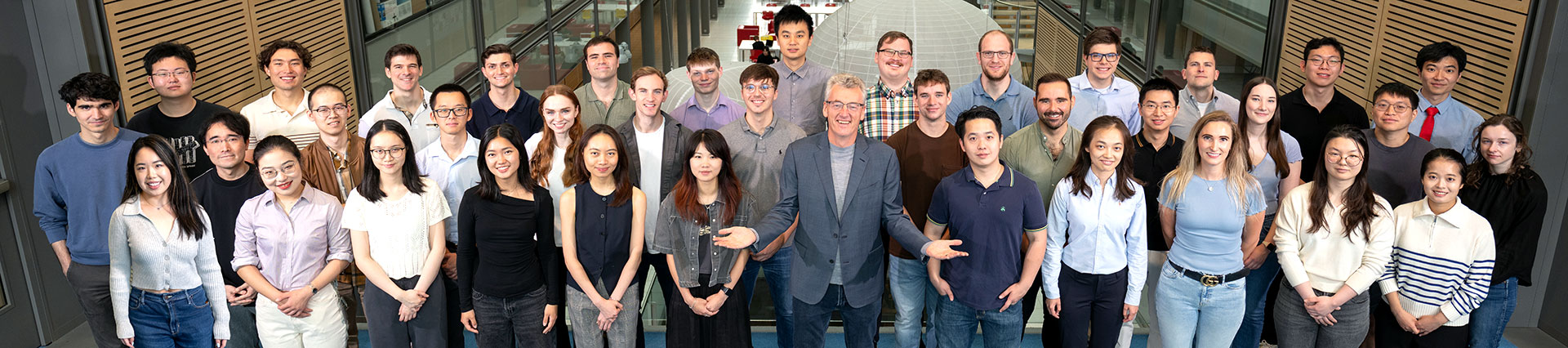
The MacMillan Group at Princeton
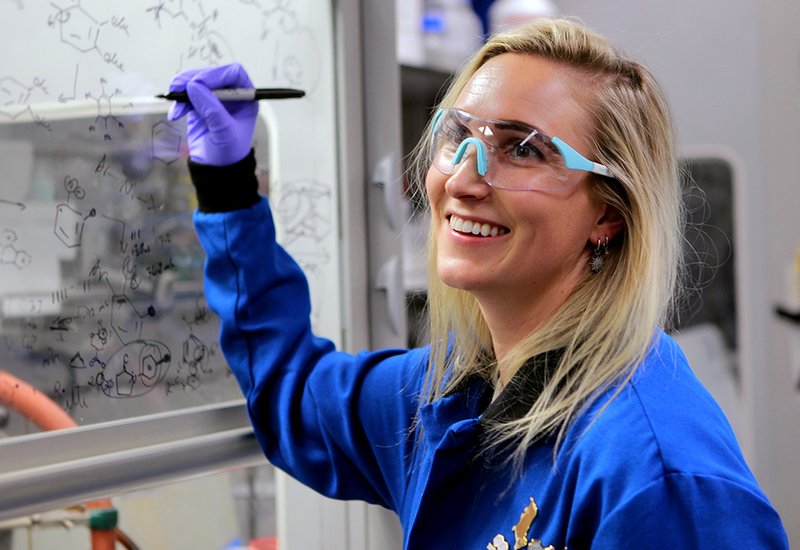
Photo by C. Todd Reichart
Moving from Scotland to New Jersey meant more than a change of scenery. Danielle sought a postdoctoral position that would challenge how she thinks, not just which techniques she uses. The MacMillan group offered exactly that: a chance to pivot toward chemical biology and translational research while continuing to develop new chemical tools. Working alongside pharmaceutical partners has also shaped how she approaches biological questions, keeping one eye on therapeutic application.
What first drew her to peptides, Danielle says, is their position between small molecules and biologics—chemically tunable yet biologically sophisticated.
What keeps her excited is watching the field deliver on that promise. Peptide therapeutics for diabetes, obesity, and other diseases are now reaching patients. The molecules she studies are no longer just academic curiosities.
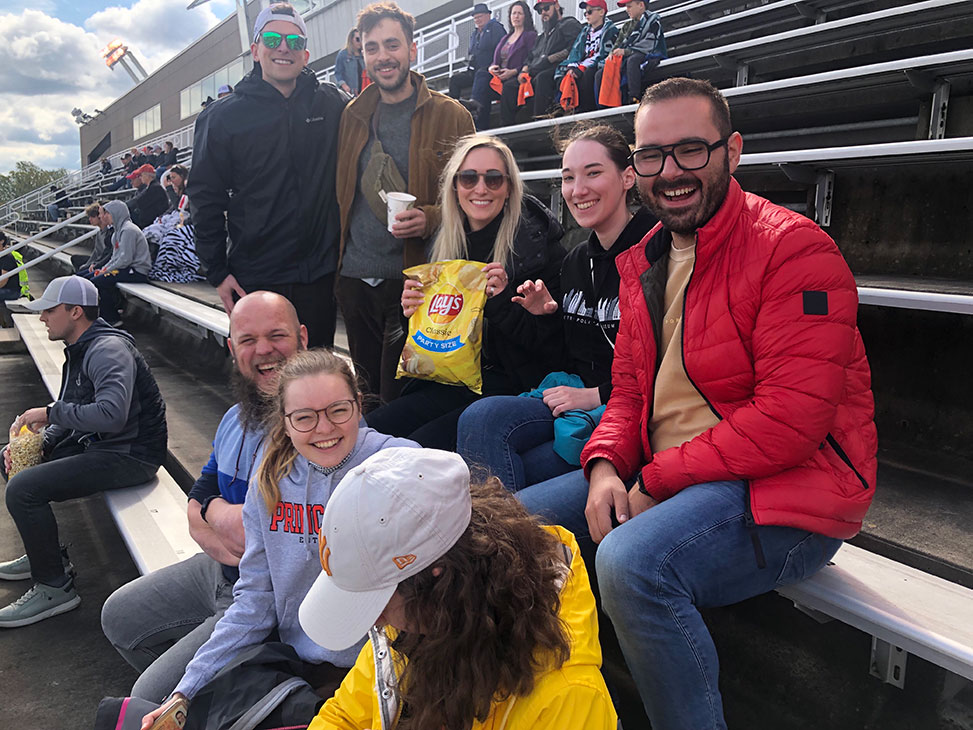
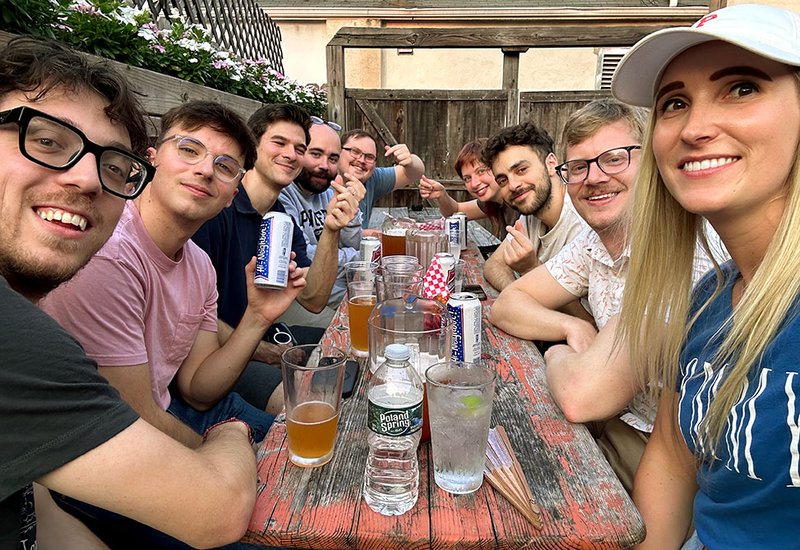
MacMillan group members supporting local sports.
After nearly a decade in Scotland, Danielle has embraced her new American surroundings. She hikes in upstate New York in the fall, visits the Jersey Shore in summer, and has discovered the particular energy of Princeton football games and Phillies baseball. The sports culture, she notes, is different from back home—and fun.
For graduate students considering a postdoc position abroad, Danielle's advice is direct: choose something that challenges how you think. Moving abroad is demanding, but the rewards—both scientific and personal—are real.
She would know. She gave a talk in sandals, jumped off a bridge, and kept going.
Danielle Morgan is a Postdoctoral Researcher in the MacMillan Group, Department of Chemistry, Princeton University, Princeton, New Jersey, USA.