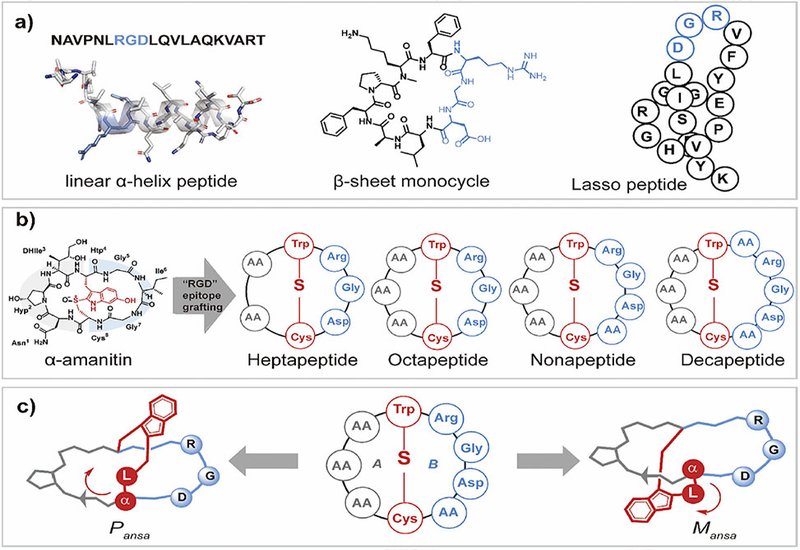
Integrin αvβ6 is upregulated across multiple tumor types and drives cancer invasion and metastasis, making it an attractive target for precision oncology. Peptide ligands for αvβ6 range from the linear 20-mer A20FMDV to engineered lasso peptides, yet each scaffold carries limitations: poor plasma stability, insufficient selectivity across the integrin family, or inadequate lysosomal trafficking that undermines cathepsin B-mediated payload release in peptide-drug conjugates, PDCs. Bicyclic peptides offer higher conformational rigidity and lower binding free energy than linear or monocyclic counterparts, but the conformational space of bicyclic scaffolds has not been fully exploited for integrin targeting.
Researchers in the Yao Group at the Greater Bay Area Institute of Precision Medicine and Fudan University, the Wang Group at Sun Yat-sen University, and the Süssmuth Group at Technische Universität Berlin, published in Angewandte Chemie International Edition, grafted the RGD motif into an amanitin-derived bicyclic scaffold and systematically varied ring size from 7-mer to 10-mer. Exploiting the amanitin tryptathionine crosslink as a conformational clamp, they pursued both Pansa and Mansa ansamer isomers, separable by RP-HPLC and assignable by UV absorption maxima at λ = 289 nm and λ = 293 nm, respectively. A competitive solid-phase binding ELISA against six integrin subtypes, αvβ3, αvβ5, αvβ6, αvβ8, α5β1, and αIIbβ3, guided iterative structure-activity relationship analysis, and biolayer interferometry confirmed binding kinetics for lead isomers.
Among first-generation bicycles, the 9-mer 5-Mansa showed selective αvβ6 inhibition with an IC50 of 7.9 ± 4 nM, whereas its counterpart 5-Pansa was some 36-fold weaker. Substituting L-Leu with cyclohexylglycine, Chg, yielded 10-Mansa with an IC50 of 6.5 ± 1 nM against αvβ6 and negligible activity against all other tested integrins above 185 nM. Biolayer interferometry confirmed a KD of 8.23 ± 0.84 nM for 10-Mansa against αvβ6, compared with 243 ± 56 nM for 10-Pansa, a roughly 30-fold gap driven entirely by conformational identity. Single-particle cryo-EM of the αvβ6 headpiece bound to 10-Mansa at 2.88 Å overall resolution revealed that the Arg sidechain forms two pairs of hydrogen bonds with D218 of the αv subunit, the Asp coordinates the MIDAS Mn2+ ion and hydrogen-bonds S127 in β6, and the cyclohexyl sidechain of Chg engages in hydrophobic contacts with Ile183 and the disulfide bond within the β6 SDL2 loop. This last interaction explains αvβ6 selectivity: Ile183 is replaced by bulkier or polar residues in β3, β5, β8, and β1 subunits, disfavoring cyclohexyl accommodation.
A conjugation-ready analogue, 14-Mansa, retained αvβ6 potency at IC50 = 11 ± 5 nM and showed plasma stability with a t1/2 ≥ 24 h, outperforming monocyclic S7 at 10.3 h and linear Pra-A20FMDV at 4.1 h. Cy5-labeled 14-Mansa bound selectively to HEK293-αvβ6 transfectants, co-localized with the lysosomal marker LAMP1, and persisted in PC-9 non-small cell lung cancer xenograft tumors for 24 h post-injection in vivo, whereas Cy5-A20FMDV signal was undetectable beyond 2 h. PDC2-M, pairing 14-Mansa with monomethyl auristatin E via a GGFG cathepsin B-cleavable linker, achieved tumor growth inhibition of 95% and 97% at 1.0 and 2.0 mg/kg, respectively, in the PC-9 xenograft model with no significant body weight loss or liver or kidney toxicity. In DLD-1 colorectal xenografts, PDC2-M showed no activity, consistent with αvβ6 expression being more than fivefold lower in DLD-1 tumors than in PC-9 tumors in vivo, confirming target-dependent efficacy.
This work establishes the ansamer concept as a practical tool for expanding the pharmacophore space of bicyclic peptides: a single conformational flip between Mansa and Pansa can convert a potent, selective integrin binder into an essentially inactive one. The cryo-EM structure at 2.5 Å local resolution provides an atomic-level rationale for that selectivity, pointing to Chg-Ile183 hydrophobic contacts as a designable handle for αvβ6 specificity. The lysosomal trafficking of 14-Mansa addresses a key limitation of A20FMDV-based PDCs and opens a path toward bicyclic peptide-toxin conjugates with improved tumor-selective delivery across αvβ6-expressing cancers.