Multiple sclerosis, MS, is driven in part by autoantibodies that attack myelin proteins including GlialCAM, myelin basic protein, MBP, and myelin oligodendrocyte glycoprotein, MOG. Existing disease-modifying therapies blunt this assault by depleting B-cell or T-cell populations wholesale, an approach that carries serious risks of opportunistic infection, malignancy, and rebound syndrome upon discontinuation. A more targeted strategy would intercept the pathological antibodies themselves, occupying their antigen-binding sites before they can engage myelin-derived proteins. The obstacle is diversity: each autoantigen attracts a pool of structurally heterogeneous autoantibodies, and designing a separate decoy for every antibody variant is not practical. What is needed is a single molecule capable of blocking many variants at once, without disrupting the normal antibodies that protect against infection.
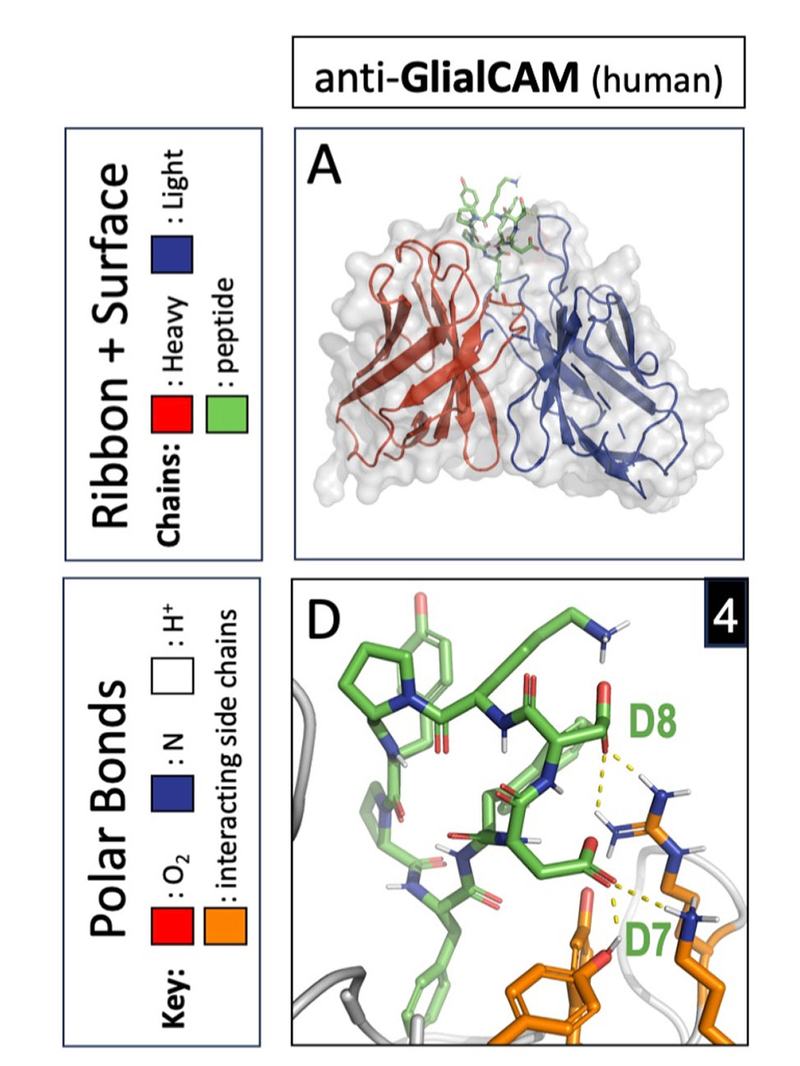
Researchers in the Kumar Lab at New Jersey Institute of Technology (NJIT) and the University of Houston, published in the European Journal of Medicinal Chemistry, reasoned that the CDRL3 loop of MS-associated autoantibodies offered the right target. Structural alignments of 23 patient-derived antibodies against GlialCAM, MBP, and MOG revealed that CDRL3 loops are comparatively uniform in shape and length, roughly 8 to 11 residues, even when their sequences diverge. The team used iterative PyRosetta and FlexPepDock simulations to identify a common binding stub, Pro-Phe-Trp, that docked favorably into CDRL3 pockets across all three representative autoantibodies. Successive design rounds built out the full sequence around that stub, converging on the 8-mer cyclic peptide KPYPFWDD, which they named CAP8. Molecular dynamics simulations confirmed persistent occupancy of the antibody binding pocket over 100 ns, and in vitro validation by microscale thermophoresis measured a KD of 0.294 mM for CAP8 binding to human anti-GlialCAM autoantibody, roughly nine-fold tighter than a scrambled cyclic control, with no significant binding to a representative non-pathological human anti-influenza antibody.
The work establishes a proof-of-principle computational workflow for designing broad-spectrum autoantibody decoys that spare normal immunity. The authors position CAP8 as a potential complement to existing T-cell-directed therapies, and propose future studies in experimental autoimmune encephalomyelitis models to evaluate in vivo dosing and efficacy. Because the same CDRL3-targeting logic could apply to other antibody-mediated autoimmune diseases, the platform may generalize well beyond MS.