Invasive fungal infections kill roughly 3.8 million people each year, and the problem worsens as antifungal resistance spreads. Candida species rank among the major contributors. Ribosomally synthesized and post-translationally modified peptides, RiPPs, offer a growing reservoir of bioactive scaffolds, and lanthipeptides are one of the largest RiPP families. Until now, antifungal activity within the lanthipeptides had been documented only once, in the class I pinensins from Chitinophaga. Whether any class II lanthipeptide could match it stayed an open question, and a gene cluster in Nostoc punctiforme PCC 73102 offered a promising, if underexplored, lead.
Researchers in the van der Donk Group at the University of Illinois at Urbana-Champaign, published in Biochemistry, characterized the products of the npu biosynthetic gene cluster. They coexpressed the precursor peptide NpuA, fused to an N-terminal SUMO tag to boost yields, with the class II lanthipeptide synthetase NpuM in Escherichia coli, then released the fully cyclized core with the protease LahT150. Tandem mass spectrometry with Interactive Peptide Spectral Annotator annotation, site-directed mutagenesis of individual Cys and Ser residues, and Marfey's analysis assigned ring connectivity and stereochemistry. A panel of antimicrobial and membrane-activity assays established potency and mode of action, and the acetyltransferase NpuN was characterized separately in vitro across a range of acyl-CoA cosubstrates.
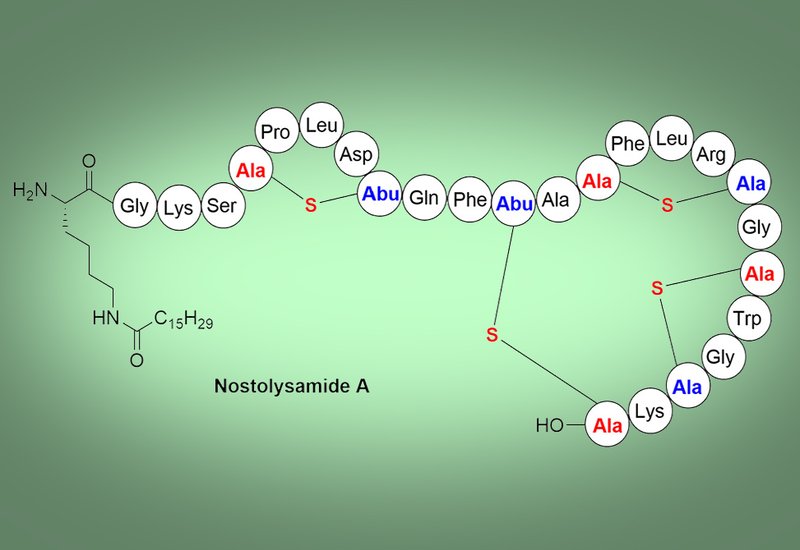
NpuM installed four dehydrations and closed all four rings: an N-terminal methyllanthionine ring between Cys5 and Thr9, and three overlapping rings at the C-terminus, with lanthionine bridges between Ser18 and Cys14 and between Ser23 and Cys20, and a methyllanthionine ring between Thr12 and Cys25. Marfey's analysis confirmed that all four residues carry the DL configuration. Mutagenesis pinned down the overlapping C-terminal rings: the NpuA-C25A variant, which disrupts only the outermost macrocycle, still formed a cleanly 4-fold dehydrated, correctly cyclized product with retained DL stereochemistry. NpuM belongs to the ProcM clade and forms rings in both C-to-N and N-to-C directions, a hallmark of this cyanobacterial subgroup, in which the substrate sequence, not the enzyme, governs regioselectivity.
The core peptide after leader removal, named nostolysamide C, inhibited Bacillus subtilis 168 and three Candida species, including Candida albicans SN250, Candida glabrata, and Candida tropicalis, at concentrations as low as 6.25 μM. Time-kill experiments showed fungicidal rather than fungistatic action. A LiaRS reporter assay ruled out lipid II as the target, consistent with fungi lacking lipid II, and a DiSC3(5) assay showed rapid membrane depolarization of C. tropicalis. The tandem-domain GNAT enzyme NpuN transferred acyl groups regioselectively to the ε-amino group of Lys1, with palmitoyl-CoA giving the highest conversion in vitro, matching the C16 products seen during coexpression. Despite this broad tolerance, acylation at Lys1 did not appreciably alter antibacterial or antifungal potency in any assay.
Nostolysamide C extends the chemical space of antifungal lanthipeptides to the class II family and offers a membrane-active scaffold distinct from the class I pinensins in both ring architecture and biosynthetic machinery. Because the Lys1 acyl chain proved dispensable for activity, the biological role of NpuN acylation stays unresolved, and the authors note the answer may require testing against organisms that share the habitat of Nostoc punctiforme PCC 73102. The substrate tolerance of NpuN toward acyl-CoA donors also raises the prospect of using the enzyme as a chemoenzymatic tool to make diversely lipidated RiPPs for structure-activity work.