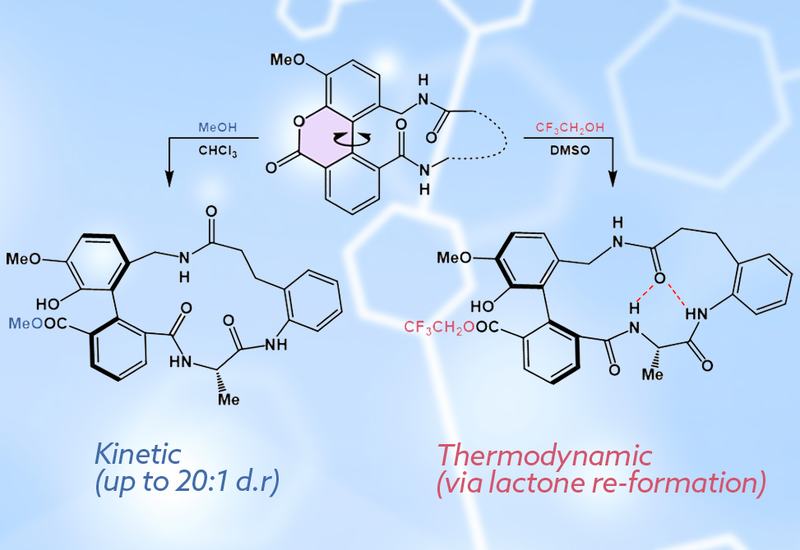
Macrocyclic peptides derive much of their biological relevance from their three-dimensional shape, yet controlling which conformation a macrocycle adopts has remained an unsolved challenge. Biaryl-containing macrocycles can exist as atropisomers, axially chiral forms whose interconversion is slow on the laboratory timescale, but conventional synthesis offers little leverage over which isomer forms preferentially. Photochemical switches and thermal equilibration can nudge conformational populations, yet both are limited to π-bond isomerizations or require elevated temperatures that place harsh demands on the molecule. What has been missing is a ground-state chemical reaction that directly selects a macrocyclic conformation as its product, with kinetic and thermodynamic outcomes separately accessible through choice of conditions.
Researchers in the Yudin Group at the University of Toronto and the Dudding Group at Brock University, published in J. Am. Chem. Soc., recognized that Bringmann's lactone, a bridged biaryl motif long used in small-molecule atropisomer synthesis, could serve as precisely this kind of conformational switch when embedded within a macrocyclic peptide framework. The bridging lactone lowers the rotational barrier about the biaryl axis, allowing the two atropisomeric lactone conformers to equilibrate rapidly. Because that equilibration is far faster than nucleophilic ring-opening at room temperature, the system satisfies Curtin–Hammett conditions: the product ratio reflects the relative energies of the two ring-opening transition states, not the ground-state atropisomer distribution. In nonpolar CHCl3 with methanol as the nucleophile, base-mediated ring-opening kinetically traps the less stable atropisomer in up to 96:4 diastereomeric ratio. Switching to DMSO with trifluoroethanol reverses the outcome: the product undergoes transient lactone reformation via neighboring phenol participation, allowing equilibration to the more stable conformer. NMR-assisted molecular dynamics and X-ray crystallography confirm that the two atropisomers occupy genuinely distinct regions of conformational space.
The ability to select macrocyclic conformation through a single late-stage chemical step, rather than through total resynthesis or photochemical intervention, opens a practical route to conformational diversity from a common scaffold. The reversible lactone equilibrium also functions as a molecular balance for quantifying subtle noncovalent interactions within macrocyclic frameworks. For peptide scientists designing conformationally defined ligands or probing structure–activity relationships, this strategy offers a tuneable handle on three-dimensional shape, with full substrate scope, transition-state analysis, and conformational characterization reported in the original publication.