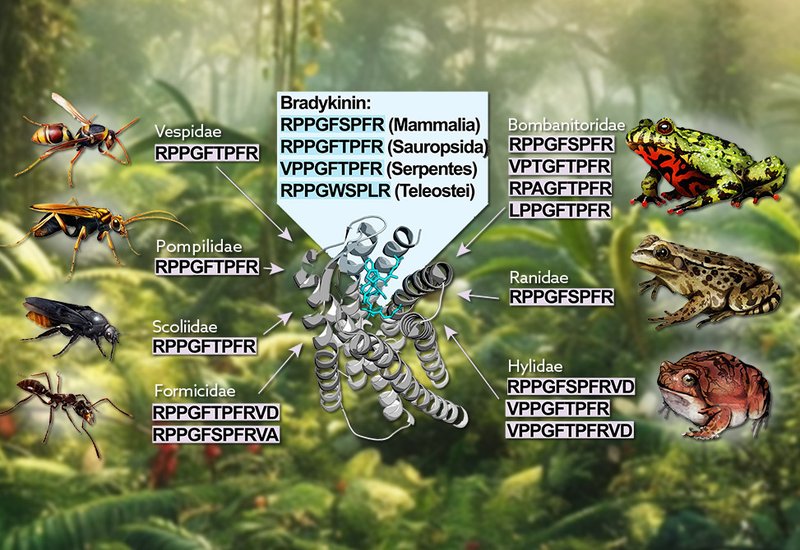
Bradykinin is a nine-amino acid peptide hormone found in vertebrates. Released from its precursor protein kininogen in response to tissue damage, it causes local vasodilation, increased vascular permeability, and both acute and long-lasting pain through its action on bradykinin receptors. For decades, researchers noted that strikingly similar peptides appeared in the venoms of certain wasps and ants and in the defensive skin secretions of some frogs. The assumption was that these molecules shared a common evolutionary ancestor with the vertebrate hormone. New research now overturns that assumption entirely.
Researchers in the Robinson Group at the University of Queensland, published in Science, demonstrated that bradykinin-like peptides found in hymenopteran venoms and anuran skin secretions evolved completely independently of vertebrate bradykinin. Rather than descending from the vertebrate kininogen gene, these molecules arose through duplication and neofunctionalization of unrelated toxin-encoding gene families, and this happened on at least four separate occasions within the order Hymenoptera and at least three times within the Anura. The research team used venom gland transcriptomics, mass spectrometry-based proteomics, phylogenetic reconstruction, and receptor pharmacology to trace the evolutionary history of these peptides across dozens of species. The evolutionary conclusion is remarkable: identical molecules, arrived at independently, from entirely unrelated genetic origins. The study reflects a broad international collaboration, drawing on expertise from the University of Queensland, the CNRS Ecology of Guianese Forests unit in French Guiana, the University of Copenhagen, and the University of Utah.
The functional data are equally striking. Hymenopteran venom bradykinin-like peptides proved to be potent agonists at both mammalian and sauropsidan bradykinin receptors. Several peptides, including Thr6-BK found in vespid, pompilid, and scoliid venoms, produced spontaneous pain behaviors and long-lasting mechanical hypersensitivity in mouse models at doses comparable to endogenous mammalian bradykinin. Responses were blocked by the B2 receptor antagonist Hoe140, confirming receptor-mediated activity. For the frog skin peptides, the team measured receptor potencies of bradykinins from mammals, sauropsidans, teleost fish, and the frog Bombina bombina at four orthologous receptors. Each bradykinin variant showed high specificity for its own species receptor and weak or no activity at others. Crucially, the skin secretions of B. bombina contain peptides identical to mammalian and sauropsidan bradykinin, which are potent at those predators' receptors but inactive at the frog's own bradykinin receptor. Selection clearly favored peptides tuned to the physiology of the predator, not the producer.
This work reframes our understanding of molecular mimicry in nature. The bradykinin-like peptides of wasps, ants, and frogs represent an example of Gilbertian mimicry, in which the model molecule belongs to the target species itself. By evolving toxins that hijack the pain and inflammation machinery of vertebrate predators, these invertebrates and amphibians gain a powerful deterrent without having ever shared evolutionary ancestry with the signaling molecule they mimic. The findings underscore how shared selection pressure can drive unrelated gene families toward convergent solutions at the molecular level. For peptide researchers, the study highlights both the pharmacological potency of short peptide sequences and the remarkable plasticity with which biology can arrive at identical functional outcomes from entirely different genetic starting points.