Protein–protein interactions, PPIs, govern virtually every cellular signaling pathway, and their dysregulation drives disease. Yet PPIs remain stubbornly difficult to drug, especially those mediated by β-strands rather than α-helices. β-strand interfaces present shallow, extended surfaces with recognition handles projected both above and below the plane of the strand, frustrating conventional molecular design. PDZ domains exemplify this problem: their highly conserved binding grooves recognize partner proteins through a β-strand consensus motif anchored, canonically, by a C-terminal carboxylate. That carboxylate dependence narrows the chemical space available to medicinal chemists and makes PDZ domains among the most challenging PPI targets. New strategies that circumvent the C-terminal constraint while accessing more of the domain's solvent-exposed surface would substantially broaden the toolkit for targeting this medically relevant protein family.
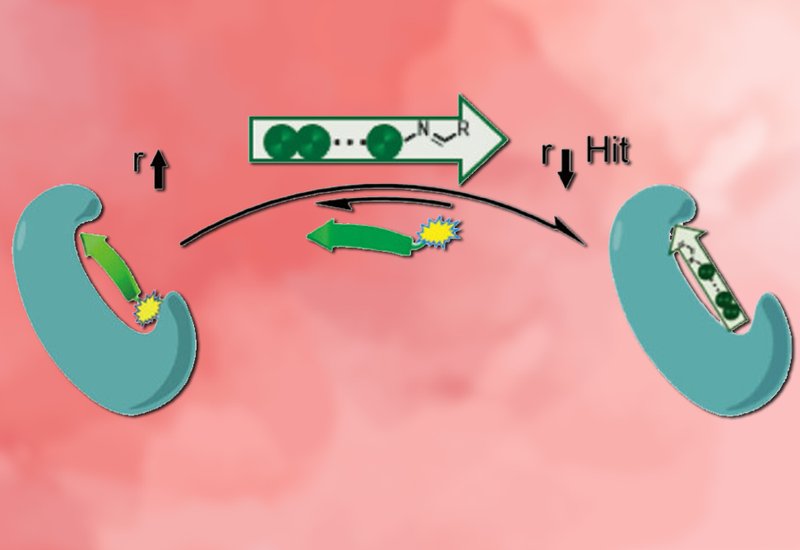
Researchers in the Wilson Group at the University of Birmingham, published in Biochemistry, applied dynamic ligation screening, DLS, to the SHANK1-PDZ domain using an internal PDZ binding motif as the starting template rather than a canonical C-terminal ligand. The team first truncated the nine-residue sequence Glu-Glu-Ser-Thr-Ser-Phe-Gln-Gly-Pro from both its N- and C-termini to identify minimal sequences that retained measurable binding affinity. The shortest viable fragment, N1C3T, retained the critical Phe residue but shed one N-terminal Glu and three C-terminal residues, giving an IC50 of 246 μM. Acylhydrazone handles were then appended to either terminus, and reversible hydrazone exchange with a 165-compound aldehyde library was carried out in the presence of SHANK1-PDZ, using fluorescence anisotropy competition assays to detect fragments that shifted the equilibrium toward tighter binders. Molecular dynamics simulations with YASARA and isothermal titration calorimetry provided mechanistic insight into the binding thermodynamics of selected peptide-fragment hybrids.
C-terminal DLS delivered a rich set of hits. Screens using the truncated anchors C1T, C2T, and C3T identified fragments bearing aromatic rings and carboxylate or hydroxyl groups that restored inhibitory potency to low-micromolar levels, comparable to the full-length internal ligand. The best C-terminal hybrids, including C2T-[C007], C2T-[C012], C2T-[C047], and C2T-[C101], reached IC50 values of 1.3–3.0 μM, matching the untruncated nine-residue peptide. Notably, C-terminal screening succeeded here because the internal motif lacks the canonical C-terminal carboxylate, granting access to regions of the PDZ surface that conventional peptide binding motif-based ligands cannot reach. N-terminal DLS against N1T and N1C3T anchors produced up to 28 hits per screen; five validated hits for N1C3T showed up to a tenfold potency gain over the precursor peptide, with N1C3T-[N086] achieving an IC50 of 29 μM. Fragments with aromatic rings and carboxylate groups dominated the N-terminal hits, consistent with their compensating for the hydrogen-bonding contacts lost when Glu at position −5 was removed.
Combining N- and C-terminal fragments into ternary hybrids proved more nuanced. For the shorter template N1C3T, attaching fragment [N086] at the N-terminus and [C047] at the C-terminus produced a compound with an IC50 of 112 μM, worse than either single modification alone. Isothermal titration calorimetry and molecular dynamics simulations supported a model of negative cooperativity in which one terminal fragment constrains peptide dynamics and suppresses effective engagement by the other. Extending the C-terminal truncation by one residue to give N1C2T relieved this tension: the ternary hybrid N1C2T-[N086−C101] reached 13.1 μM and N1C2T-[N086−C012] reached 9.5 μM, both bearing free carboxylate groups that may form additional contacts with the domain. These doubly capped compounds carry lower molecular weight than their single-fragment counterparts and, crucially, their N- and C-terminal caps should suppress aminopeptidase and carboxypeptidase degradation, improving metabolic stability.
The work establishes that reversible acylhydrazone DLS can be applied successfully to internal PDZ binding motifs, circumventing the canonical C-terminal carboxylate requirement that restricts most PDZ ligand discovery programs. The target-agnostic nature of fragment selection proved its value: hit fragments shared few common structural features, justifying the broad, unbiased library approach. More broadly, this successive fragment-screening and combination workflow should transfer to other β-strand-mediated PPIs beyond PDZ domains, opening new avenues for ligand-efficient peptidomimetics against some of the most intractable targets in the proteome.