Huntington's disease, HD, is a fatal autosomal dominant neurodegenerative disorder caused by expansion of a CAG repeat tract in the Huntingtin gene above 35 repeats. Despite the genetic cause being identified more than three decades ago, no disease-modifying therapies exist. The encoded protein, HTT, is a 3,144-amino-acid scaffold organized into HEAT-repeat globular domains and is implicated in autophagy, vesicular trafficking, mitosis, and RNA binding, among other processes. Its only structurally characterized interactor in the published literature is the 40-kDa huntingtin-associated protein HAP40, which confers structural stability to the full-length protein. The absence of selective, well-validated chemical tools has been a persistent barrier to understanding how HTT carries out its functions in healthy cells and how those functions go wrong in disease.
Researchers in the Harding Group at the University of Toronto and the Suga Group at the University of Tokyo, published in PNAS, used the RaPID platform, random nonstandard peptide integrated discovery, coupled to flexible in vitro translation to screen a library of more than 1012 macrocyclic peptides against recombinant HTTQ23 and the HTTQ23-HAP40 complex. The FIT system reprogrammed the AUG codon to incorporate N-chloroacetylated L-tyrosine or D-tyrosine at the peptide N-terminus, enabling spontaneous thioether macrocyclization with a downstream cysteine. After five to six rounds of mRNA-display selection against each target, the team identified enantioselective, enriched sequences and validated candidates by solid-phase synthesis using standard Fmoc SPPS followed by HPLC purification and MALDI-MS confirmation. Five macrocycles, HL2, HD4, HL5, HHL1, and HHD3, were taken forward for full biophysical and structural characterization.
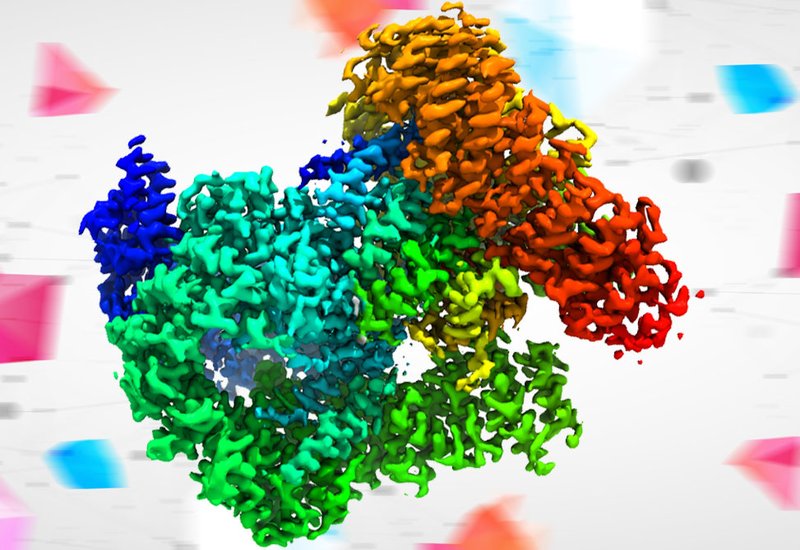
Surface plasmon resonance and fluorescence polarization assays established that all five macrocycles bound HTT or HTT-HAP40 with affinities in the low-nanomolar range. HL2 and HD4 engaged both apo HTT and the HTT-HAP40 complex, binding pockets distal to the heterodimer interface. HL5 bound apo HTT more tightly than the complex, consistent with a site near or overlapping the HAP40 interface. HHL1 and HHD3 required the presence of HAP40, pointing to a binding pocket at the HTT-HAP40 interface itself. Notably, affinity did not vary appreciably with polyglutamine length: macrocycles showed similar binding constants for HTTQ23 and HTTQ54, indicating that the N-terminal polyQ tract does not contribute to recognition. Hydrogen-deuterium exchange mass spectrometry mapped the protected and destabilized peptide regions on the full-length protein upon macrocycle binding, and cryo-EM structures of two HTT-HAP40 macrocycle complexes were solved at 2.1 Å and 2.3 Å resolution, deposited as PDB 9PMW and 9PN0. The atomic models revealed that HL2 folds into a β-turn within a negatively charged pocket in the HTT N-terminal domain, while HHL1 and HHD3 adopt a distinctive "figure 8" conformation at the positively charged HTT face of the HAP40 interface.
In chemoproteomics experiments, biotinylated macrocycles pulled down endogenous HTT from HEK293T cell lysates, with enrichment confirmed against HTT-null knockout controls. HAP40 co-purified with HTT at every polyglutamine length tested, in both HEK293T cells and isogenic neuronal progenitor cell lines carrying Q30/Q19, Q45/Q19, and Q81/Q27 alleles. Across all conditions, HAP40 was the only interactor consistently and significantly co-enriched with HTT, leading the authors to describe the HTT-HAP40 heterodimer as the dominant endogenous proteoform. Nine additional proteins, including factors involved in cytoskeletal regulation, proteostasis, RNA processing, and transcriptional corepression, recurred across both cell types, identifying candidate conserved components of the HTT interaction network.
The structural data lay a foundation for rational development of small-molecule mimetics derived from the macrocycle binding footprints, particularly the two-subdomain architecture revealed by the "figure 8" conformations of HHL1 and HHD3. The macrocycles do not disrupt HTT's NEAT1 RNA-binding activity and do not induce oligomerization or aggregation at a 1:10 protein-to-macrocycle ratio, properties important for their use as clean affinity reagents. The authors note that macrocycle engineering for cell permeability could extend these tools to live-cell applications inaccessible to antibodies. Further applications include PET tracer development, biofluid-based HTT detection, and use as target-engaging warheads in peptidic PROTAC strategies for HTT degradation, a direction the authors report is already underway.