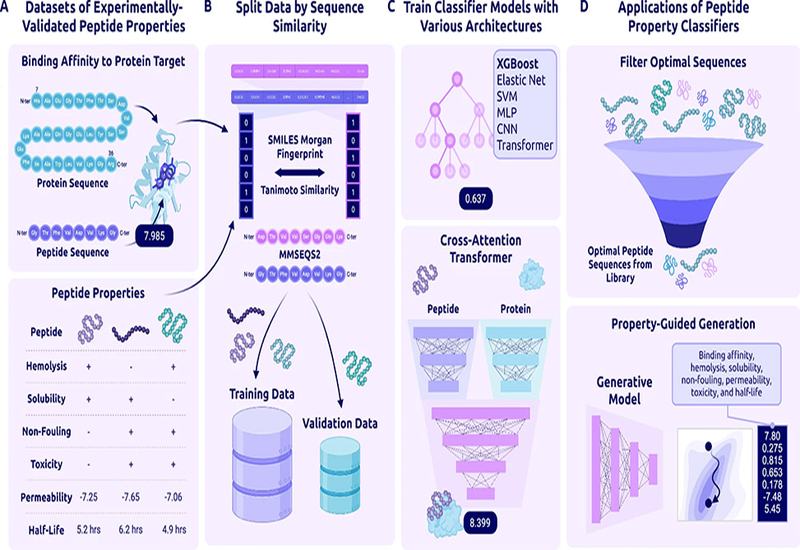
Designing a therapeutic peptide demands more than optimizing binding affinity. Poor membrane permeability, rapid proteolytic degradation, hemolysis, nonspecific protein adsorption, and low solubility each erode translational potential, and modern drug campaigns increasingly rely on non-canonical amino acids, D-residues, cyclization, and other chemical modifications to counter these liabilities. Yet available computational tools have operated in silos: sequence-based predictors such as PeptideBERT handle canonical amino acids only, general small-molecule ADMET platforms are trained on chemical space that diverges substantially from peptides, and peptide-oriented SMILES predictors cover only a narrow slice of clinically relevant properties. No unified framework existed that could accept either amino acid sequences or SMILES representations of chemically modified peptides and return a comprehensive developability profile in a single pass.
Researchers in the Chatterjee Group at the University of Pennsylvania, published in Nature Communications, address this gap with PeptiVerse, a modular property-prediction platform built on frozen embeddings from large pretrained protein and chemical language models: ESM-2 for sequence inputs and PeptideCLM or ChemBERTa for SMILES inputs. Rather than retraining deep representation models, the team trains lightweight predictor heads on carefully curated, similarity-split experimental datasets spanning hemolysis, solubility, non-fouling behavior, toxicity, membrane permeability, half-life, and binding affinity. A key architectural finding shapes the design philosophy: across virtually every task, the choice of embedding dominated predictive accuracy far more than the choice of downstream model, meaning that high-quality pretrained representations paired with well-regularized classical learners match or outperform bespoke deep architectures at a fraction of the computational cost. The team also shows that structure-prediction confidence scores from OpenFold3 exhibit negligible correlation with experimental peptide-protein binding affinity, motivating fast embedding-based affinity surrogates over reliance on structural modeling alone.
PeptiVerse is deployed as an open-access web interface on HuggingFace Spaces and ships with standardized datasets, trained model weights, and an API designed for integration into generative peptide design pipelines. The platform has already been coupled to PepTune, TR2-D2, and moPPIt as a reward-evaluation layer for multi-objective guided sequence generation. For the peptide therapeutics community, PeptiVerse offers a practical on-ramp to property-aware candidate prioritization across the full chemical diversity of modern peptide modalities, with the dataset and model registry structured for incremental expansion as new experimental measurements accumulate.