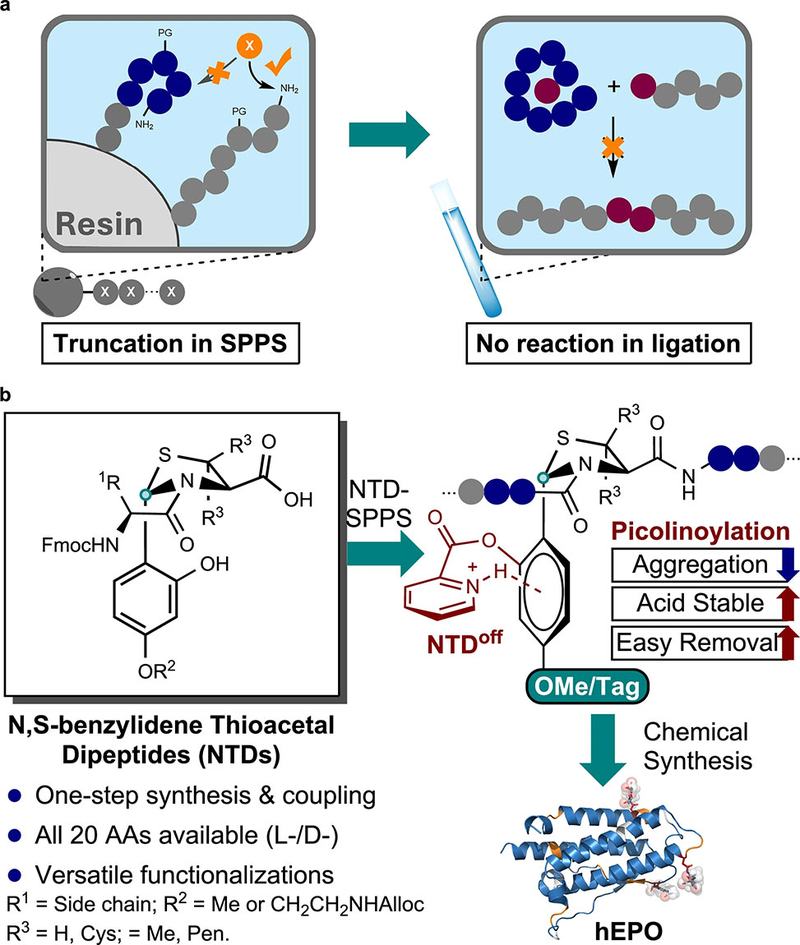
Chemical protein synthesis grants atomic-level control over sequence and modification, yet hydrophobic and aggregation-prone proteins remain a stubborn obstacle. N,S-benzylidene thioacetal intermediates, formed at cysteine ligation sites, can disrupt the β-sheet hydrogen bonding that causes aggregation both on resin and in solution. The problem is stability: the p-methoxy-substituted thioacetal undergoes rapid acidolysis under the trifluoroacetic acid, TFA, cocktails required for global side-chain deprotection, vanishing within minutes before it can do its job in later ligation steps. Prior workarounds demanded narrow acidolysis windows and restricted scavenger choice. A more reliable way to protect the thioacetal during deprotection and restore it selectively afterward was the missing piece.
Researchers in the Li Group at The University of Hong Kong, published in Nature Communications, report a solution built around picolinoyl-protected N,S-benzylidene thioacetal dipeptides, NTDs, directly compatible with standard Fmoc SPPS as ordinary coupling partners. Screening a broad set of acylating agents on the thioacetal phenol revealed that 2-picolinoyl chloride stood apart: the NTD remained nearly intact after three hours of TFA/EDT/H₂O treatment, while acetyl and nitrobenzoyl analogs degraded within the same window. DFT calculations and NMR titration studies converged on a mechanistic explanation: under acidic conditions, the pyridine nitrogen is protonated to pyridinium, which forms an offset face-to-face cation-π interaction with the adjacent thioacetal benzene ring at 3.04 Å. This contact depletes electron density at the sulfur atom, creating a charge-repulsion barrier against the first protonation step of acidolysis. The positional specificity is strict, as moving the nitrogen to the meta or para position abolishes both efficient capping and acid stability. The picolinoyl group is subsequently removable under mild pH 4.0–6.0 conditions, providing the on-demand switching the field required.
The NTD strategy enabled convergent total synthesis of human erythropoietin, a 166-residue hydrophobic hormone assembled from five fragments via native chemical and serine/threonine ligations, with NTD sites suppressing aggregation at critical stages. The approach extends to macrocyclization and chemoselective cysteine manipulation in multi-fragment assembly, opening a practical path to difficult proteins that have so far resisted chemical synthesis.