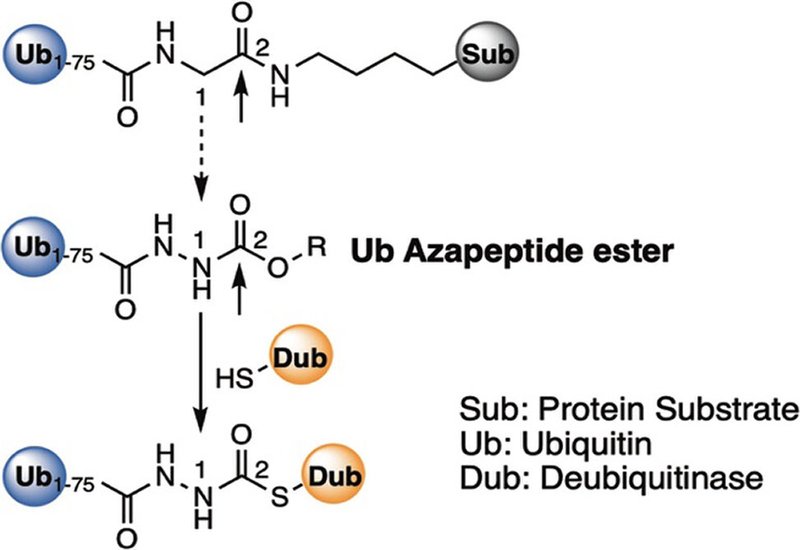
Published as an ASAP article in the Journal of the American Chemical Society, researchers from the Wenshe Liu Lab at Texas A&M, currenly our "Lab of the Month," present the development and characterization of ubiquitin azapeptide esters as novel activity-based probes for profiling cysteine enzymes involved in the ubiquitination and deubiquitination cascade. Traditional ubiquitin probes, such as ubiquitin propargylamine, UbPa, often fail to fully mimic the enzymatic substrate interactions or catalytic mechanisms inherent to this pathway. To address this, the authors engineered azapeptide ester variants of ubiquitin incorporating a C-terminal azaglycine moiety, thus achieving structural and mechanistic fidelity to natural ubiquitinated substrates.
The synthesized probes—FlagUbMTC, FlagUbETC, and FlagUbTFEGHC—demonstrated superior covalent reactivity with a wide spectrum of cysteine-dependent deubiquitinases, DUBs, and ubiquitin-activating, E1, conjugating, E2, and select ligating, E3, enzymes. These azapeptide ester probes formed stable thiocarbamate linkages with target enzymes and provided enhanced sensitivity and selectivity in both in vitro enzyme assays and complex biological systems such as HEK293T cell lysates and murine tissue extracts.
Proteomic analyses revealed that azapeptide ester probes successfully labeled active DUBs—including UCHL1, UCHL3, UCHL5, OTUB1, and OTUD6B—and identified targets that conventional probes failed to detect, such as Ataxin-3 and OTULIN. Kinetic and inhibitory assays confirmed improved binding kinetics and inhibition potency compared to UbPa. Importantly, azapeptide ester probes also revealed tissue-specific DUB profiles, underscoring their potential for use in disease-specific enzymatic mapping.
Collectively, the findings establish ubiquitin azapeptide esters as next-generation tools for comprehensive activity-based profiling of the ubiquitin signaling machinery. The probes’ superior biochemical performance and structural fidelity to native substrates highlight their promise in elucidating disease-associated dysregulation and guiding the development of targeted therapeutics.