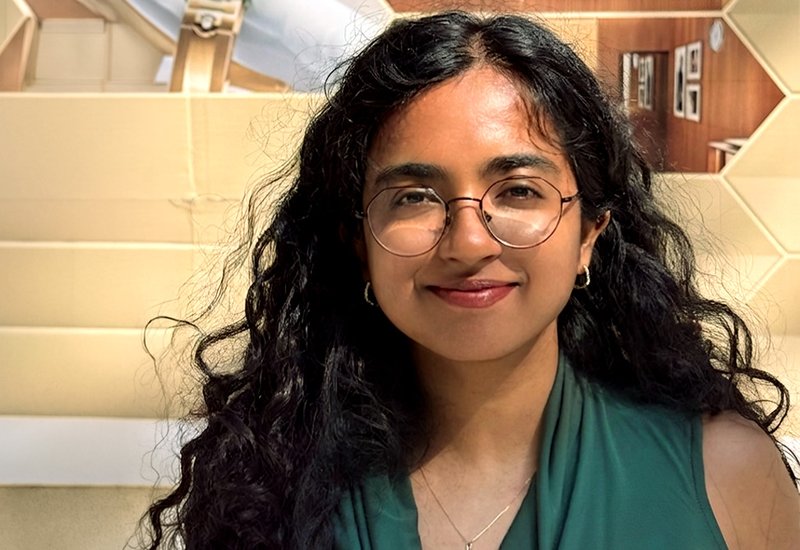
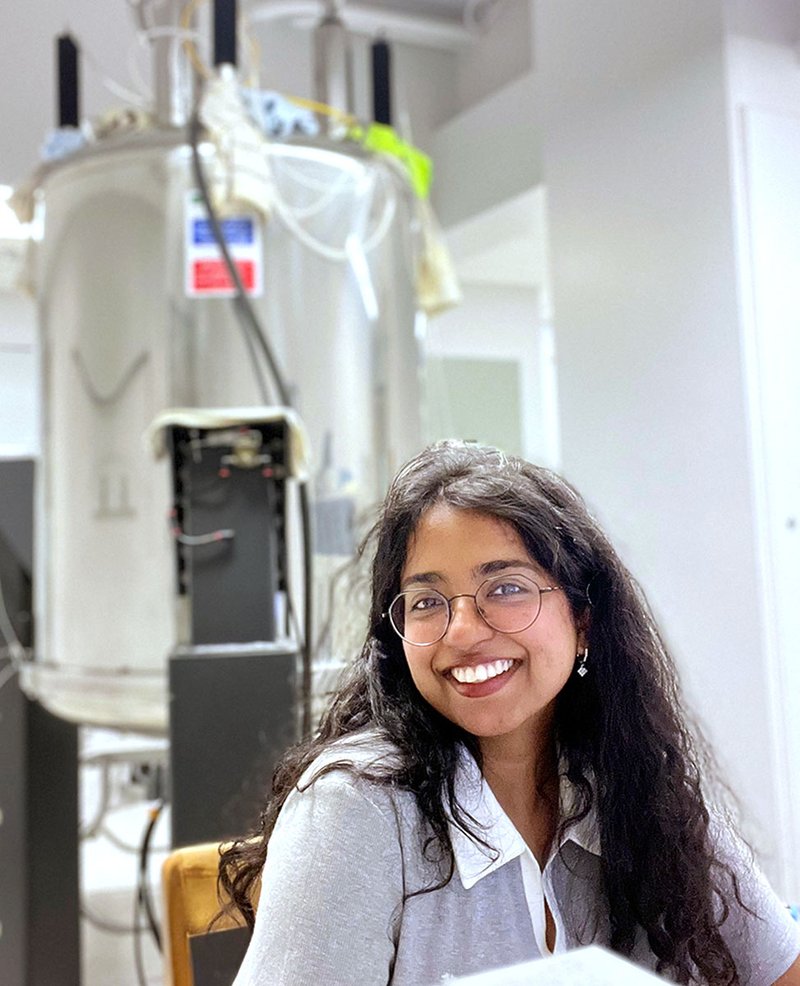
There is a long-standing puzzle in antimicrobial peptide research. The peptide concentrations that disrupt model lipid bilayers in the laboratory bear little resemblance to the far higher amounts required to kill intact bacteria. Something happens at the bacterial cell envelope first, and Arunima Sandeep is using solid-state nuclear magnetic resonance, ssNMR, to find out what.
A fourth-year Ph.D. candidate in the Marcotte Lab at the Université du Québec à Montréal, Sandeep was first author on a paper in J. Am. Chem. Soc. earlier this year that demonstrated direct binding of three amphibian-derived antimicrobial peptides to wall teichoic acids in Gram-positive bacteria, broadening the standard membrane-disruption model of antimicrobial peptide action. The finding offers a mechanistic explanation for a well-known resistance strategy. Bacteria that increase d-alanylation of their teichoic acids reduce their net negative surface charge and thereby lower peptide affinity. Sandeep is now extending the approach to Escherichia coli, developing envelope models and integrating ssNMR with complementary biophysical techniques to map the equivalent encounters in Gram-negative bacteria.
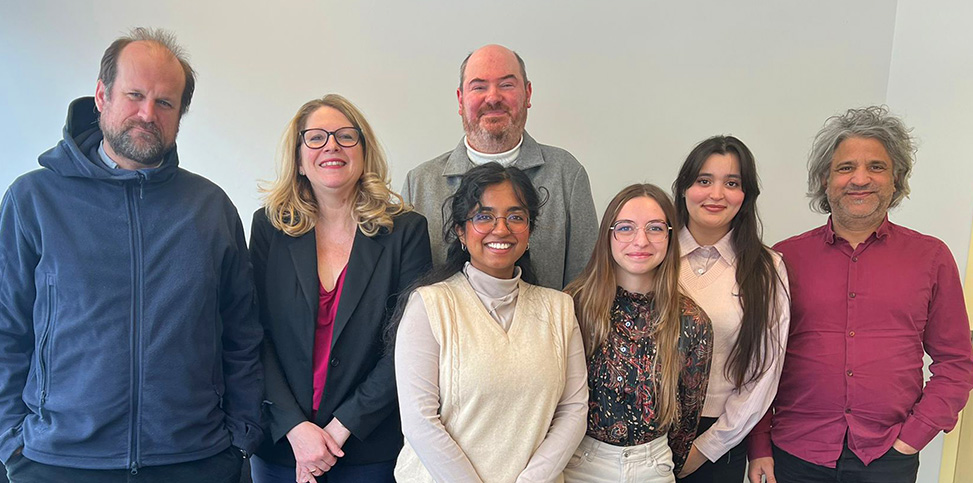
From left to right:Dr. Alexandre Arnold, NMR Manager; Professor Isabelle Marcotte, Group Leader; Dr. Stéphane Beauclercq, Research Assistant; Arunima Sandeep; Solène Verger, research intern; Rana Moussaoui, Master-degree student; Dr. Dror Warschawski, collaborator to the lab and researcher at CNRS-Paris and Sorbonne Université.
Sandeep's path to ssNMR began at home. Her mother teaches physics and her father is an engineer, and she credits both with sparking her interest in science from primary school onward. She enrolled in the integrated BS-MS program at the Indian Institute of Science Education and Research Thiruvananthapuram, where the curriculum exposes students to every scientific discipline before they declare a major. Two years in, she chose chemistry, and within chemistry she found her way to physical chemistry and spectroscopy. A master's thesis on protein structural studies in the NMR laboratory of Dr. Vinesh Vijayan crystallized her direction.
By her final year, Sandeep was applying for Ph.D. positions abroad and looking for an environment that could broaden her perspective. The Marcotte Lab's combination of antimicrobial peptides and ssNMR caught her attention, and after a long conversation with Isabelle Marcotte, she made the decision to move to Canada.
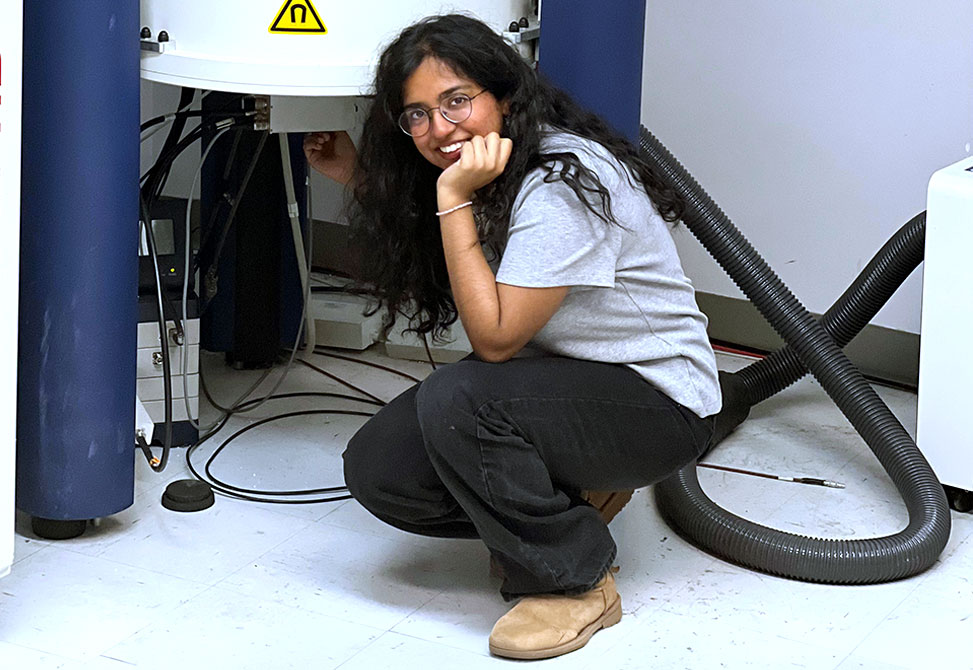
In her second year, Sandeep gave an oral presentation at the East-Canadian MOOT NMR meeting at McGill University and won the prize for best oral presentation. In her third year, she received the highly competitive FRQNT PBEEE doctoral scholarship from Quebec's Fonds de recherche, and she currently holds a scholarship from the PROTÉO research network. At the 8th International Symposium on Antimicrobial Peptides in Marseille in 2024, she encountered the breadth of the field firsthand and came away with a clearer sense of how many distinct research approaches converge on the same fundamental questions about peptide-bacterial interactions.
Sandeep is drawn toward an industry-connected postdoctoral position, hoping to take her science in a more integrated and application-oriented direction. The mechanistic foundations she has laid in the Marcotte Lab give her plenty to build on. Outside the lab, she explores Montréal in small, unplanned ways, trying new cafés and walking or biking through different neighborhoods. Summer and fall in the city are her favorite seasons, and she takes long picnics in the parks whenever the weather allows. She travels when she can, mostly to see the world from new angles.
She keeps a piece of advice from a friend close at hand. Out of 100 days in research, she says, perhaps five are the days when everything works. Those are the days that produce results, papers, and presentations. The other 95 days, the ones filled with setbacks and persistence, are the ones that make those five possible.