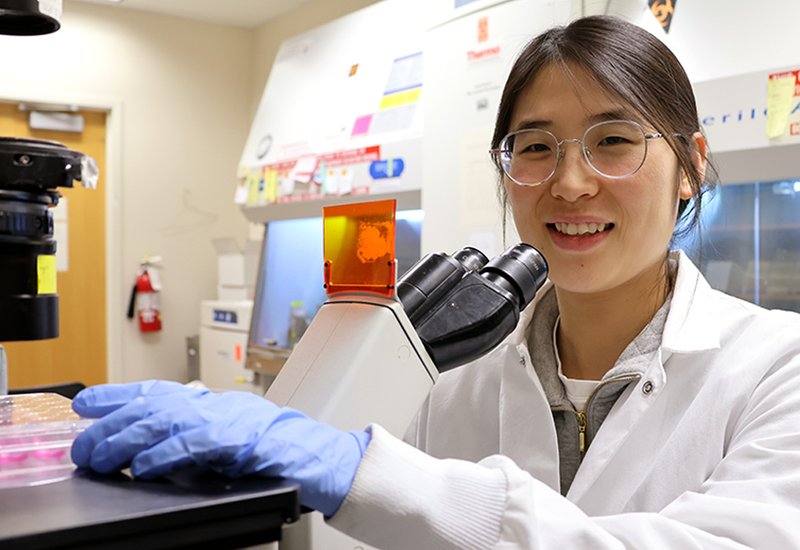
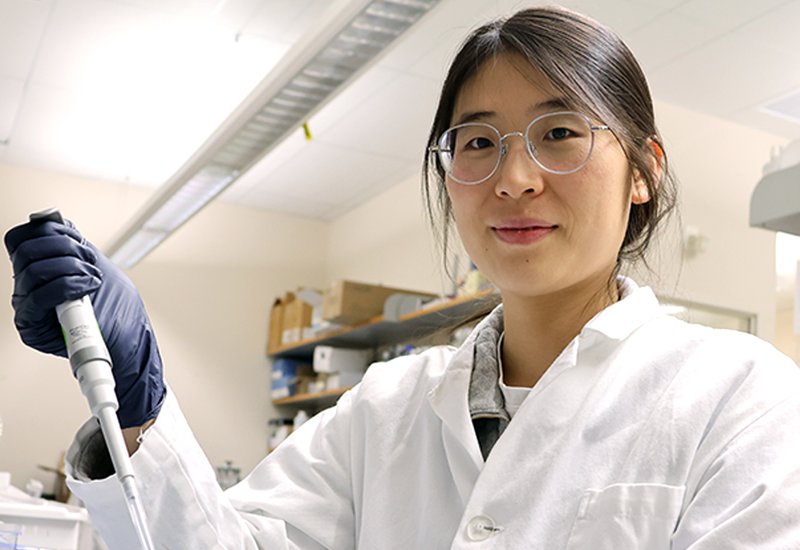
Yuan Zhao is a Ph.D. candidate in Weiping Tang's laboratory at the University of Wisconsin-Madison School of Pharmacy, where she is developing the chemical tools that could make previously undruggable proteins accessible to therapeutic intervention. Her path to Wisconsin brought early research experiences that shaped her broad expertise across the chemical modalities driving targeted protein degradation.
As an undergraduate at Nankai University, Yuan first worked with Professor Yue Chen on organic synthesis. She then joined Professor Martin Burke's group at the University of Illinois Urbana-Champaign, whose laboratory pioneered automated small molecule synthesis and molecular prosthetics. A year at Peking University in Tuoping Luo's laboratory followed before she began her doctoral studies in 2021.
At Wisconsin, Yuan joined the Tang Group, led by Janis Apinis Professor Weiping Tang, who also directs the UW Medicinal Chemistry Center. The group has established itself as a leader in degrader technology, with contributions ranging from PROTAC development to novel approaches for targeting extracellular proteins. Yuan's doctoral research focuses on targeted protein degradation, a strategy that harnesses the cell's own machinery to eliminate disease-causing proteins rather than simply blocking their function. Her work spans small molecules, peptides, and antibody-based degraders.
That expertise is evident in Yuan's first-author publication in Advanced Science, highlighted here on our website. The paper describes an engineered insulin-like growth factor II mutant for lysosome-targeting chimeras. The work addresses a fundamental limitation of existing degrader technologies: most can only reach proteins inside cells, leaving roughly 40% of the proteome inaccessible. By creating an IGF-II variant that selectively engages the lysosomal trafficking receptor while avoiding mitogenic signaling through related receptors, the team established a safer foundation for degrading extracellular and membrane proteins. The degraders successfully eliminated therapeutically relevant targets including EGFR, PD-L1, and Her2.
Summer 2025 brought an industry perspective through a twelve-week internship at Genentech in San Francisco. There, Yuan screened functional peptides using phage display for drug delivery across biological barriers, work she describes as complementary to her doctoral research. While her Ph.D. studies focus on evaluating molecules against known targets through cell-based assays, the Genentech project involved identifying binders in the first place. The internship also reinforced the value of connections. Beyond her three assigned mentors, Yuan sought coffee chats with scientists working in areas related to her research, learning how industry approaches projects differently than academia.
With graduation anticipated in 2026, Yuan plans to pursue postdoctoral training to gain experience in different research environments before deciding on her long-term path.