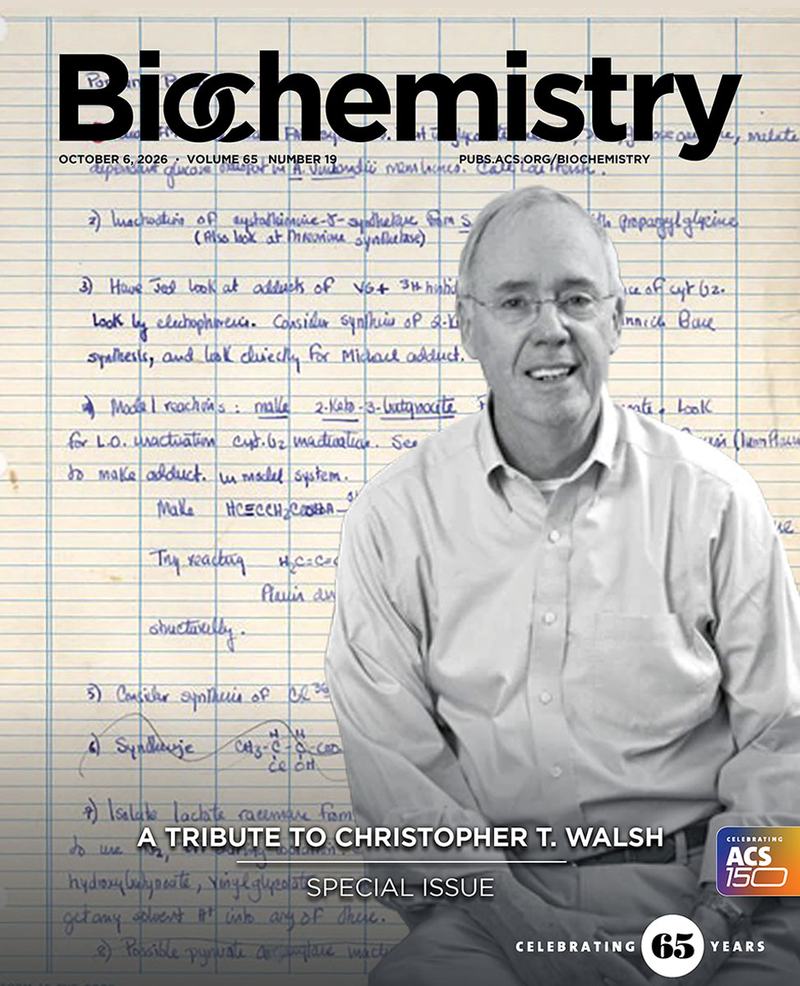
Christopher T. Walsh, 1944–2023, would probably not have called himself a peptide scientist. Open almost any recent paper on nonribosomal peptide synthetases, on ribosomally synthesized and post-translationally modified peptides, or on the glycopeptide antibiotics, though, and his fingerprints are on the method, the vocabulary, or both.
Biochemistry has given him an entire issue. Published October 6, 2026, and assembled by Albert A. Bowers of the University of North Carolina at Chapel Hill with Roberto Kolter, it gathers more than fifty peer-reviewed articles alongside two dozen remembrances from colleagues and former trainees. The choice of venue was his own long before it was theirs. Walsh wrote eight books and more than 800 papers, and roughly 200 of them appeared in Biochemistry, which makes him the most published author in the journal's history.
The peptide thread
Several of those papers sit at the foundation of work our members do every day.
In 1998 his laboratory reported that the phosphopantetheinyl transferase Sfp from Bacillus subtilis would activate carrier protein domains drawn from a wide range of nonribosomal peptide and polyketide systems. Gregory Challis of the University of Warwick singles out that result as the one that accelerated the whole field, because it gave everyone a reliable route to functional holo-synthases. A great deal of in vitro NRPS biochemistry traces back to it.
Between 1998 and 1999 the lab published a rapid sequence of papers on microcin B17, the thiazole- and oxazole-containing gyrase inhibitor, working out how cysteine and serine residues are heterocyclized after the ribosome has finished. Bowers describes that body of work as a blueprint for the study of RiPPs, written before the field had settled on a name for itself.
Wilfred van der Donk of the University of Illinois Urbana–Champaign puts a finer point on it. He encountered the 1996 microcin B17 paper while writing his faculty applications, and it sent him reading about other bioactive peptides, which led him to the lantibiotics and from there to RiPPs. He describes Walsh as the figure who built the natural products biosynthesis community in the United States.
There is more in the same vein. Over seventeen years and nine papers the lab took apart the enterobactin assembly line enzyme by enzyme, from EntA through EntF and on to reconstitution of the full synthetase. The 1991 identification of the vancomycin resistance protein VanA as a D-alanine:D-alanine ligase with altered substrate specificity reframed how the field thought about resistance. His 2013 work on echinocandin biosynthesis showed that a late hydroxylation was dispensable for antifungal activity, an insight that Micha Fridman of Tel Aviv University credits with shaping his own route to echinocandins that overcome target-site resistance. The last papers from the Harvard lab, with his final postdoc Jared Parker, worked out the biosynthesis of the dipeptide antibiotic bacilysin. He finished on a peptide.
Two hundred and fifty, and counting
The science is only half of what the issue is about. Walsh trained more than 250 graduate students and postdocs, and advised a great many more who never worked in his lab.
The remembrances converge on a handful of images. There are the index cards, on which he drafted seminar slides and kept notes on each trainee's project, and the hand-drawn structures with their curved arrows. Eric Brown of McMaster University says the real lesson was in reading those drafts, because you could watch him decide what mattered and what could be left out. Several contributors describe sending data late at night and finding a first draft of the manuscript waiting in the morning.
There are the sayings. He studied the molecular logic of an enzyme rather than its mechanism. He described his own outlook as chemocentric. Bo Li of the University of North Carolina at Chapel Hill, choosing a postdoctoral project, was told to choose her own poison. Michael Marletta of the University of California, Berkeley recalls that a genuinely strange result would earn an offer to ruminate on it for a while, after which an answer invariably arrived. Thomas O'Halloran of Michigan State University still passes on the line that negotiation is the fine art of proposal.
And there is the kindness, which nearly every contributor reaches for. Felicia Etzkorn of Virginia Tech remembers that he had a kind word for everyone in the building and judged people on their merits. Catherine Grimes of the University of Delaware recalls him sitting down with the graduate students at breakfast to ask about their writing habits, and offering the advice that he wrote for twenty minutes every day. Xue Sherry Gao of the University of Pennsylvania describes reading a recommendation letter he had written for her at a difficult moment, and deciding that if he believed in her that strongly she had better believe in herself. Wenjun Zhang of the University of California, Berkeley, convinced as a postdoc that she had been scooped, was sat down and walked through the similarities and the differences until the ground her work still occupied came back into view.
Gerard Wright of McMaster University tells the one that will land hardest with anyone who has given a talk to the wrong room. Early in his independent career he presented careful mechanistic enzymology to a microbiology audience and lost them five minutes in. Walsh's verdict afterward was that you have to know your audience.
Why it belongs here
The American Peptide Society is a community of people who build and study peptides. Walsh spent his career on enzymes. The reason this tribute belongs on our pages is that so many of the names in it are ours, and so much of what he left behind is now routine equipment in peptide laboratories: a transferase that primes a carrier protein, a mechanistic grammar for post-translational heterocyclization, a way of looking at a complicated biosynthetic pathway and expecting it to make chemical sense.
Bowers closes by hoping the collection preserves some measure of what he calls the “Chris effect” for the biochemists who come next. On the evidence of the fifty-odd papers behind it, that work is already well underway.
Read the issue: Bowers, A. A.; Kolter, R. Christopher T. Walsh: A Leader in Biochemistry. Biochemistry 2026, 65, 2929–2934. https://doi.org/10.1021/acs.biochem.6c00504