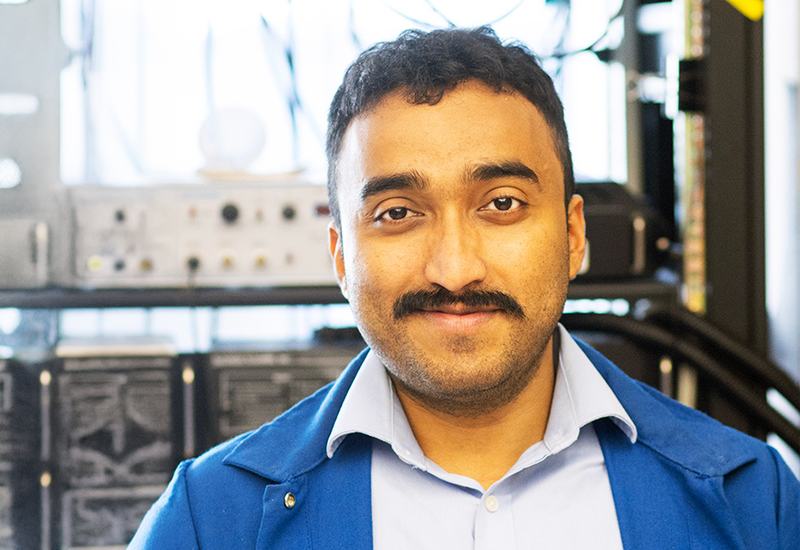
Most design campaigns are judged on the fraction that works. Sagar Bhattacharya is at least as interested in the rest. What he says he enjoys about his field is the iterative relationship between design and experiment, and he is specific about why: experimental results are there not only to improve function, but to explain why a design worked or did not, and to yield principles that carry into the next generation of scaffolds. A design that fails informatively is not a wasted synthesis. It is the only kind of result that tells you something general.
Bhattacharya is a postdoctoral fellow in the DeGrado Lab in the Department of Pharmaceutical Chemistry at the University of California, San Francisco, where he designs and engineers peptides and proteins for catalysis and for biomedical application. The two directions run in parallel. On one side, de novo design of sustainable catalysts for chemical transformations that remain difficult by conventional means. On the other, functional peptide and protein systems built for therapeutic use, including drug delivery and selective metal binding.
The workflow is deliberately circular. Computational protein design supplies the starting sequences, experimental screening and directed evolution interrogate them, and structural, biophysical, and mechanistic characterization explains the outcome. That last stage is the one he treats as non-negotiable, because it is where the design rules come from.
On the computational tools now reshaping the field, he is enthusiastic and precise about their limits. Machine learning allows sequence and structural space to be explored at a scale that was not previously available, and he regards the resulting designs as extremely powerful starting points. Starting points, though, is the operative phrase. Experimental testing, directed evolution, and mechanistic characterization remain essential, both to optimize function and to recover the underlying principles that raise the success rate of the designs that follow.
The thread running back through all of it begins in synthetic organic chemistry. During his master's research, Bhattacharya became interested in whether sustainable biocatalysts might complement conventional catalytic approaches, and that question followed him into peptide and protein engineering rather than being left behind in it. What converted interest into commitment was watching very small molecular building blocks self-assemble into higher-order structures with emergent catalytic function. The combination of chemical tunability, self-assembly, and biological compatibility is still, by his account, what makes peptides compelling as platforms for both catalysis and medicine.
He completed his Ph.D. in chemistry at Syracuse University in the laboratory of Ivan V. Korendovych, where he developed an NMR-based spectroscopic strategy for identifying hot spots for the directed evolution of enzymes. The appeal of the method is what it does not require: it locates productive positions without prior knowledge of structure or function, and it delivered rapid gains in activity. That work appeared in Nature in 2022.
Alongside it, he worked on short self-assembling catalytic peptide assemblies that hydrate carbon dioxide with catalytic efficiency in the enzymatic range, a result that sits at the junction of his two long-standing interests. The line of work continues: a 2026 preprint on Research Square argues that conserved catalytic motifs encode enzyme-like supramolecular peptide assemblies.
The move to San Francisco was chosen on complementarity. William DeGrado is a pioneer of de novo protein design and has also contributed substantially to the design and study of amyloidogenic peptides, a pairing that mapped closely onto Bhattacharya's own training in NMR-guided directed evolution and self-assembling metal-binding peptide fibrils. UCSF offered the environment to extend that expertise into de novo design and biomedical application, including testing designed systems in animal models.
That extension is already on the record. In a 2026 Nature Chemistry paper on which Bhattacharya is a co-first author, the group applied crystallographic fragment screening to a de novo apixaban-binding helical bundle and found that it behaves as natural proteins do, forming weak and promiscuous complexes alongside its designed one. Those weak complexes turned out to be excellent starting points: redesign around them produced a turn-on fluorophore binder and a Kemp eliminase with a catalytic efficiency of 3,200,000 M-1 s-1, approaching the diffusion limit. The author list closes a loop of its own, since Korendovych is on it.
Ask about mentorship and he names both supervisors in the same breath, crediting their trust and support as the foundation of whatever independence he now has. Protein engineering and directed evolution were entirely new to him when he joined the Korendovych lab, and he credits that mentorship with his falling for the field. DeGrado, he says, has consistently pushed him to develop research ideas of his own while insisting on the importance of teaching and mentorship alongside them.
Sagar is just amazing to have in the group. He is like three postdocs in one! In the area of directed evolution, he brought a new capability and depth to the lab. With respect to catalysis, he doesn’t just want to design highly active enzymes, he wants to understand why they are active. In so doing he is explaining how natural enzymes work and providing new insights into practical biocatalysis. Additionally, in his work on bioactive delivery systems, he is showing great ingenuity and persistence. On a personal level, I love interacting with him and we have almost daily conversations about data or science in general. We can expect great things of this very talented and spirited scientist!
WIlliam DeGrado, Professor, University of California at San Francisco
The external recognition has arrived steadily: the Dr. Elizabeth A. Schram Award in 2023, the W. H. Peterson Award from the ACS Division of Biochemical Technology in 2024, an honorable mention for the IUPAC-Solvay International Award for Young Chemists the same year, and the ACS Nobel Laureate Signature Award for Graduate Education in Chemistry in 2025, followed by a University of California President's Lindau Nobel Meetings Fellowship. The two that matter most structurally are the ones that buy time: a Damon Runyon Postdoctoral Fellowship, held as a Conie and Bob Lurie Fellow from 2024 to 2027, and an independent research grant from UCSF's Program for Breakthrough Biomedical Research, supported in part by the Sandler Foundation. Independent support at the postdoctoral stage does something that project funding cannot, and he is using it as intended, to begin developing the directions of a future laboratory. The goal is an independent academic program in de novo peptide and protein design for sustainable catalysis and biomedical application, and the current training is deliberately bridging design, dynamics, mechanistic biophysics, and in vivo work.
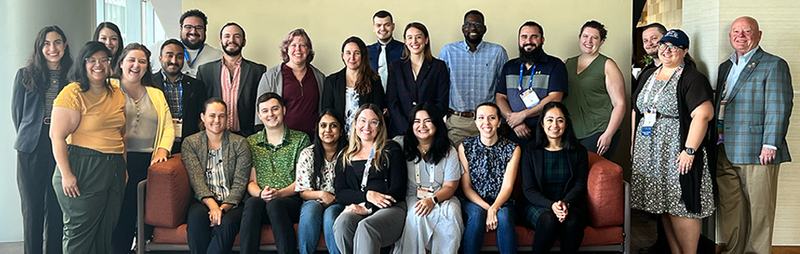
The 28th American Peptide Symposium in Scottsdale in 2023 is the meeting he singles out. He presented the NMR-guided directed evolution work in the Young Investigator Poster Competition and received the Schram Award there, and he served on the APS Student Activities Committee and volunteered during the symposium, which he describes as a chance to contribute to the community rather than only to present to it. His award address as the 2025 Nobel Laureate Signature Award recipient, delivered at the ACS spring national meeting in San Diego, was the other occasion that stayed with him.
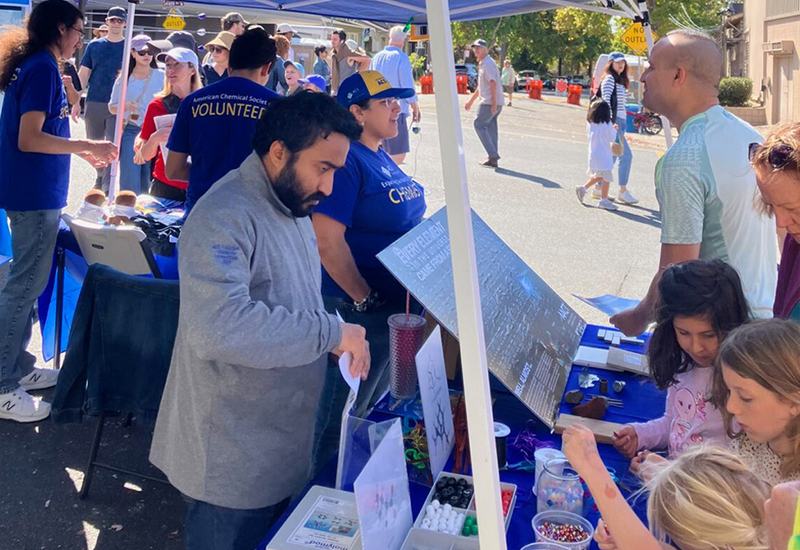
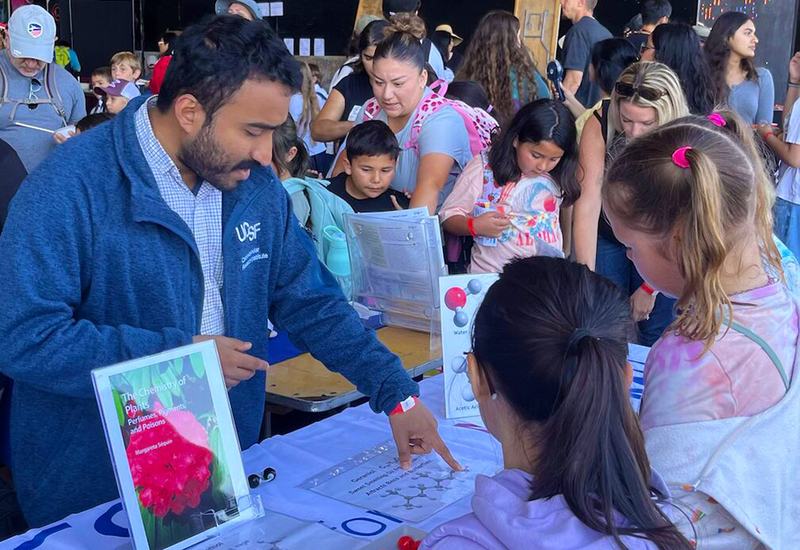
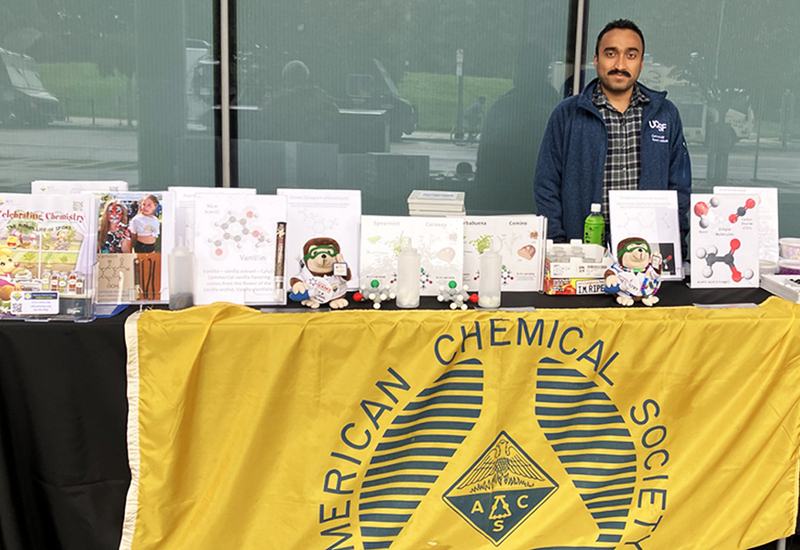
That instinct toward service is not incidental to how he works. Bhattacharya is a member of the ACS Younger Chemists Committee and organizes its Local Section Leadership Summit, connecting local section leaders with national committee members. He served as District Delegate-at-Large of the ACS Central New York Local Section and is currently an Alternate Councilor of the California Local Section, and he was named ACS Volunteer of the Year in 2026. On weekends the same commitment takes a more hands-on form, at community chemistry events during Chemists Celebrate Earth Week and National Chemistry Week. Asked for the detail that captures him as a person rather than a scientist, he offers this one: however busy the research gets, he makes time for outreach, and he says plainly that he enjoys it.
The openness extends to the science itself. He shares work through preprints, deposits structural and NMR data publicly, and circulates methods and protocols with reproducibility in mind, on the straightforward argument that it accelerates everyone. His advice to graduate students considering a postdoc is of a piece with that: choose on the environment rather than the reputation, pick somewhere that will teach you something genuinely new and let you build a scientific identity of your own, and look for mentors and collaborators who will challenge you while they support you.
When there is quiet time, he travels, often on the back of a conference, and he plays chess online. It is a fitting choice. Chess is a game you improve at mainly by going back over the positions you lost, working out exactly where the plan broke down, and carrying the principle into the next game. Which is more or less the method, applied to a smaller board.