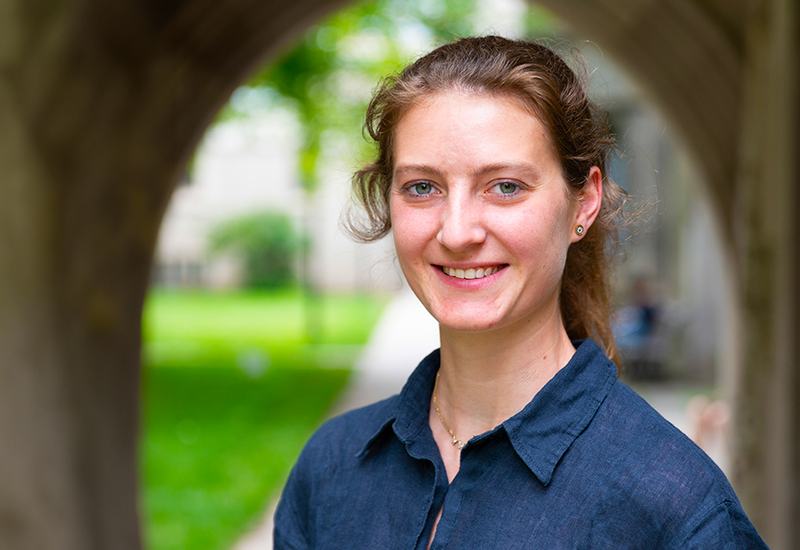
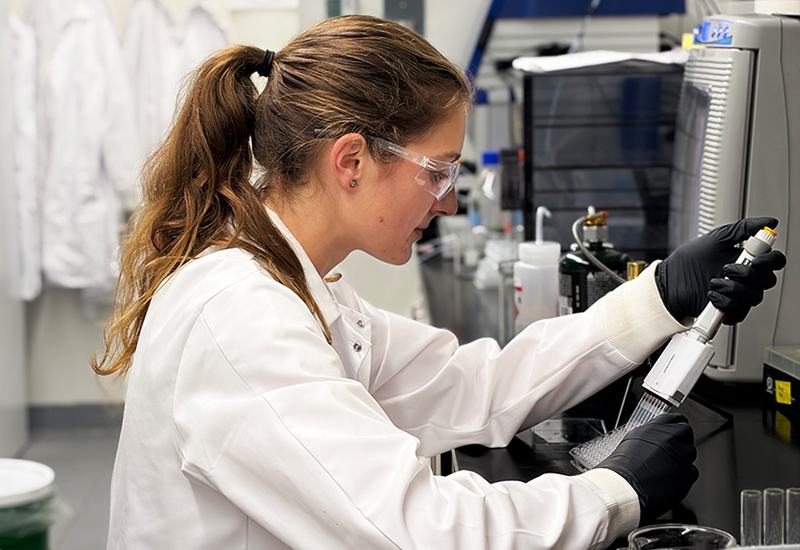
Adeline Schmitt has worked out something about herself that most people never bother to name: she does not like staying in one place. Ask how she recovers from a hard week and the answer involves twenty thousand steps a day, a bouldering gym, a bicycle, and, often enough, a dance floor. It is a fitting temperament for a scientist who has worked in four countries and now spends her days building a laboratory designed never to stop iterating.
Schmitt is a postdoctoral fellow in the Brown Lab at the Leslie Dan Faculty of Pharmacy, University of Toronto, where the project is a self-driving laboratory for peptide discovery. The phrase has become fashionable, but the architecture underneath it is concrete: automated high-throughput peptide synthesis and biological screening wired to computational models in a closed loop, so that each round of experimental results informs the design of the next.
What the loop is pointed at is a hard target. Schmitt and her colleagues are developing noncanonical peptide inhibitors of the lipopolysaccharide transport pathway in Gram-negative bacteria, whose outer membrane is an effective barrier against most conventional antibiotics and whose multidrug-resistant strains remain a serious clinical problem. Interfering with the machinery that builds and maintains that membrane is one of the more appealing routes around the wall, and peptides, with their large contact surfaces and tunable properties, are a sensible class to bring to it.
Her methodological center of gravity is chemical space. Schmitt expands it using noncanonical amino acids built into macrocyclic peptide libraries, and she follows those libraries across the entire workflow, from solid-phase synthesis and library design through biological testing and into the machine-learning models that consume the results. The point is multiparameter optimization: tuning several peptide properties at once, past what the canonical residues allow on their own.
There is an efficiency dividend she is careful not to oversell. Peptide synthesis is a solvent- and reagent-hungry business, and Schmitt is conscious of it. Her project leans on direct-to-biology assays with mass spectrometry readouts, which accept crude compounds without purification, so synthesis can run at microscale and still return meaningful data. The greener chemistry falls out of the method.
She arrived at all of this from a different direction. Schmitt completed her Ph.D. at ETH Zürich in the group of Helma Wennemers, working on conformationally constrained proline-rich cell-penetrating peptides for intracellular and organelle-specific delivery. The questions there were structural and precise: how amphipathicity and the positioning of individual residues govern cellular uptake, and where a peptide ends up once it is inside. That work produced papers in ACS Chemical Biology, the Journal of Peptide Science, and RSC Chemical Biology across 2025 and 2026, and one of her delivery platforms traveled into a collaboration with the Jessen and Grosse groups at the University of Freiburg, carrying an inositol pyrophosphate into the nucleoli of mammalian cells.
Adeline is a force—scientifically, on the mountain trails, the bouldering walls, and as a fine human being always willing to go the extra mile for herself and others. When Adeline joined my lab, she looked up to others: “Wow, everyone is so fit, both in science and sports.” Soon, everyone admired and appreciated Adeline for her smart ideas, perseverance, curiosity, and constant willingness to help. Joseph is lucky to have Adeline at his side to build up the lab.
Helma Wennemers, Full Professor at the Department of Chemistry and Applied Biosciences, ETH Zürich
The move to Toronto was deliberate. Schmitt wanted a postdoc that would take her somewhere new in how peptides are developed as therapeutics, and the Brown Lab offered the exact combination she was after: peptide and peptidomimetic chemistry, biological screening, automation, and machine learning under one roof. She is frank that the computational side is something she is learning, not something she brought with her, and what interests her is the seam between the two. Moving between labs in four countries has also taught her to be comfortable being the new person, which is a skill rather than a temperament.
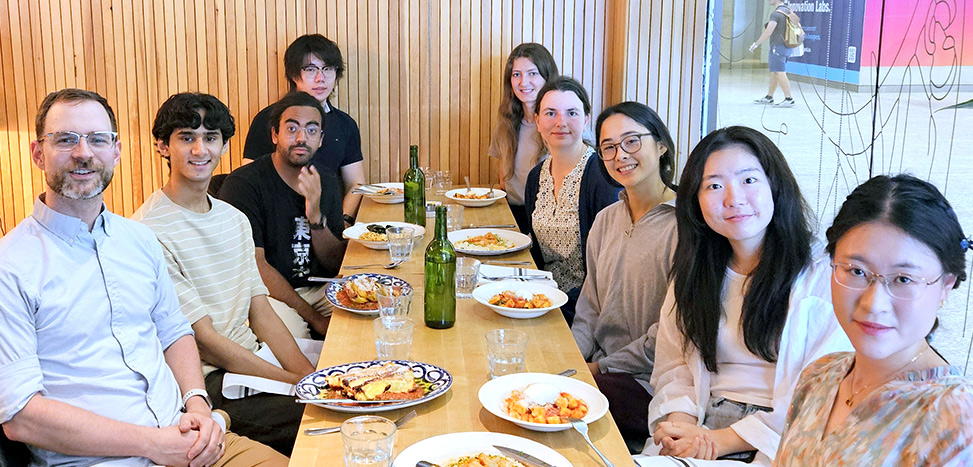
The other attraction was the newness of the lab itself. Joseph Brown joined the Leslie Dan Faculty of Pharmacy in January 2026 from the Acceleration Consortium's Medicinal Chemistry Self-Driving Lab, and Schmitt is part of his first cohort. Joining a group while it is still being assembled is a particular kind of postdoc, with fewer inherited protocols and rather more say in what those protocols become. She counts that as a feature, and she has also been selected for the Acceleration Consortium's training program in accelerated discovery.
Ask how she got into peptides in the first place and the answer is disarming: luck. Peptide chemistry was not part of her bachelor's curriculum. She chose a research project in the Torbeev group because the work on the group's website, using peptides and proteins as tools to interrogate complex biological processes, appealed to her, and she went in, by her own account, naively. She stayed because peptides turned out to be an unusually tunable molecular class sitting right at the join between fundamental chemistry and therapeutic application. On mentorship she is generous and specific: the Ph.D. students and postdocs she worked beside every day shaped her as much as anyone, and Wennemers shaped the rest, teaching her how to carry a project from an initial idea through to publication and how much careful writing matters.
The community side of the field matters to her too. The American Peptide Symposium in San Diego in 2025 stands out, and not only for the science. She valued the lunch organized for young investigators, which put graduate students, academic researchers, and industry scientists at the same tables, and the site visit to Bachem. In Switzerland she was a regular at the smaller, more informal Peptide Therapeutics Forum in Basel, and during her Ph.D. she was active in Women in Natural Sciences at ETH Zürich.
She is keeping her options open, though she currently expects to move toward an R&D position in industry, with high-throughput screening, machine-learning-assisted discovery, and automation as the transferable skills. Her advice to graduate students weighing a postdoc abroad is brief, offered with the caveat that she is only a few months into her own and reserves the right to revise it. A postdoc is a bounded period in which you can learn something genuinely new, work inside a different research culture, and live somewhere you would not otherwise have chosen. The professional discovery and the personal discovery arrive together. So, why not?

Which brings it back to the steps. Schmitt runs two to four times a week along the Toronto waterfront or through the city's parks, partly for the running and partly to survey a new city. She boulders, commutes by bike, hunts down coffee shops and live music wherever she lands, and says yes to more invitations than she can reasonably evaluate in advance. Her reasoning is the reasoning of a good closed loop: if it works, excellent, and if it does not, she has learned something. Either way, you run the next round.