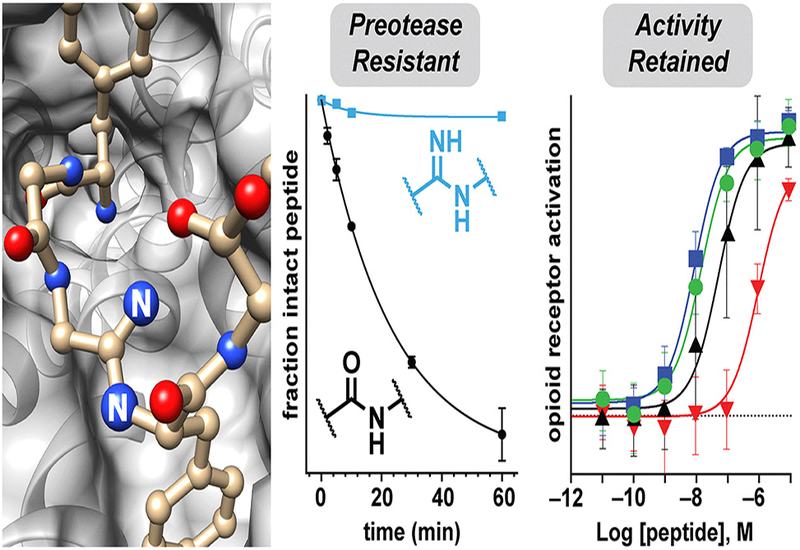
Proteolytic instability is one of the most stubborn obstacles in peptide drug discovery. Strategies that blunt protease activity, including D-amino acid substitution, N-methylation, β-amino acid replacement, and backbone aza-peptide modification, work by disrupting the structural features that proteases recognize. That disruption, however, tends to cascade into exactly the conformational and physicochemical properties that hold a peptide pharmacophore together. A minimal, site-specific intervention capable of defeating a protease without collateral damage to the binding epitope has remained elusive, and solving it would allow medicinal chemists to rescue promising peptide leads without wholesale scaffold redesign.
Researchers in the VanVeller Group at Iowa State University and the Che Group at Washington University, published in RSC Chemical Biology, address this dilemma by replacing the carbonyl oxygen of individual backbone amide bonds with an NH group to generate amidine-containing peptides. Because proteases initiate hydrolysis by engaging the carbonyl oxygen, swapping that oxygen for NH removes a critical recognition element while retaining amide-like geometry, hydrogen-bonding behavior, and near-neutral backbone charge. The team used Leu-enkephalin, YGGFL, as their model: a short-lived but pharmacologically attractive opioid peptide with a well-mapped primary cleavage site at the Tyr1–Gly2 bond and a plasma t1/2 of roughly 10 minutes. A backbone mutagenesis scan placed the amidine at the first three positions in turn, and aminopeptidase N proteolysis assays confirmed that amidine substitution at the primary cleavage site effectively stalled degradation. Microsecond molecular dynamics simulations at the μ-opioid receptor binding pocket provided a structural rationale: the G3 analog, carrying the amidine at the third position, supports an altered intrapeptide hydrogen-bonding network that stabilizes the bound conformation relative to the native sequence, consistent with its enhanced Gi1 potency in a cell-based BRET assay.
The finding that one amidine analog not only preserves but enhances G-protein signaling at the μ-opioid receptor while simultaneously reducing β-arrestin2 recruitment points toward a practical framework for tuning both stability and signaling bias in a single backbone edit. For peptide scientists working on metabolically labile leads, the paper outlines a clear workflow: map cleavage sites, place amidines selectively at vulnerable positions, and balance any potency shifts with orthogonal modifications. Full pharmacological profiling, structural simulation data, and synthetic details are in the original publication.