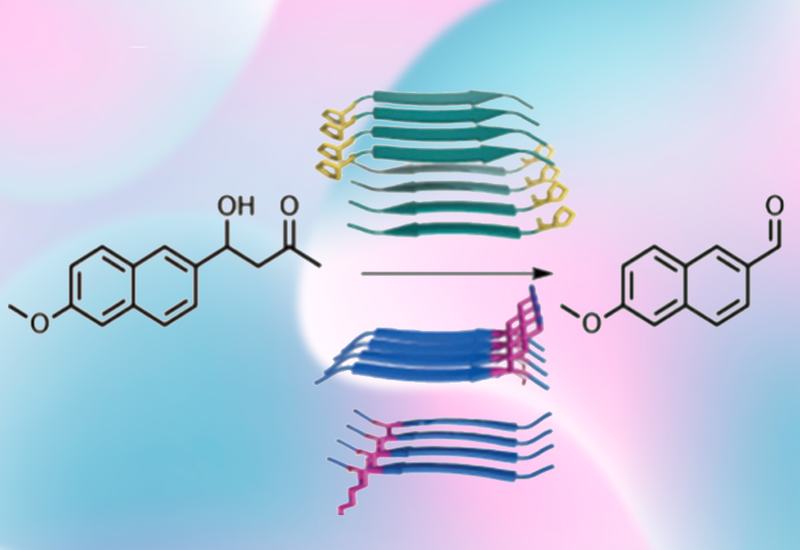
Enzyme design has long confronted a core tension: catalytic power in natural enzymes arises from precisely preorganized active sites shaped by evolutionary pressure over vast timescales, yet the minimalist ambition of de novo design is to achieve function from simpler, shorter starting points. Short peptides can fold and self-assemble, but generating a defined binding pocket within an amyloid-like supramolecular architecture has remained an unsolved challenge. Without substrate binding, classical Michaelis-Menten saturation fails to develop, and catalytic efficiency suffers. The question driving this work is whether a minimalist assembly could produce retroaldolase activity comparable to state-of-the-art computationally designed proteins, and if so, what sequence features actually matter.
Researchers in the Korendovych Group at Baylor University, published in Biochemistry, designed short peptides built around alternating hydrophobic and histidine residues and asked how sequence order and N-terminal capping govern catalytic output against the model substrate methodol. None of the self-assembled catalysts show appreciable KM values, consistent with the lack of a well-defined substrate binding pocket in a catalytic amyloid architecture. Acetylation of the N-terminal amine abolishes catalysis, pointing to a free amine as the catalytic nucleophile. To the authors' knowledge, the best-performing assembly, PFHFHFHF-NH2, is more active in promoting retroaldol cleavage of methodol than any previously reported peptide or peptide assembly, and is on par with the best foldamers containing unnatural amino acids.
The finding that supramolecular peptide assemblies can reach this performance tier without a sculpted active site supports what the authors call "the power of the minimalist approach to enzyme design" and raises the possibility, which they present as speculative, that such assemblies might have played a role in the evolution of enzymatic function. The full kinetic characterization, sequence-activity relationships, and structural data are reported in the paper.