The rational and predictive design of supramolecular architectures in peptide-based materials remains a major challenge. High-resolution structural analyses have exposed a core difficulty: intermolecular interactions deliberately programmed into a designed sequence often give rise to emergent structural interfaces that current design frameworks do not anticipate. Part of the problem has been technical. For the bola-amphiphilic peptide scaffold Ac-Lys-Ile-Ile-Ile-Xaa-Lys-NH2, earlier comparisons of filaments bearing Phe vs. Tyr at the variable position could not distinguish significant structural differences between the two because the available resolution was insufficient. The structural influence of Phe-to-4-fluorophenylalanine substitutions was even less accessible, with no near-atomic-resolution data on record. Without structural information at that level of detail, the question of how a single-site chemical edit propagates into higher-order architecture was unanswerable.
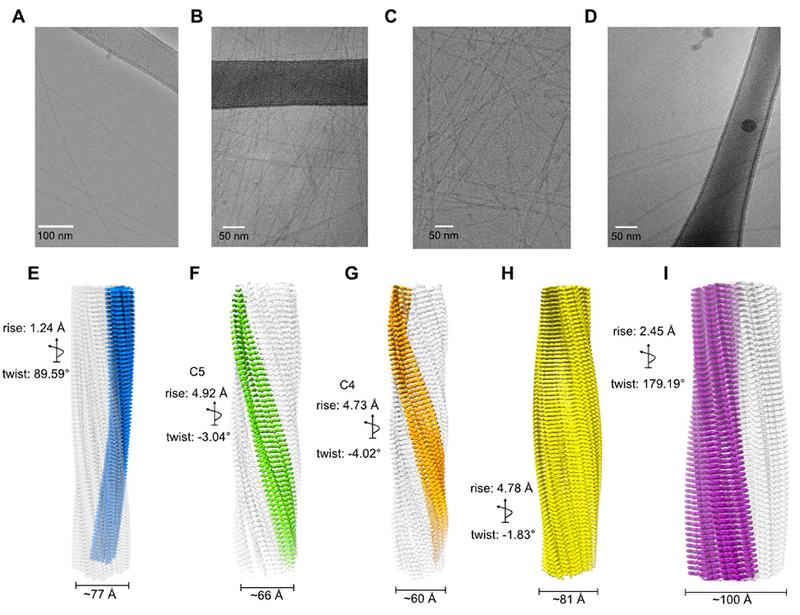
Researchers in the Conticello Group at Emory University, published in the Journal of the American Chemical Society, hypothesized that single-atom or single-functional-group substitutions could interrogate how local sequence changes govern supramolecular structure. Working within a single bola-amphiphilic scaffold, Ac-Lys-Ile-Ile-Ile-Xaa-Lys-NH2, with substitutions at one position, the team determined cryo-EM structures of five peptide filaments at near-atomic resolution, enabling direct structural comparisons not possible at lower resolution. Minimally perturbative chemical substitutions at a single site significantly altered supramolecular structure despite superficial similarity in filament morphology. The authors hypothesize this sensitivity arises from subtle changes in side-chain polarity and solvent interactions that remodel peptide packing at cross-sectional amyloid interfaces. Contrary to the expectation that fluorine substitutions would restore the parent Phe structural phenotype, a subset of fluorinated residues resided at surface-exposed sites with higher estimated solvent accessibility than the corresponding Tyr residues.
The authors argue that their results highlight a fundamental limitation in predictive design: subtle chemical modifications in local composition can produce disproportionate changes in higher-order structure, and atomic-scale edits cannot be assumed to preserve supramolecular architecture. The study is limited to this single bola-amphiphilic scaffold with substitutions at one position, so broader generalizability to other self-assembling systems is not established. Within that scope, the authors suggest that chemical editing provides a strategy for interrogating and potentially controlling biomolecular assembly, a prospect the full paper explores in structural detail.