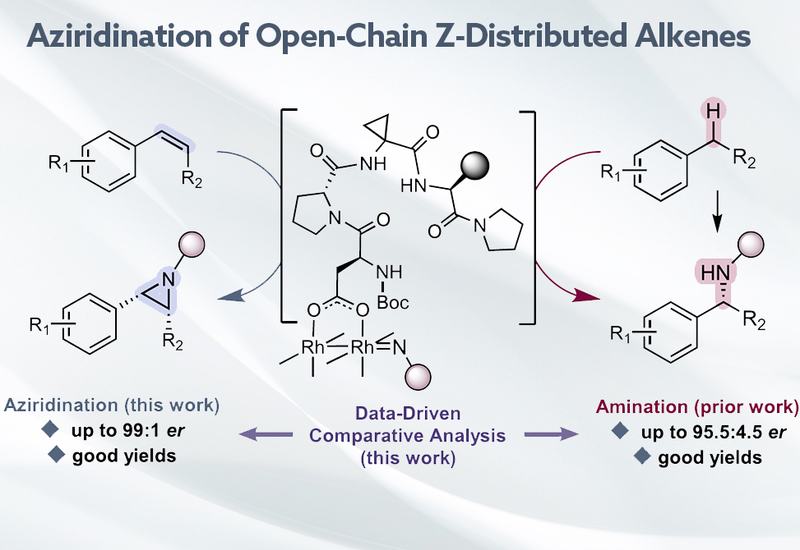
Aziridines rank among the most versatile electrophilic building blocks in synthesis: their strained ring opens with predictable regio- and stereochemical control to deliver 1,2-aminofunctionalized products, and nature exploits the same reactivity in bioactive natural products such as the mitomycins. Enantioselective aziridination of simple alkenes has attracted sustained effort, yet one substrate class has proved stubbornly difficult. Open-chain Z-disubstituted alkenes slip through the fingers of established copper-based catalysts that deliver high selectivity only on cyclic analogs, and the dirhodium or substrate-directed methods that do work on open-chain substrates either require a tethered directing group on the alkene or cover only a narrow substrate range. A broadly applicable, directing-group-free route to cis-aziridines from these substrates has remained an open problem.
Researchers in the Miller Group at Yale University and the Sigman Group at the University of Utah, published in J. Am. Chem. Soc., recognized that dirhodium metallopeptides built on β-turn-biased aspartyl tetramers offered an untested angle of attack. The groups had already shown that the conformationally organized chiral pocket of such metallopeptides enables enantioselective benzylic C(sp3)–H amination, and they reasoned that the scaffold's modularity could be redirected toward alkene aziridination. Systematic variation of the peptide sequence, particularly the identity of the i + 3 residue, revealed a pronounced selectivity dependence: introduction of the noncanonical adamantylglycine residue at that position proved critical, and the optimized catalyst delivers cis-aziridines in up to 99:1 er across electronically and sterically diverse open-chain Z-disubstituted alkenes. Alongside the synthetic campaign, the authors built a unified gradient boosting regression model trained on steric and electronic descriptors of both catalysts and substrates to compare stereocontrol in aziridination with the previously reported C(sp3)–H amination. SHAP analysis reveals that catalyst steric features dominate enantioselection in both reactions, while substrate steric descriptors carry greater weight in aziridination, providing a data-driven rationale for why the two reactions respond differently to changes in catalyst structure.
The work delivers two advances that will interest the peptide catalyst community. The synthetic method provides a modular entry to enantioenriched cis-aziridines previously inaccessible without substrate-bound directing groups, and the accompanying data science framework establishes a blueprint for dissecting how a shared peptidic scaffold enforces stereochemistry across mechanistically distinct transformations, pointing toward a more principled strategy for repurposing metallopeptide catalysts across reaction classes.