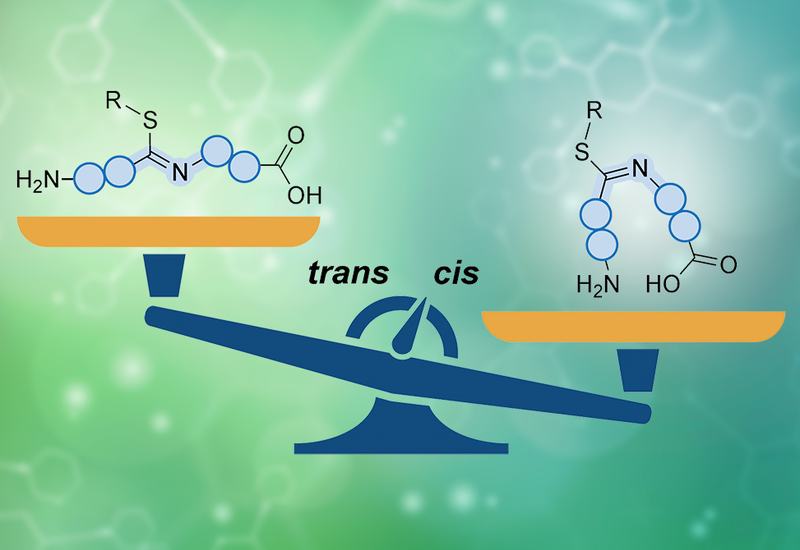
Head-to-tail cyclization of short peptides is a persistent synthetic challenge rooted in peptide bond geometry. Native amide bonds strongly favor the trans configuration at above 99.8% per amide bond, producing extended backbone conformations poorly predisposed toward ring closure. Macrocyclization is typically conducted under high-dilution conditions to favor the intramolecular reaction, which limits throughput and generates substantial solvent waste. Thioimidates, formed by thioamide alkylation and replacing the amide oxygen with sulfur, populate their trans and cis isomers in nearly equal amounts, making them attractive conformational handles. However, the structural factors governing that equilibrium had not been systematically characterized, leaving it unclear whether flanking amino acid identity or stereochemistry would substantially shift the isomer distribution or the barrier to interconversion in sequence-specific ways that would constrain practical use.
Researchers in the VanVeller Group at Iowa State University, published in Organic Letters, conducted the first systematic, quantitative investigation of structural and mechanistic factors governing thioimidate trans/cis isomerization in peptides. To probe the equilibrium, the team synthesized model dipeptides in which the steric bulk and stereochemistry of flanking amino acid side chains were systematically varied and measured isomer populations by integration of resolved CbzN-H resonances alongside variable-temperature EXSY spectroscopy. The headline finding is that the trans/cis equilibrium and the barrier to interconversion are largely insensitive to the steric bulk and stereochemistry of amino acids flanking a methyl thioimidate, providing sequence-independent access to a substantial cis population. DFT calculations support isomerization through rehybridization at nitrogen via a linear transition state rather than direct C-N bond rotation, though this pathway is not confirmed experimentally.
The sequence independence of methyl thioimidate isomerization provides flexibility in where a thioimidate can be placed within a peptide sequence to promote macrocyclization, with approximately equal cis and trans populations expected regardless of adjacent residue identity. The authors note potential implications for reducing aggregation on resin and for positioning thioimidates according to other synthetic considerations, though these remain potential rather than demonstrated outcomes. Full conformational data, mechanistic calculations, and scope details are available in the original publication.