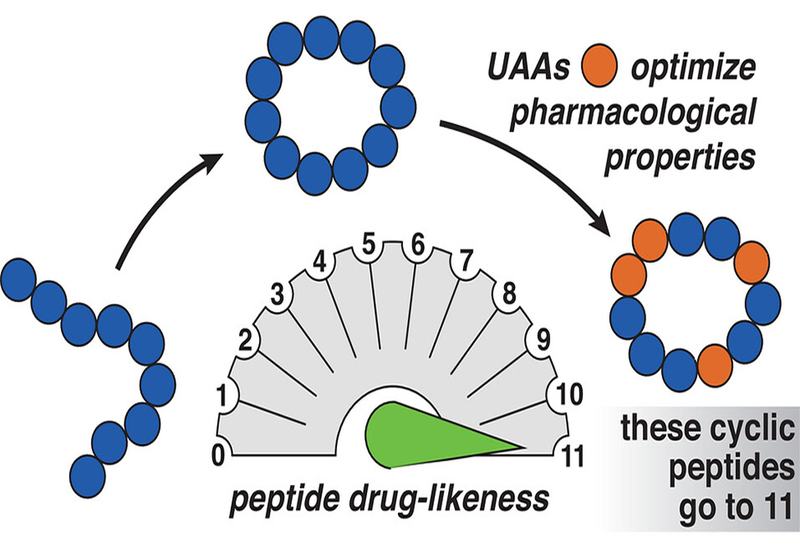
Macrocyclic peptides occupy a productive middle ground between small molecules and biologics, offering target selectivity and structural rigidity that linear peptides cannot match. Yet their clinical translation runs into persistent pharmacokinetic obstacles. Most reach patients only via parenteral routes, because enzymatic degradation in the gastrointestinal tract makes oral delivery the exception rather than the rule. Despite significant advances in peptide drug discovery, generalizable strategies for improving membrane permeability, blood–brain barrier penetration, and oral bioavailability remain elusive. Tuning one property often compromises another, and the conformational complexity of macrocycles adds a further challenge: as the paper notes, “a good conformation analysis of cyclic peptides remains a major challenge to the field.”
Researchers in the Sharma Group at East Tennessee State University, the Jain Group at the National Institute of Pharmaceutical Education and Research, and the VanVeller Group at Iowa State University, published in Angewandte Chemie International Edition, argue that unnatural amino acids, UAAs, are the most productive lever available for reshaping the pharmacokinetic properties of macrocyclic peptides. This review contends that strategic incorporation of UAAs is critical for overcoming limitations of membrane permeability, blood–brain barrier penetration, target selectivity and oral bioavailability. D-amino acids, N-methylated residues, and β-amino acids modulate proteolytic stability, conformational preference, and cell permeability.
This review provides medicinal chemists, drug discovery scientists, and peptide scientists with a structured framework for thinking about UAA selection in macrocyclic drug design, mapping which structural choices have moved the needle in approved or late-stage candidates and where the field still needs new solutions. Readers will find the full case-study analysis, the curated dataset of FDA-approved macrocyclic peptides, and the mechanistic discussion in the original publication.