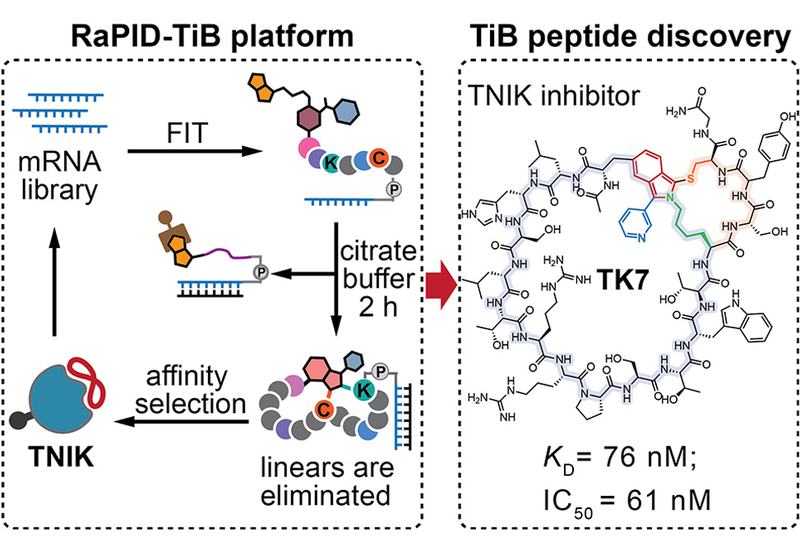
Bicyclic peptides occupy an attractive region of chemical space for drug discovery: a second ring adds conformational rigidity beyond what monocyclic macrocycles provide, reducing entropic penalties on binding and improving metabolic resilience. Thioisoindole-bridged bicyclic peptides are particularly appealing because the isoindole motif appears in potent bioactive natural products and pharmaceuticals, yet this scaffold had seen almost no exploration in encoded library platforms. The obstacle was kinetic: the earlier route to these peptides relied on a semicarbazone-protected aldehyde that required overnight deprotection and left unconverted linear precursors contaminating the library, a combination that made high-fidelity affinity selection impractical.
Researchers in the Suga Group at The University of Tokyo, published in Angewandte Chemie International Edition, replaced the semicarbazone with a more acid-labile biotin–hydrazone mask on the key 2-nicotinoylbenzaldehyde residue incorporated at the translation initiator position via the flexible in vitro translation system. The hydrazone deprotects under mild citrate buffer conditions within 2 h, triggering condensation of the N-terminal aldehyde with a Lys ε-amine and subsequent Cys thiol closure to form the thioisoindole-bridged bicyclic scaffold. Crucially, the biotin tag built into the protecting group allows streptavidin-coated magnetic beads to capture and remove linear precursors before affinity selection begins, eliminating a principal source of background noise. This chemistry proved compatible with genetic code reprogramming and with incorporation of multiple nonproteogenic amino acids, expanding the structural diversity of the libraries. Two libraries were then screened against Traf2- and NCK-interacting kinase, TNIK, a validated colorectal cancer target for which no approved inhibitor yet exists, and the most active candidate inhibited TNIK with an IC50 of 61 nM. X-ray crystallography of the complex revealed an unexpected feature: the inhibitor occupies the substrate-binding site and forms an intermolecular disulfide bond with TNIK-Cys234, a covalent interaction that was not by design.
The platform addresses a genuine gap in the mRNA display toolkit by providing access to scaffolds that sit outside the structural space reachable via conventional thioether cyclization or triselectrophile-mediated bicyclization. The biotin-addressable protecting group also opens secondary uses beyond library purification, including quantitative readout of cyclization efficiency at scale. For the peptide drug discovery field, the work establishes a practical route to a topologically distinct bicyclic scaffold class and demonstrates that the RaPID system can deliver potent, structurally characterized leads against a clinically relevant kinase target.