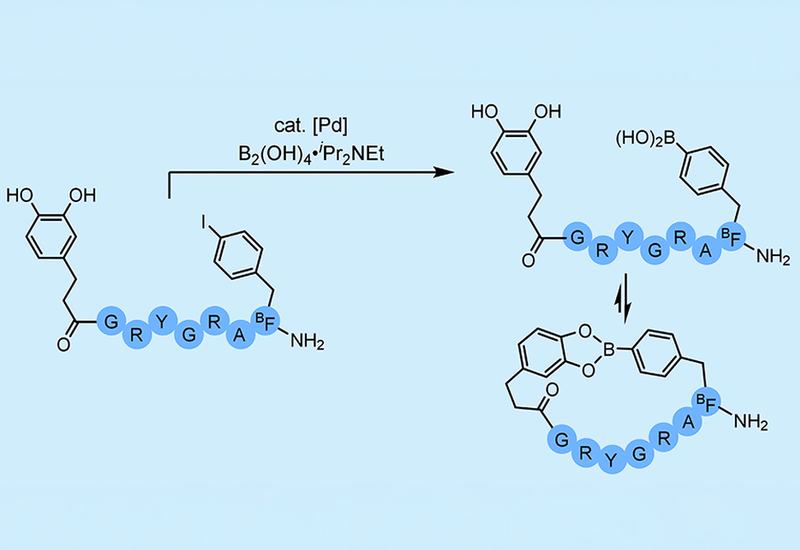
Arylboronic acids are prized handles in peptide chemistry: they participate in dynamic covalent chemistry, enable prodrug strategies, and serve as sites for further functionalization. Yet complex, unprotected peptides have resisted reliable borylation. Late-stage installation is preferable because boronic acids suffer from protodeboronation and oxidation, making it impractical to carry a sensitive boronic ester through solid-phase synthesis. When researchers attempted Miyaura borylation on a fully unprotected peptide under typical mild aqueous conditions, the reaction produced a complex mixture dominated by byproducts, including reduction to a phenylalanine residue and intramolecular X–H cyclization products. The challenge was not conceptual but mechanistic: standard reagents simply could not handle the density of reactive functional groups present in unprotected peptides.
Researchers in the Ball Group at Rice University, published in Organic Letters, traced the failure to the borylating agent itself: premixing tetrahydroxydiboron, B2(OH)4, with an amine base before adding it to the reaction suppresses side products and gives reliable access to arylboronic acid-containing peptides from unprotected peptide aryl iodide precursors under mild conditions. NMR studies support formation of tetracoordinate boron adducts on premixing, and the authors postulate that a 4-coordinate ate-complex facilitates productive transmetalation, though they note future mechanistic studies may be crucial. The method is compatible with all canonical amino acid residues with the exception of cysteine, consistent with thiol-mediated inhibition of palladium-catalyzed cross-coupling, and yield is compromised in the presence of oxygen or without preincubation of the base and B2(OH)4.
To illustrate what the new method unlocks, the authors prepared a dual-functionalized catechol–boronic acid peptide and showed it undergoes dynamic covalent macrocyclization with an equilibrium constant of 18 ± 3, implying approximately 95% cyclization at equilibrium. The authors anticipate the methodology to be a starting point for more sophisticated covalent assemblies, including dynamic macrocyclization of borylated glycopeptides and activatable peptide drug systems, inviting peptide chemists to explore the full scope reported in the paper.