Artificial membraneless organelles, AMLOs, offer a programmable platform for mimicking the liquid-like condensates that cells use for signaling, catalysis, and compartmentalization. Most chemical routes to AMLOs rely on backbone modifications, multiple components, or charged polymers to coax short peptides into phase-separating rather than gelling. What has remained largely unexplored is whether stereochemistry alone, specifically the pattern of L- and D-residues along a peptide backbone, could serve as the decisive control element. Resolving that question would open a minimalist design logic: rather than building a new scaffold, a chemist could reprogram an existing peptide-drug conjugate, PDC, through chirality editing alone.
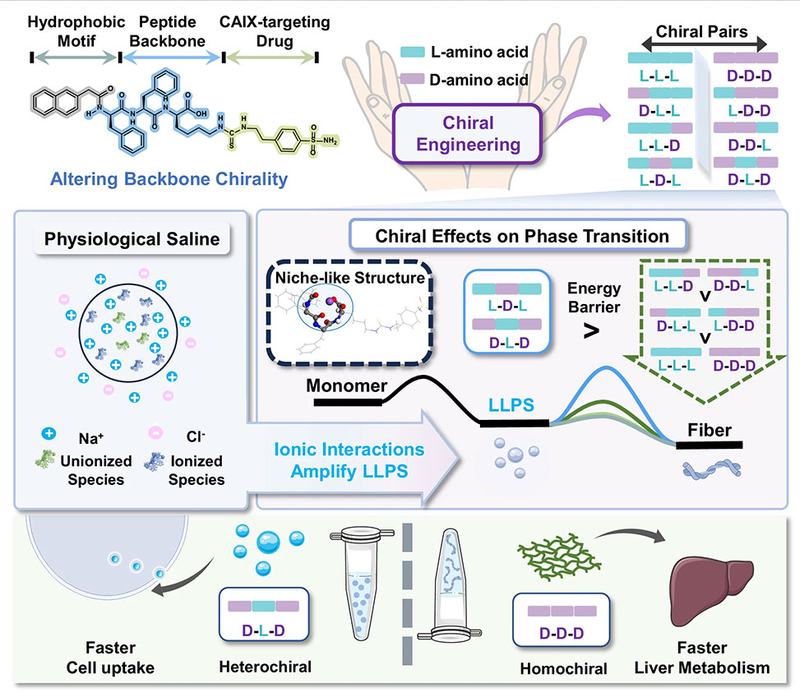
Researchers in the Chen Lab at the National Center for Nanoscience and Technology of China, published in Nature Communications, took a previously reported hypoxia-targeting PDC built on a 2-naphthaleneacetic acid-Phe-Phe-Lys backbone and systematically permuted the chirality at each of its three α-carbons to produce four diastereomeric pairs. Under physiological conditions, every pair except one gelled through β-sheet-rich amyloid-like fibers. The exception was the alternating D-L-D isomer, which formed liquid-liquid phase separation, LLPS, droplets instead. The team traced this divergence to an interplay between chirality and ionic interactions: Na+ or K+, but not Li+, Rb+, or Cs+, bind to the carbonyl and carboxyl groups of the ionized D-L-D species, forming a coordination geometry that twists the backbone away from the ordered hydrogen-bond arrangement β-sheets require. Density functional theory calculations showed that heterochirality at the drug-conjugated Lys and adjacent Phe raises the energy barrier for the liquid-to-gel transition, and tannic acid trapping experiments revealed that all four diastereomers pass through an LLPS intermediate on their way to gel; D-L-D simply cannot clear that barrier under physiological ionic conditions.
Because phase behavior governs how the conjugate circulates and enters cells, the stereochemical switch translates into measurable pharmacological differences: the LLPS-forming D-L-D isomer shows faster tumor-cell internalization and a distinct biodistribution profile compared with the gel-forming D-D-D homochiral analog. For peptide scientists designing PDCs or seeking to engineer synthetic condensates, the work establishes chirality editing as a handle on the energy landscape separating liquid droplets from fibers, one that requires no new chemistry, only a change in configuration. Full characterization, energy-landscape analysis, and in vivo tumor data are reported in the original publication.