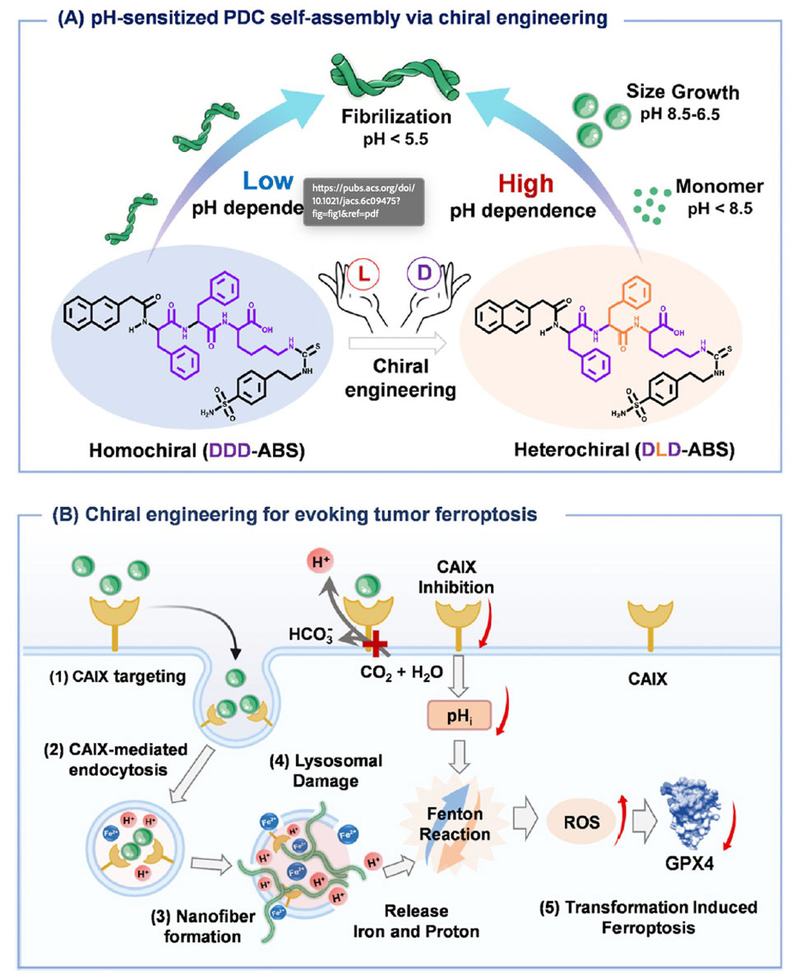
Responsive supramolecular assemblies that sense pH, redox state, or enzymatic activity have emerged as a compelling platform for targeted cancer therapy, yet programming them to act at a precise subcellular address remains a persistent challenge. Most strategies require adding chemically labile linkages or responsive motifs that demand extra synthetic steps and can compromise the structural integrity of the conjugate. A subtler lever, the stereochemistry of the backbone itself, has attracted interest, but its consequences for biological fate inside living cells have remained largely unexplored. If chirality could redirect where a peptide-drug conjugate assembles, from the cell surface to the lysosomal lumen, an entirely new axis of spatiotemporal control would open up.
Researchers in the Li Lab at the National Center for Nanoscience and Technology of China, published in J. Am. Chem. Soc., show that alternating D/L residues in a naphthalene-capped Phe-Phe-Lys tripeptide conjugated to a carbonic anhydrase IX, CAIX, inhibitor confer sharply heightened pH sensitivity on self-assembly without altering the molecular backbone. The key observation is a chiral-sequence-specific pKa shift: the heterochiral isomer DLD-ABS, carrying alternating D/L chirality, undergoes a more than 40-fold drop in critical micellization concentration as pH falls from 7.5 to 5.5, transitioning from nanospheres to amyloid-like nanofibers, while the homochiral DDD-ABS remains fibrous across the same range. The authors trace this to a protonation-induced conformational rearrangement that is kinetically gated by the heterochiral backbone geometry. In CAIX-overexpressing triple-negative breast cancer cells under hypoxia, CAIX-mediated endocytosis carries DLD-ABS into lysosomes as nanospheres; the acidic lysosomal environment then triggers fiber formation in situ. The resulting intraluminal fibers rupture the lysosomal membrane, releasing Fe2+ into the cytosol and amplifying the Fenton reaction, while concurrent CAIX inhibition further perturbs redox homeostasis, driving cells toward ferroptosis.
The findings establish chirality as a low-footprint design parameter for controlling the subcellular address of self-assembling conjugates and offer a mechanistic explanation for heterochirality-dependent biological effects. For the peptide community, the work points toward therapeutic systems that exploit the tumor lysosomal microenvironment as a trigger rather than a barrier, with in vivo antitumor outcomes in breast tumor xenografts that underscore the translational reach of the approach.