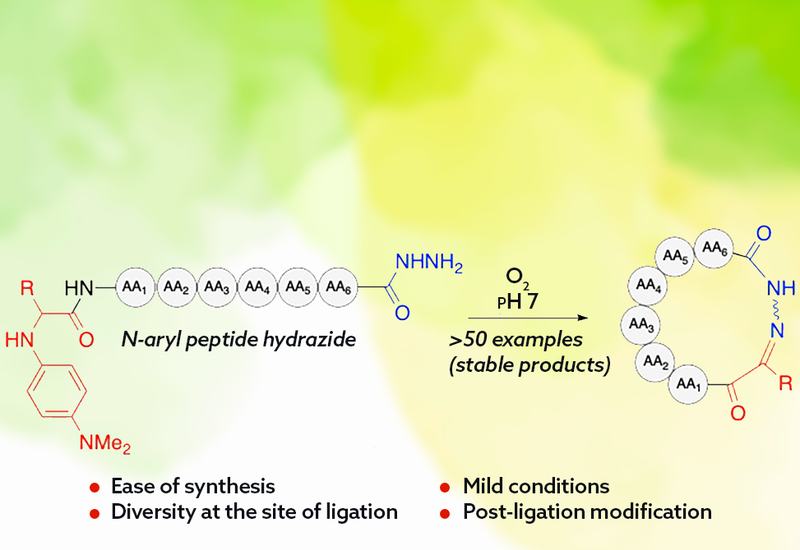
Head-to-tail peptide macrocyclization via hydrazone and oxime ligations is attractive in principle: these reactions are chemoselective, water-compatible, and produce linkages that can be elaborated post-cyclization. In practice, intramolecular reactions between α-oxo aldehydes or ketones and α-nucleophiles on peptide substrates have remained scarce, with few head-to-tail examples demonstrated. Prior methods also left little room to vary the side chain at the ligation site, keeping the method from reaching general utility.
Researchers in the Proulx Group at North Carolina State University, published in Organic Letters, reasoned that N-aryl peptide hydrazides could serve as bifunctional precursors and bypass those constraints. N-aryl amino acids are incorporated via standard peptoid submonomer procedures, and the C-terminal hydrazide is easily introduced during solid-phase assembly. After cleavage, the unprotected peptide is dissolved in phosphate buffer at pH 7 under O2 atmosphere: oxygen oxidizes the N-aryl terminus to an α-imino amide intermediate, which the C-terminal hydrazide captures intramolecularly to close the ring as a stable keto-hydrazone in a single step.
Analogs of the antimicrobial peptide Gramicidin S and the integrin receptor ligand RGDfK were prepared using the method, extending its reach toward bioactive scaffolds. By establishing a mild, one-pot oxidative macrocyclization that accommodates diverse sequences and ring sizes of 16 to 25 atoms, the work offers the peptide community a practical route to hydrazone-bridged libraries for future therapeutic and structural studies.