The antibiotic pipeline urgently needs chemical novelty, and gram-negative pathogens present the steepest challenge. Novel antibiotic classes with broad activity against gram-negative organisms and without cross-resistance to marketed drugs are, as the authors frame it, exceedingly rare. The marine bacterial genus Aquimarina has drawn attention because its members carry numerous natural product biosynthetic gene clusters, yet few of those clusters have yielded characterized compounds. A recent study chemically synthesized lipopeptides predicted from Aquimarina genomic data and found antibacterial activity, but the structures of the actual natural products remained unknown, leaving the genus's true chemical output an open question.
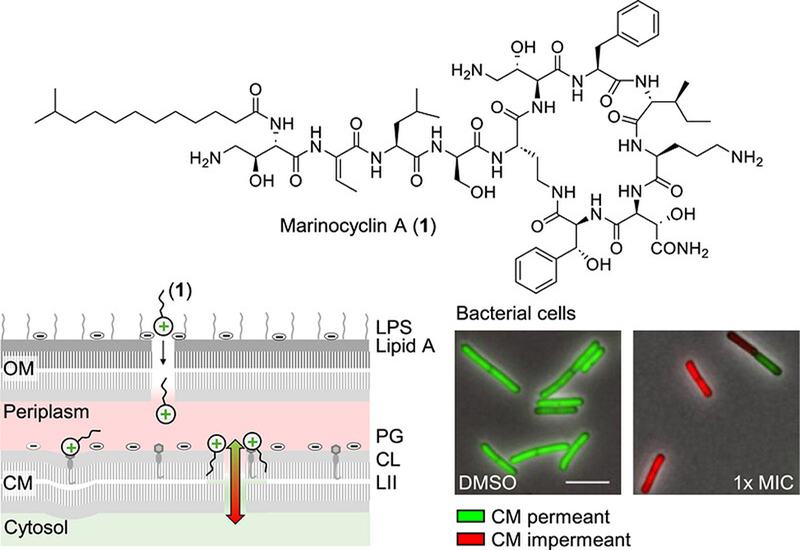
Researchers in the Brötz-Oesterhelt Group at the University of Tübingen, the Costa Group at Instituto Superior Técnico, University of Lisbon, and the Piel Group at Eidgenössische Technische Hochschule Zürich, published in Angewandte Chemie International Edition, report the isolation of marinocyclins A through G from Aquimarina megaterium EL43, a bacterium associated with the octocoral Eunicella labiata. The role of the mar biosynthetic gene cluster in marinocyclin assembly remains putative, because heterologous expression experiments with MarE and MarF failed to demonstrate hydroxylation of free amino acids, and MarE proved mostly insoluble even as a SUMO fusion. Marinocyclin A targets multiple lipid partners simultaneously, binding lipopolysaccharides, anionic phospholipids, and peptidoglycan precursors; outer-membrane transit is proposed by analogy to polymyxins rather than directly demonstrated. The authors argue this polypharmacology likely slows resistance development. Marinocyclin A showed broad-spectrum activity against drug-resistant gram-negative and gram-positive pathogens, including colistin-resistant strains, at MICs of 2 to 8 µg/mL across the entire ESKAPE panel.
Marinocyclin A showed broad activity against gram-positive and gram-negative WHO priority pathogens, including strains carrying the plasmid-borne mcr-1 colistin-resistance determinant, with minimal inhibitory concentrations of 2 to 8 µg/mL across the ESKAPE panel; of the seven congeners isolated, only marinocyclins A, B, and D were tested for antimicrobial activity, because the remaining congeners were obtained in insufficient amounts. The authors suggest medicinal chemistry optimization could yield preclinical candidates for drug-resistant infections, and full antimicrobial, mechanistic, and structural data are available in the original publication.