Genetically encoded display platforms have opened broad access to cyclic peptide ligands, but they have relied predominantly on noncovalent interactions for target engagement, which may be insufficient to achieve prolonged occupancy at challenging protein interfaces. Rational covalent warhead design has largely been restricted to small molecules targeting kinase domains with well-characterized active sites, and small molecules often struggle to engage proteins with flat or flexible binding surfaces. For Keap1, a therapeutically relevant protein that presents such a surface, previously reported phage-displayed cyclic peptide ligands have generally exhibited binding affinities in the double- to triple-digit nanomolar range, and further improvements through scaffold optimization alone have remained challenging. The combined tuning of hydrolytic stability, thiol reactivity, and adduct residence time within a single electrophilic scaffold had not, to the authors' knowledge, been systematically explored prior to this work.
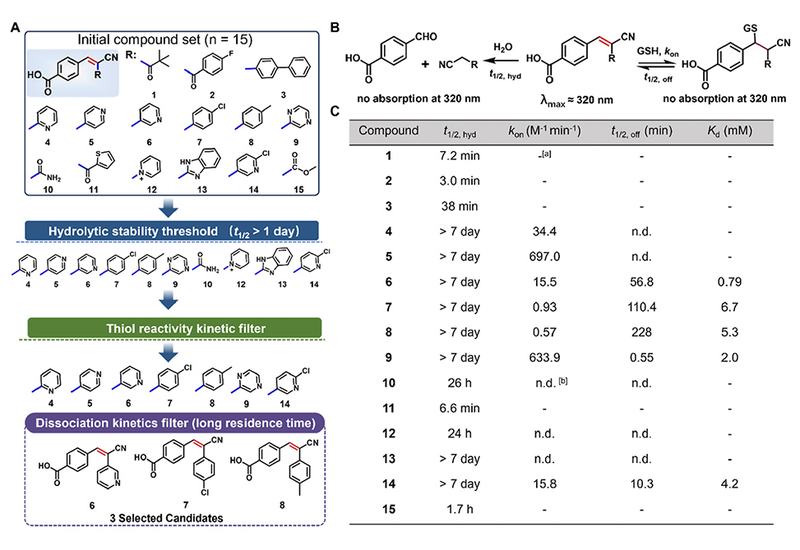
Researchers in the Gao Group at Changzhi University and the Zheng Group at Sun Yat-Sen University, published in the Journal of the American Chemical Society, addressed this gap by systematically optimizing α,β-unsaturated nitrile electrophiles and incorporating the selected warhead into phage-displayed peptides to construct a library of reversible covalent cyclic peptides. Screening this library against Keap1 enabled de novo identification of ligands with nanomolar affinities. The mechanistic reasoning rests on proximity: the cyclic peptide framework positions the reversible electrophile near Keap1 Cys434, generating a high effective local thiol concentration, which suggests the strategy enriches sequences that bring the warhead close to the target cysteine. The most potent ligand identified, cyclic peptide 32, exhibits a Ki of 3.7 nM against Keap1, retains binding under thiol-rich conditions, and can capture Keap1 from a complex cellular environment.
The authors describe this study as establishing a versatile platform for reversible covalent ligand discovery that promotes proximity-driven covalent strategies, demonstrated here against Keap1 as a model target. For peptide scientists working on structurally challenging proteins, the approach offers a path to potency gains that scaffold optimization alone cannot reliably deliver. Full selectivity data, electrophile kinetic profiling, and proteomics results are reported in the original publication.