Cracking Siglec-7

Reflecting work in the Derda Lab

Published here November 27, 2026

Noncarbohydrate Inhibitors of Sialic Acid-Binding Immunomodulatory-Type Lectin‑7 (Siglec-7) Discovered from Genetically Encoded Bicyclic Peptide Libraries

Danial Yazdan, A. Michael Downey, Ana Gimeno, Caishun Li, Edward N. Schmidt, Jeffrey Y. K. Wong, Caleb Loo, Jaesoo Jung, Ryan Qiu, Ewa Lis, Lily Lindmeier, June Ereño-Orbea, Jesús Jiménez-Barbero, Matthew S. Macauley, and Ratmir Derda

Journal of the American Chemical Society 2026, 148, 48042–48053. https://doi.org/10.1021/jacs.6c14068

View Original Publication


Glycan-binding proteins sit at the intersection of cancer immunology and drug discovery yet have resisted the standard hit-finding playbook. Their native ligands engage receptors through multivalent carbohydrate interactions that small molecules, peptides, and aptamers struggle to replicate. Siglec-7, an immunomodulatory lectin expressed on natural killer cells and implicated in tumor immune evasion, exemplifies the challenge. To the best of the authors' knowledge, the feasibility of identifying aglycone inhibitors of any Siglec had not been reported, although unpublished attempts to discover Siglec-10 antagonists exist in the mRNA display field, leaving open the question of whether peptide-based approaches could gain a foothold on this receptor class.

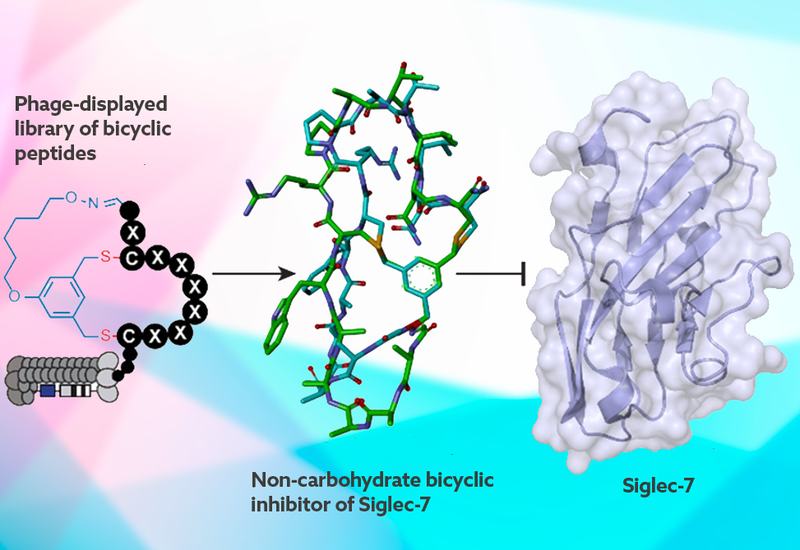
Researchers in the Derda Group at the University of Alberta, published in the Journal of the American Chemical Society, addressed the problem by deploying bicyclic genetically encoded libraries, produced by chemically modifying phage-displayed peptides with twofold symmetric linchpins, to discover inhibitors of the Siglec-7:GD3 interaction. This work provides the first demonstration of bicyclic peptide macrocycles as inhibitors of Siglec-7. Panning and next-generation sequencing identified candidates, and competitive ELISA confirmed leads disrupting the Siglec-7:GD3 interaction at low-to-mid micromolar IC50 values. Monocyclic analogs showed a 7- to 10-fold loss in activity, confirming the bicyclic topology as a key contributor to binding. STD-NMR with the full extracellular domain, but not with the isolated V-Ig set domain alone under the same experimental conditions, indicated that lead peptide 46e engages a noncanonical binding site rather than the canonical sialic acid-binding pocket.

The authors conclude that bicyclic genetically encoded libraries can reach Siglec targets previously inaccessible to noncarbohydrate modalities, while being candid about what remains unsolved: expanded-ring constructs showed increased binding to Siglec-7-positive cells, but, as the authors note, "the binding to Siglec-7‑ CHO cells increased proportionally," failing to improve cell-surface specificity. The authors describe this unexplained affinity for unknown cell-surface components as a major caution for future development, and they point to ring expansion, physicochemical optimization, and multivalent design as routes toward more developable inhibitors.

Author

June Ereño-Orbea is Group Leader of the Cancer Glycoimmunology Lab at CIC bioGUNE and an Ikerbasque Research Associate. She earned her BSc in Biochemistry and her PhD in Molecular Biology and Biomedicine from the University of the Basque Country, then joined the Julien laboratory at SickKids Hospital in Canada, where she characterized the structure of CD22, an inhibitory co-receptor of B cells and a target for antibody-based therapies. Her group uses integrative structural biology and biophysical methods to study Siglec glycoimmune checkpoint receptors and antibodies against tumor-associated glycans for next-generation cancer immunotherapy.

Author

Ewa Lis is the Founder and Chief Executive Officer of Koliber Biosciences, a San Diego-based biotechnology company applying artificial intelligence to peptide drug discovery and microbiome engineering. She earned her B.A. in Chemistry from Cornell University and her Ph.D. in Biological Sciences from The Scripps Research Institute, then held leadership positions at Life Technologies, Genomatica, and Reveal Biosciences before founding Koliber in 2014. Her work centers on proprietary peptide encodings and deep learning architectures for the discovery and optimization of therapeutic peptides, with support from the National Science Foundation. She has presented this research at the American Peptide Symposium.

Author

Jesús Jiménez-Barbero is Ikerbasque Research Professor and Scientific Director of CIC bioGUNE. An internationally recognized leader in chemical glycobiology, his research has transformed the understanding of glycan–protein recognition through innovative NMR methods integrated with chemistry, biophysics, molecular biology and computational approaches. His highly collaborative career has generated more than 700 publications and over 350 invited and plenary lectures worldwide. A committed scientific leader and mentor, he has supervised more than 40 PhD students and 50 postdoctoral researchers. He formerly served as President of the Spanish Royal Society of Chemistry and Head of Spain’s National Chemistry Evaluation Panel. His distinctions include, among many others, the International Whistler Award, the Gold Medal of the Spanish Royal Society of Chemistry, Spain’s 2023 National Research Award in Chemical Sciences and Technology, and the 2024 Humboldt Research Award.

Author

Ratmir Derda received his B.Sci. in Physics, his Ph.D. in Chemistry from the University of Wisconsin-Madison, under the supervision of Laura L. Kiessling and a postdoctoral training at Harvard University under the supervision of George M. Whitesides and Donald E. Ingber. As a Professor at the Department of Chemistry, University of Alberta, he has supervised over 100 trainees, undergraduate, graduate and post-doctoral fellows, published nearly 100 peer reviewed publications and founded multiple start-up companies that translate technology from Derda Lab.

Cracking Siglec-7

Author

Danial Yazdan received his bachelor's degree from the University of British Columbia in 2021 before joining Professor Ratmir Derda's research group at the University of Alberta in 2022, where he is currently pursuing his Ph.D. in Chemistry. His research encompasses phage display, peptide chemistry, chemical modification of genetically encoded libraries, and biochemical and cell-based binding and inhibition assays. His work primarily focuses on the discovery, characterization, and development of peptide-based ligands targeting biologically and therapeutically relevant proteins.