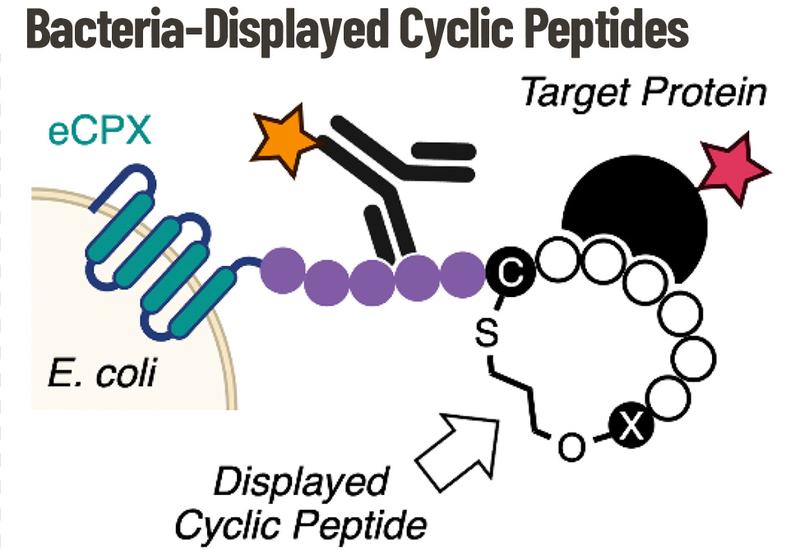
Cell-surface display technologies give researchers a powerful advantage over phage display: binding affinity can be measured directly on the cell, enabling rapid, expression-normalized hit ranking without re-cloning or resynthesis. For this advantage to extend to macrocyclic peptides, the cyclization chemistry must work cleanly at the surface of a living bacterium, an environment far more chemically complex than a phage capsid. Disulfide-based cyclization is reductively labile, and chemical post-translational crosslinking strategies that perform well on phage often show poor regioselectivity on cells or require copper catalysts toxic to bacteria. A mild, genetically programmable route to surface-displayed macrocyclic libraries has therefore remained out of reach.
Researchers in the Tharp Group at Indiana University School of Medicine, published in ACS Chemical Biology, approached this problem by transplanting cysteine-reactive unnatural amino acids, uAAs, from the phage display world onto a bacterial outer-membrane scaffold. Using an engineered, circularly permuted OmpX variant and orthogonal aminoacyl-tRNA synthetase and suppressor tRNA pairs, the team directed site-specific uAA incorporation in response to amber stop codons. Once displayed, the electrophilic uAAs undergo spontaneous intramolecular reaction with a flanking cysteine to close a thioether-bridged macrocycle directly on the E. coli surface. High-resolution LC-MS confirmed efficient cyclization and, critically, no detectable adducts from glutathione or other competing nucleophiles in the outer-membrane milieu. A maleimide-accessibility assay provided orthogonal, on-cell evidence that cyclization reaches near-completion within a standard overnight induction. The platform also accommodates dual uAA incorporation, using two mutually orthogonal synthetase–tRNA pairs to place a second non-canonical residue inside the macrocyclic ring and expanding the chemical diversity accessible to a single library format.
To test whether the system could support genuine ligand discovery, the authors constructed a 1.6-million-member library of cyclic octapeptides and screened it against streptavidin by fluorescence-activated cell sorting. Five rounds of selection yielded de novo ligands bearing a conserved Trp-Trp motif and an apparent KD of 155 ± 6 nM, a result that mirrors hits independently recovered by phage display campaigns using related cyclization chemistries. This positions bacterial display as a complementary technology for genetically encoded macrocyclic libraries, opening routes to on-cell affinity ranking, multi-parameter selectivity screening, and dual-uAA macrocycles not readily accessible by existing phage-based methods.