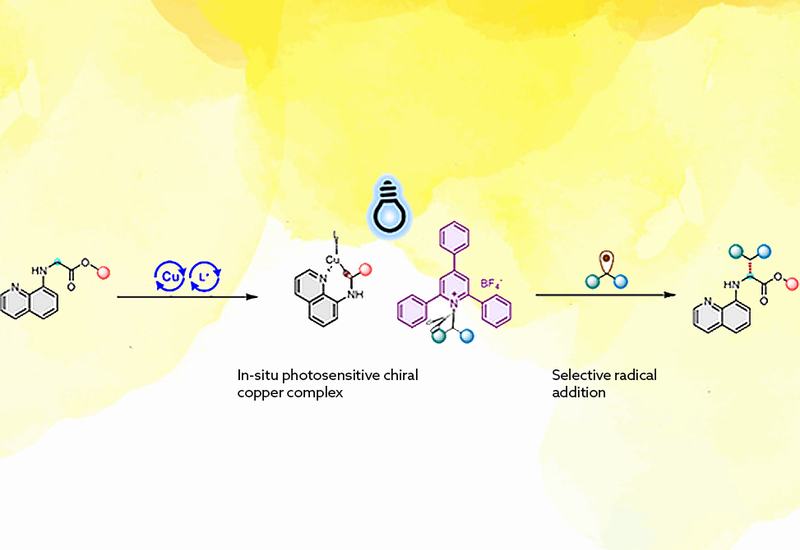
Building unnatural amino acids, UAAs, with controlled stereochemistry at the α-carbon sits at the center of modern peptide drug design: the configuration governs receptor binding, metabolic stability, and overall pharmacological behavior. Radical-based deaminative strategies, which convert primary amines into Katritzky salts and then fragment those salts to alkyl radicals, offer abundant and inexpensive starting materials, but asymmetric variants had remained underdeveloped. Prior copper-photocatalytic approaches to glycine functionalization relied on activated carboxylate surrogates such as N-hydroxyphthalimide esters, restricting the amine feedstock pool entirely. Attempts to extend Katritzky salt chemistry to chiral settings faced two compounding problems: radical intermediates are difficult to position precisely within a chiral pocket, and the stoichiometric triphenylpyridine byproduct released during deamination competes with the chiral ligand for the copper center, eroding enantioselectivity before the product forms.
Researchers in the Singh Group at the Indian Institute of Technology, New Delhi, published in Organic Letters, reasoned that a quinolinyl-8-glycinate ester template could coordinate tightly enough to a chiral copper complex to pre-organize the prochiral carbon within the ligand sphere before the incoming radical arrives. The key design move was to form the Cu(I)/(S)-Xyl-BINAP photocatalyst in situ with the substrate already bound, blocking the copper coordination sites against the achiral triphenylpyridine byproduct. Under blue-light irradiation at 456 nm and mild 5 °C conditions in dimethylacetamide, the photoactive copper complex reduces the Katritzky salt by single-electron transfer, generating an alkyl radical that is then captured with stereocontrol through a ligand-to-metal charge transfer and reductive elimination sequence. The optimal conditions delivered the model cyclohexyl-derived UAA in 66% isolated yield with an enantiomeric ratio of 96:4. The protocol extended without loss of enantiopurity to glycine-containing dipeptides, tripeptides, and pentapeptides, with regioselective activation occurring exclusively at the quinolinyl-8-glycinate position even when a second glycine residue was present in the chain.
A photocatalytic method that turns commodity amines directly into enantioenriched UAA building blocks and elaborates them within intact peptide substrates addresses a practical bottleneck in the preparation of peptide therapeutics. The gram-scale demonstration and stereodivergent access to both enantiomers via ligand switching broaden the synthetic toolkit further. Full substrate scope data, mechanistic studies including Stern–Volmer fluorescence quenching, and spectroscopic support for the proposed catalytic cycle are detailed in the original publication.